
Adobe Patents a Way to Animate Still Photos With AI-Chosen Motion and Speed
Adobe is working on a tool that looks at a regular still photo, figures out what objects are in it, and turns those objects into moving video at whatever speed you want. No manual frame-drawing required.
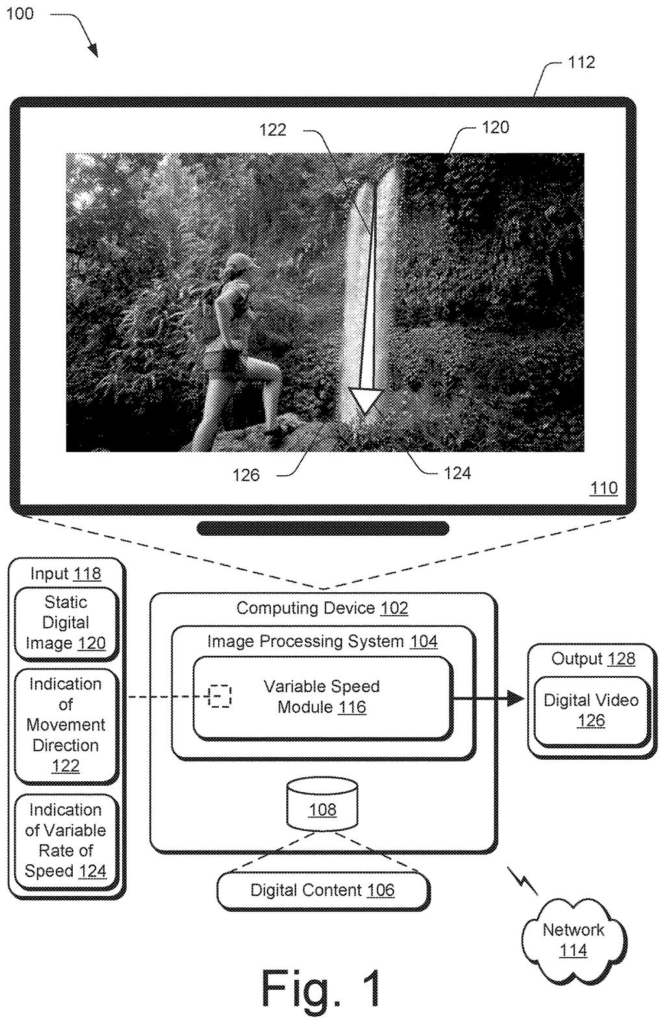
What Adobe's still-photo-to-video system actually does
Still photos don't move, and turning one into a convincing animation today usually means a lot of manual work in editing software, tracking objects by hand and guessing how things should flow. Adobe wants to skip most of that.
The system described in this patent looks at a photo, uses AI to identify objects in it (a waterfall, a person's hair, clouds, fabric), and then figures out which direction each object would naturally move. You pick a speed, and the system generates a video where those pixels move accordingly. Fast-moving water, slow-drifting fog, whatever the scene calls for.
The key word in the patent is variable speed. You're not locked into one uniform animation rate across the whole image. Different parts of the photo can animate at different paces, which is what makes the result look natural rather than like a bad Instagram filter.
identifying, by a processing device, a region of a static digital image to animate by identifying an object depicted in the static digital image using one or more machine learning models …
Translation: AI looks at a still picture to figure out what object inside of it should move.
How the AI picks what moves and how fast
The system works in three broad steps, each handled by machine learning models running in the background.
Object identification: The AI scans the static image and finds recognizable regions, such as a tree, a river, or a person's jacket. Each identified region gets treated as a candidate for animation.
Direction inference: Based on the type of object it found, the model decides which way it should move. Water flows downward. Flames rise. Fabric ripples sideways. This is inferred from the object class, not drawn by the user.
Speed selection and video generation: The user selects a rate of speed (faster or slower), and the system generates a digital video in which pixels from the identified region travel in the inferred direction at that chosen rate. The phrase variable rate of speed in the patent means the pace can differ across regions within the same image, so one part of the frame can move quickly while another drifts slowly.
The whole output is displayed inside a user interface, presumably inside a tool like Adobe Firefly or Photoshop, without the user having to work in a video timeline at all.
… generates a digital video based on the static digital image, the digital video having pixels that move in the movement direction at a speed that varies based on the variable rate of speed based on pixels from the static digital image …
Translation: The system turns the photo into a video where the pixels move at whatever speed is chosen.
What this means for creators who work with still images
For designers, marketers, and social-media creators, static images are everywhere and video gets far more engagement. The gap between the two has always required either motion-graphics skills or access to expensive production. A tool that bridges that gap automatically, even imperfectly, removes a real barrier.
The variable speed piece is what separates this from the simpler "cinemagraph" tricks that have existed for years. Those tools require users to manually mask and animate regions. If Adobe's AI can correctly guess direction and let users tune speed, that's a workflow that compresses hours of work into seconds. Adobe's run of generative-video filings suggests this is part of a broader push to bring AI-generated motion into its creative suite.
Adobe's 36th filing we've tracked in the AI photo editing race since May follows its work on portrait relighting and new camera angles.
Most people with a photo and a deadline have no practical way to turn that photo into a moving image without learning software that takes months to master. That gap costs real time and real money, especially as short video has become the default format for marketing, social media, and storytelling.
Adobe's approach here matches the scale of that problem fairly well. Anchoring the animation to a real photograph keeps results grounded and predictable, and giving users control over speed variation means the output can feel intentional rather than generic.
The honest question is whether the finished product actually closes the gap for ordinary users, not just technically sophisticated ones. A patent describes a direction, not a guarantee of ease, and ease is everything when the audience is someone who just wants their photo to move.
There are more where this came from
We read every patent application Big Tech publishes and send you the ones worth knowing. Plain English, free, every week.
The drawings
10 drawing sheets from US 2026/0278907 A1 · click any drawing to enlarge


Want this weekly breakdown for a company we don't cover? Patentlyze Pro →