
Nvidia Files Patent to Turn One Ordinary Photo Into a 360-Degree Scene
Nvidia has filed for a way to take one flat photo and invent everything behind, above and below the camera. It picks a different specialist AI depending on whether you shot a desert or a living room.
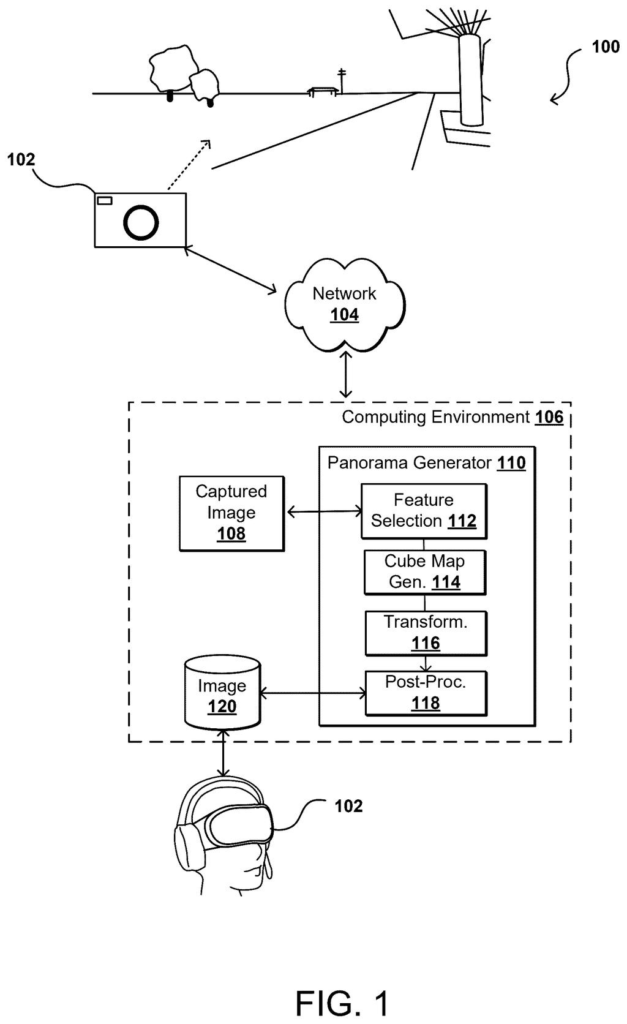
What Nvidia's one-photo 360-degree trick does
Ever wished you could step back into a vacation photo and look behind the camera? You can't. Your phone captured one flat rectangle, and everything outside the frame is gone for good.
This Nvidia patent application describes software that guesses what was out there and paints it in. You give it one ordinary photo, say a beach or a living room. The system first works out what kind of scene it is, then hands the job to an AI that specializes in that kind of scene. Beaches and living rooms get different specialists. The result is a full 360-degree image you can look around in with a VR headset.
The filing even admits that photos can be ambiguous. Ceramic tile could be a bathroom or a swimming pool, so the system can produce several possible panoramas and let you choose the one that fits.
… generate a spherical panoramic image using features extracted from a single input image.
Translation: The system builds a full 360-degree scene using details pulled from just one ordinary photo.
How Nvidia picks a specialist AI per scene
The claims describe a two-stage setup. A first model looks at the input image and pulls out features such as edges, textures, or objects. Those features then decide which second model gets picked from a pool of models. That second model generates more features, and the final output image blends the original features with the new ones. In the description, the picker is a gating network (a traffic director that learns which specialist handles which kind of scene), and the whole thing is a mixture-of-experts design (a team of specialists instead of one generalist).
The description walks through a pipeline for a 360-degree result:
- Feature selection: keeps the core features of the photo and strips noise, using autoencoders (networks that compress an image into a compact summary).
- Cube building: a 360-degree scene is treated as six views (front, back, top, bottom, left, right). The input is assumed to be one face, and the model generates the other five so they stay consistent with each other.
- Flattening to a panorama: a second network converts the cube into a standard 2:1 panorama or spherical image, with an adjustable vertical field of view.
- Tagging: metadata is added so panorama viewers recognize the file.
The specialists are generative models, such as GANs (one network creates images while another judges how real they look) or variational autoencoders. The filing's examples: one expert for landscapes like deserts and grassy hills, another for indoor spaces like living rooms and restaurants. It says the input should be an RGB image at least 256 pixels wide and tall.
What this means for VR photos and screenshots
If this ever reached you, any old photo on your phone could become a place you look around in with a headset, with no need to have shot it on a 360 camera. The filing also points to in-game screenshots on Nvidia's GeForce Now service as one place the system could be used.
The interesting design choice is the team of specialists. The filing says models trained for one type of scene add better detail and less visual noise than a single model asked to paint everything. It is also a continuation of a 2019 application, and the newer claims are wider than panoramas: the core claim covers any case where one model's reading of an image picks which other model builds the output. Panoramas and VR appear in the follow-on claims.
Nvidia's 29th patent application we've tracked in the AI photo editing race since May adds to a run that includes work on selective photo tuning and blocky video frame cleanup.
This idea sits close to something you could actually use. It needs no new hardware. Everything described runs as software on ordinary graphics chips, and the filing itself floats a hosted web service, a piece of a VR tool, or a helper for processing GeForce Now screenshots.
What has to exist first is the heavy part: a stable of trained specialist models (one for deserts, one for living rooms, and so on) plus a big pile of photos paired with matching 360-degree versions to teach them. That is a data and training chore, and Nvidia has the computing power for it.
The shortest route to a product is a website where you upload one photo and download a 360-degree file ready for a headset. One caution: everything outside your original frame is invented, so the result is a plausible guess at your scene. That works for nostalgia and games. It falls short anywhere accuracy matters.
Get our take in your Top Stories
Liked this breakdown? Add Patentlyze as a preferred source on Google, and our plain-English take shows up more often in your Top Stories the next time Nvidia patent news breaks.
There are more where this came from
We read every patent application Big Tech publishes and send you the ones worth knowing. Plain English, free, every week.
The drawings
49 drawing sheets from US 2026/0311290 A1 · click any drawing to enlarge


Want this weekly breakdown for a company we don't cover? Patentlyze Pro →
Be the first to weigh in