
Qualcomm Files Patent for Locating Phones With Only Two Satellites Overhead
Standard satellite positioning wants at least three satellites in view. Qualcomm's new patent application works out where you are with two, by waiting for them to move across the sky and measuring again.
What Qualcomm's two-satellite location trick does
A hiker's phone sits in a mountain valley with a poor view of the sky. Only one or two low-orbit satellites are visible at any moment, and the usual way of fixing a position needs at least three.
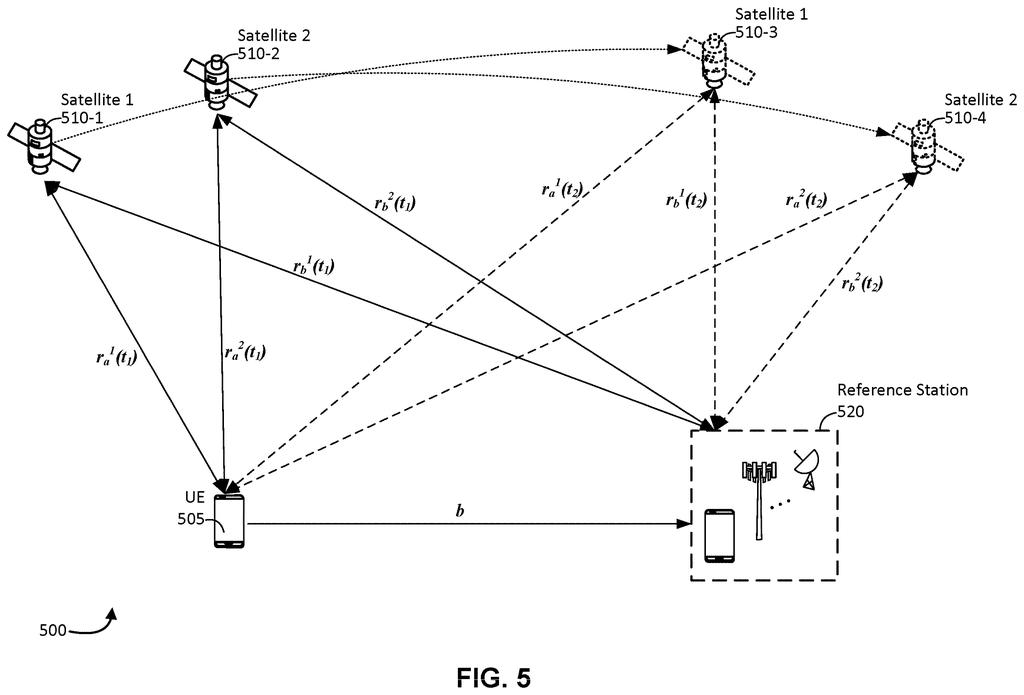
Qualcomm's patent gets around this because those satellites move fast. Your phone measures its distance to two satellites, waits while they glide to new spots, then measures again. A second device at a known location, called a reference station, takes the same readings, and the network compares the two sets so that shared errors, like atmospheric distortion, cancel out.
In the filing's simulations, a wait of about 30 seconds gave a location accurate to within meters. The claims cover the helper device's side of the job: answering the network's call, reporting where it sits, and taking the timed measurements.
… performing pseudorange measurements at the reference station, the pseudorange measurements performed at a first time and a second time, in accordance with the configuration data, wherein the second time is at least a threshold duration of time after the first time …
Translation: The system takes distance measurements at two different times to help figure out where the phone is located.
How the phone and helper station compare notes
The technique is called multi-epoch double-differenced ranging, or MEDDR. An epoch is just a moment when measurements are taken. A pseudorange is an estimated distance to a satellite, rough because clocks and the atmosphere add errors.
Double differencing removes those errors. The phone's readings are subtracted from the reference station's readings for each satellite, then the two satellites' results are subtracted from each other. What is left is mostly true geometry. This works when the two devices are fairly close. Three readings at different times are needed for a full 3D position, or two if the altitude is already known.
The claims describe the reference station's steps:
- Receive a request, such as a search signal sent by satellites looking for available reference stations (called positioning reference units).
- Reply to the network's location server with its own location.
- Receive configuration data saying which satellite signals to measure.
- Measure distances at two times, separated by at least a threshold duration.
- Send the results to the server, the phone, or both.
The threshold depends on the distance between the devices, the satellite's orbit and the accuracy needed. The filing's example is 30 seconds with satellites about 300 km up. The helper can be a base station, a fixed phone or a mobile one, and may first need to set up a radio connection to the network.
Why fewer satellites overhead matters for location
Satellite-connected phone networks are still thin, and the filing says a device often sees only one or two low-orbit satellites at a time. That is too few for the usual method of locating a phone, so getting a fix from two matters if these networks are going to help find devices. The filing lists emergency services, friend finders and pet trackers as uses for a phone's position.
There is also a battery angle. The filing describes sending positioning signals on demand instead of constantly, which narrows the window when a device has to listen. Still, this is a network-side recipe that depends on carriers having reference stations nearby, and the filing names no product.
Qualcomm's 525th filing in our Qualcomm coverage since May adds to a run that includes towers catching AI shortcuts and stopping AI signal cheating.
If this works as described, you would notice it only when you need it: stuck somewhere with a poor view of the sky and still getting a location accurate to within meters. Nothing on your phone's screen would change.
The catch is the wait. The method needs a gap between two sets of readings, about 30 seconds in the filing's example, and the basic version assumes you are staying put. That makes it a fit for a stationary hiker or a sensor on a post, and a weaker fit for live directions while you drive.
It also needs a nearby helper device at a known location, and the claims cover that helper's side of the exchange. Whether you ever benefit depends on carriers placing helpers close to where people actually are. It is a narrow idea, and a sensible one.
Get our take in your Top Stories
Liked this breakdown? Add Patentlyze as a preferred source on Google, and our plain-English take shows up more often in your Top Stories the next time Qualcomm patent news breaks.
There are more where this came from
We read every patent application Big Tech publishes and send you the ones worth knowing. Plain English, free, every week.
The drawings
10 drawing sheets from US 2026/0319100 A1 · click any drawing to enlarge


Show the other 2 sheets


Want this weekly breakdown for a company we don't cover? Patentlyze Pro →
Be the first to weigh in