
Qualcomm Files Patent So Cell Towers Can Tell When Your Phone's AI Is Cutting Corners
Your phone may use AI to guess which cell signal will work best, and it can skip some of its homework to save battery. Qualcomm's patent application is about making sure the network knows when that happens, so it doesn't blame the AI for a shortcut.
What Qualcomm's phone-AI signal check actually does
Your phone can use AI to predict how good the signal will be on the next radio beam instead of measuring every one. To save battery, the phone may feed that AI fewer readings than it could, and the predictions get worse when it does. The network can't see this, so it often assumes the AI itself is the problem.
Qualcomm's patent application describes two fixes. In one, the network tells the phone exactly which readings the AI must use. In the other, the phone reports which readings it actually used. The filing gives an example: with five past readings, the AI picks the best beams 95% of the time, but with three it drops to 70%.
With that information, the network can tell a lazy input from a model that truly doesn't fit your surroundings. It can skip swapping out a perfectly good AI or sending extra test signals it didn't need.
receive first signaling comprising an indication of a restriction of a set of measurement parameters for inclusion in a channel state information (CSI) prediction procedure …
Translation: The phone gets instructions from the tower on which data it is allowed to use for AI predictions.
How the network learns what inputs the AI got
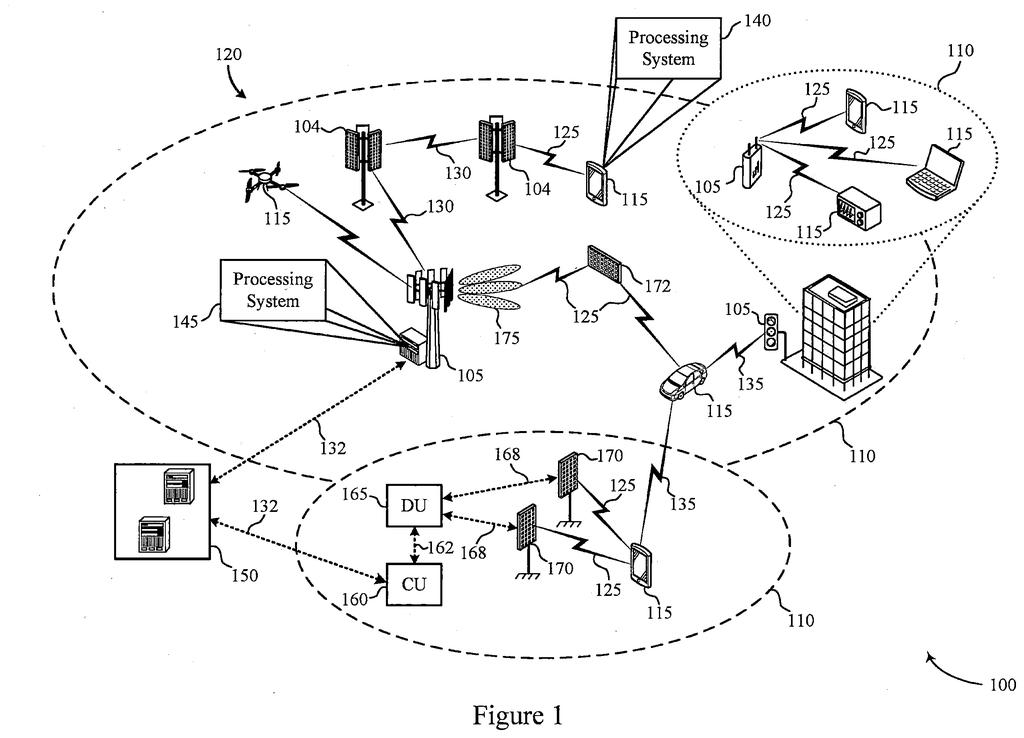
In 5G, your phone and the cell tower constantly check which radio beams (focused streams of signal) work best. Instead of testing every beam, the phone can feed a few measurements into a machine learning model that predicts the rest. The prediction is a form of channel state information, or CSI, which is basically a report card on how good a connection is.
The patent covers two related ways to keep the network informed. In the first, the tower sends a restriction telling the phone which inputs the AI must use. The restriction can set:
- How many beams to measure
- Which type of measurement to use (the tower sends several kinds of test signals)
- How much time separates measurements
- How many frequency sub-channels to include, or how far apart they are
In the second, the tower sets a reporting configuration, and the phone reports what it actually fed the model, including any measurements it skipped. The report can be sent only when accuracy slips past a threshold, such as an error above 4 dB in one example.
Either way, the phone can also check its predictions against real measurements and send back the gap, for example a mean squared error (a standard score for how far off guesses were). The tower then decides on model management: switch models, retrain, or fall back to non-AI methods. All of this travels in ordinary 5G control messages.
… network performance monitoring of user equipment (UE) machine learning (ML) models …
Translation: The system keeps tabs on how well the phone's artificial intelligence is actually performing.
Why fewer false alarms matter for your signal
Most of this plays out where you never look, but the effects could reach you. If the network blames the AI for a battery-saving skip, it may switch your phone to a weaker fallback or send extra test signals, which the filing says adds overhead and wastes network energy. Telling those cases apart could mean fewer pointless changes behind your connection.
It also gives phones and networks a clearer way to trade accuracy against battery. The network can ask for more readings when it needs them and allow fewer when it doesn't. Because it is written around 5G and 6G control signaling, any benefit would depend on carriers and phone makers adopting it.
Qualcomm's 524th filing we have tracked since May in our Qualcomm coverage adds to a run that includes a cheating-prevention idea and a signal-judging AI.
You will never find a setting for this. If it works, the benefit shows up as fewer odd moments: a connection that doesn't get shuffled onto a worse method for no good reason, and a phone that can save a little battery without causing trouble elsewhere.
The filing's own example shows the stakes. A drop from 95% to 70% accuracy looks like a broken model, and a network that can't see the cause has little choice but to act on it. Showing the network the inputs makes that call fairer.
It is plumbing for cellular networks, and it will live in chips and carrier gear. Treat it as a modest fix that matters to engineers first and to you second, in the form of a connection that holds up a little better.
Get our take in your Top Stories
Liked this breakdown? Add Patentlyze as a preferred source on Google, and our plain-English take shows up more often in your Top Stories the next time Qualcomm patent news breaks.
There are more where this came from
We read every patent application Big Tech publishes and send you the ones worth knowing. Plain English, free, every week.
The drawings
13 drawing sheets from US 2026/0322456 A1 · click any drawing to enlarge


Show the other 5 sheets


Want this weekly breakdown for a company we don't cover? Patentlyze Pro →
Be the first to weigh in