
Qualcomm Files Patent to Stop Phone AI From Cheating on Signal Tests
A phone's signal-predicting AI can ace a test by memorizing it. This Qualcomm patent filing describes a way to make that much harder by randomizing the test data.
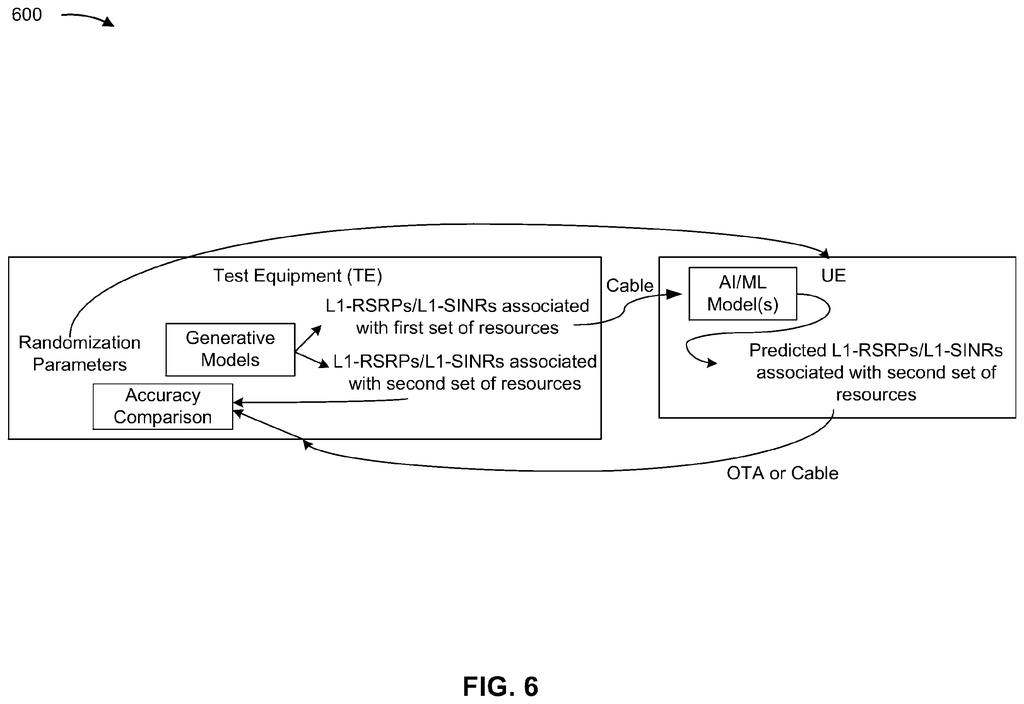
What Qualcomm's phone-AI signal test does
A new phone sits on a lab bench, wired by cable to a box of test gear. The box feeds it signal readings, and the phone's built-in AI has to guess what the readings will look like next. Your phone makes this kind of guess all the time, so it can work out which signal direction will be strongest before the connection dips.
The catch is that the usual test setup uses fairly simple, predictable readings. A phone maker could train the AI on exactly those readings, and the AI would ace the exam without being any good in real life. Qualcomm's filing fixes this by having the test box invent its readings on the fly, using random settings such as how fast you're moving or whether you're indoors or outdoors.
The phone never learns which settings produced which readings, so it can't memorize the answers. The test box then checks the phone's guesses against what its own model says should have happened.
transmit layer 1 (L1) reference signal received power (RSRP) or L1 signal-to-interference-plus-noise ratio (SINR) (L1-RSRP/L1-SINR) measurements associated with a first set of resources, wherein the L1-RSRP/L1-SINR measurements associated with the first set of resources are based at least in part on a generative model for test data that uses a randomization parameter; …
Translation: The testing equipment sends signal measurements created using randomized AI test data.
How the test box invents randomized signal data
Under the filing, a piece of test equipment connects to a phone by cable and sends it a first batch of signal readings, called L1-RSRP or L1-SINR values (physical-layer measures of how strong and how clean a signal beam is). These stand in for what the phone would normally measure from a cell tower.
The phone's on-board AI uses that batch to predict a second batch: readings for other beams, or for moments just ahead. It sends its predictions back by cable or over the air. The equipment compares them with its own matching 'true' values to score the phone's accuracy.
The first batch comes from a generative model (a formula or AI that produces realistic fake data) with a randomization parameter the equipment can vary, such as:
- Indoor or outdoor, urban or rural settings
- Delay spread (how much signal echoes smear out)
- Doppler shift (changes caused by motion) and phone speed
- Antenna setup and cell type
In one example, 70% of readings use a 30 ns delay spread and 30% use 100 ns. In another, readings simulate a phone moving north, then east, then south. The phone is not told which setting made which reading. The model can be a statistical formula, a machine-learning model, or both.
… a beam prediction feedback associated with a user equipment (UE)-side beam prediction, wherein the beam prediction feedback indicates L1-RSRP/L1-SINR measurements associated with a second set of resources.
Translation: The system responds with feedback based on how the phone predicted its wireless beam.
Why cheat-proof testing matters for 5G phones
Phones can use AI to guess which signal direction will be strongest next, which is meant to cut delays and extra signaling as you move. Before anyone trusts that AI, it needs a fair exam, and a lab chamber is a hard place to fake a fast train or a crowded downtown.
This patent describes a way to run that exam by cable, with test data that changes every time. The filing says the recipe could be written into the 3GPP standard (the industry rulebook for cellular), which would let rival phones be graded the same way. You would never see any of this, but it shapes how well your phone holds a connection while you travel.
Qualcomm's 523rd filing in our Qualcomm coverage since May adds to a pattern of network-sensing work seen in the radar sensing patent and the signal-judging AI patent.
Testing over a cable gives up the messy real airwaves, so the test can only be as honest as the fake data it uses. If the recipe for that data is written into a public standard, as the filing says it could be, every phone maker can read it. Randomization is then the only defense against a memorized score, and the filing itself says only that the phone is 'less likely' to know the contents.
Still, the trade looks sensible. A lab chamber cannot easily reproduce a fast train ride or a dense city block, and a cable can fake both on demand. The main audience is the engineers who write phone tests, and a score from synthetic data will never fully predict how your phone behaves on a crowded street.
Get our take in your Top Stories
Liked this breakdown? Add Patentlyze as a preferred source on Google, and our plain-English take shows up more often in your Top Stories the next time Qualcomm patent news breaks.
There are more where this came from
We read every patent application Big Tech publishes and send you the ones worth knowing. Plain English, free, every week.
The drawings
17 drawing sheets from US 2026/0322472 A1 · click any drawing to enlarge


Show the other 9 sheets


Want this weekly breakdown for a company we don't cover? Patentlyze Pro →
Be the first to weigh in