
Apple Files Patent for a Headset View That Adapts When You Stand Up or Sit Down
When a headset shows you the room through its cameras, the picture is slightly wrong, because the cameras aren't where your eyes are. Apple's patent has the headset decide how much to fix based on what you're doing, and sometimes to skip the fix entirely.
What Apple's headset passthrough fix actually does
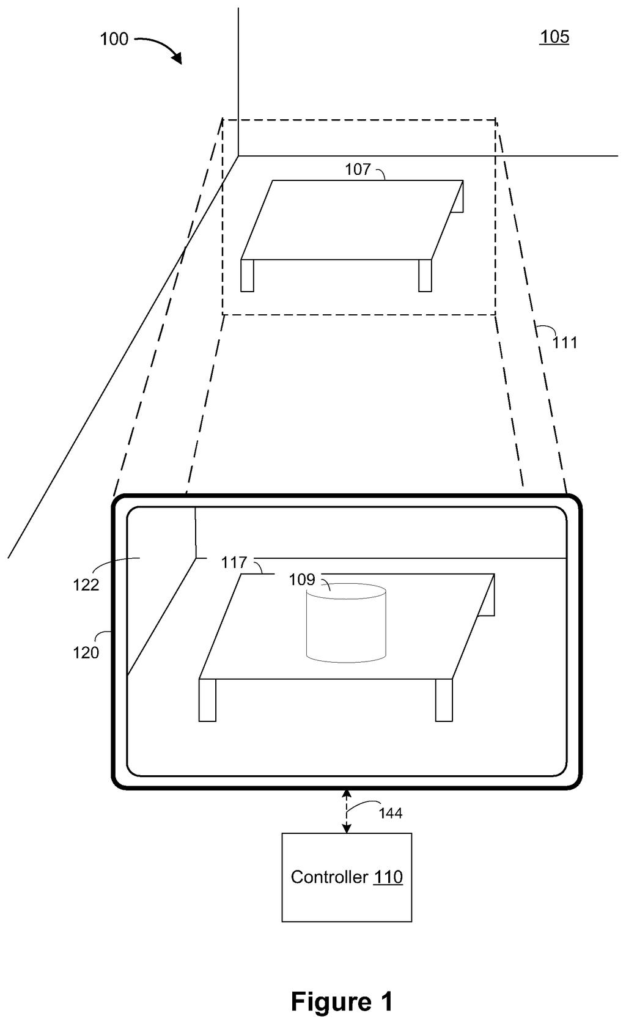
A person in a headset reaches for a mug on the kitchen counter. What they see is a live video of the counter, shot by cameras that sit a little away from their eyes. The mug looks slightly off, and so does the distance to it, which can leave you clumsy or a bit queasy.
Software can correct that mismatch, but every fix has a price: more battery drain, more visual glitches, or both. Apple's patent has the headset check what's going on before deciding how much fixing to do. It looks at what you're doing (sitting, walking, looking around), which app is open, and what the room is like.
Settle in to watch a movie and the headset can ease off to save power. Start a game on your feet and it can turn the corrections up. It can even skip them altogether when they aren't worth the cost.
… determining whether to perform perspective correction operations based at least in part on the first contextual information; in response to determining to perform the perspective correction operations: generating first corrected image data by performing a first set of perspective correction operations on the image data …
Translation: The system decides whether to adjust your view based on what you are doing and then alters the images accordingly.
How Apple's headset switches fixes mid-stride
The patent covers a computer, such as a headset, that takes in camera images of your surroundings, gathers contextual information, and uses it to decide whether to apply perspective correction (reshaping the camera's view so it looks like it was captured from where your eyes are). If the answer is yes, it runs a chosen set of corrections and shows the result. If no, it shows the uncorrected image, with virtual content still added on top if needed.
Context comes in three kinds: the user (head pose, body pose, eye tracking, motion), the app (its identity and current state), and the environment (a label for the room, objects in it, ambient sound, light level, and a 'background frequency' value, meaning how busy the backdrop is). When that context shifts, the headset can start correcting, stop, or swap to a different set.
The corrections described include:
- Depth clamping: treating anything closer than a set distance as if it sat at that distance.
- Viewpoint shifting: full or partial movement of the image toward where your eyes are.
- Depth smoothing and hole filling: cleaning up rough depth readings and patching gaps.
- Temporal warping: predicting where your eyes will be by the time a frame reaches the screen.
In one example, context is checked about once a second while frames are drawn 90 times a second. Changes happen gradually over several frames, in bigger steps during a blink. If the depth readings look unreliable, corrections that depend on them can be switched off.
… obtaining first contextual information including at least one of first user information associated with a current state of a user of the computing system, first application information associated with a first application being executed by the computing system, and first environment information associated with a current state of the physical environment …
Translation: It gathers details about your posture, the active app, and your surroundings to figure out how to adjust.
Why battery and motion sickness drive this filing
Headsets that show the room through cameras face a battery problem and a comfort problem at once. Fixing the picture helps your eyes and hands trust what they see, yet it costs power and can add visual glitches. This patent's answer is to spend effort only where it pays off: more correction when you're up and moving, less when you're settled in a chair with a movie.
For you, that could mean longer sessions between charges and fewer moments where the world looks slightly warped. It also points to headsets that treat the passthrough view as something that changes with the moment, handled automatically in the background. Apple's Vision Pro is the obvious device that could use this, though the filing itself doesn't name any product.
Apple's 91st filing we've tracked since May in our AR glasses work builds on ideas like surrounding music visuals and objects that glide on their own.
Claim 1 is wide. It asks only that a device with a camera and a screen look at at least one of three things (what you're doing, which app is running, or what the room is like) and use that to decide whether to fix the camera image at all. It never names a headset, never lists which corrections to run, and never says how the decision gets made.
That breadth is the point. If granted as written, any camera-to-screen system that switches image fixing on or off based on something like the open app would fall within the territory the claim describes. The narrower ideas, such as eye tracking, depth readings and swapping in a different set of fixes, sit in the claims underneath.
The 'don't correct' branch is the sharpest part of claim 1. Skipping the fix saves battery whenever it isn't worth the cost, and the claim covers that choice directly. Overall this is a sensible, broadly worded engineering idea, and its real value depends on how the final claims read.
Get our take in your Top Stories
Liked this breakdown? Add Patentlyze as a preferred source on Google, and our plain-English take shows up more often in your Top Stories the next time Apple patent news breaks.
There are more where this came from
We read every patent application Big Tech publishes and send you the ones worth knowing. Plain English, free, every week.
The drawings
16 drawing sheets from US 2026/0320743 A1 · click any drawing to enlarge


Show the other 8 sheets


Want this weekly breakdown for a company we don't cover? Patentlyze Pro →
Be the first to weigh in