
Samsung Patents a Headset Dial That Fits Your Head and Your Eyesight
Samsung's headset patent puts two jobs on one dial: tightening the strap and adjusting the lenses for your eyesight. The strap stays snug while you do the second one.
What Samsung's one-dial headset adjustment does
Ever fixed one thing on a gadget only to watch it undo another? Samsung's patent describes that exact problem on a VR headset. You tighten the back strap until it fits, then move the lenses closer to or farther from your eyes to sharpen the picture. Suddenly the strap is too loose, or it's squeezing your head.
The filing folds both jobs into a single dial on the forehead pad. Twist it to tighten or loosen the strap. Slide it one way to free the lens section so you can shift it to suit your eyesight, then slide it back to lock everything in place. Because the forehead pad stays put while the lens section moves, your strap setting doesn't change.
There are a few extras too. A press button lets the strap loosen quickly so you can take the headset off, and the forehead cushion is split into three pieces so it can follow the shape of your head.
… a second fixing structure configured to engage with the first fixing structure based on movement of the dial unit in a first direction and disengage from the first fixing structure based on movement of the dial unit in a second direction …
Translation: Turning the dial locks or unlocks the headset parts depending on which way you turn it.
How the dial's two moves tighten and refocus
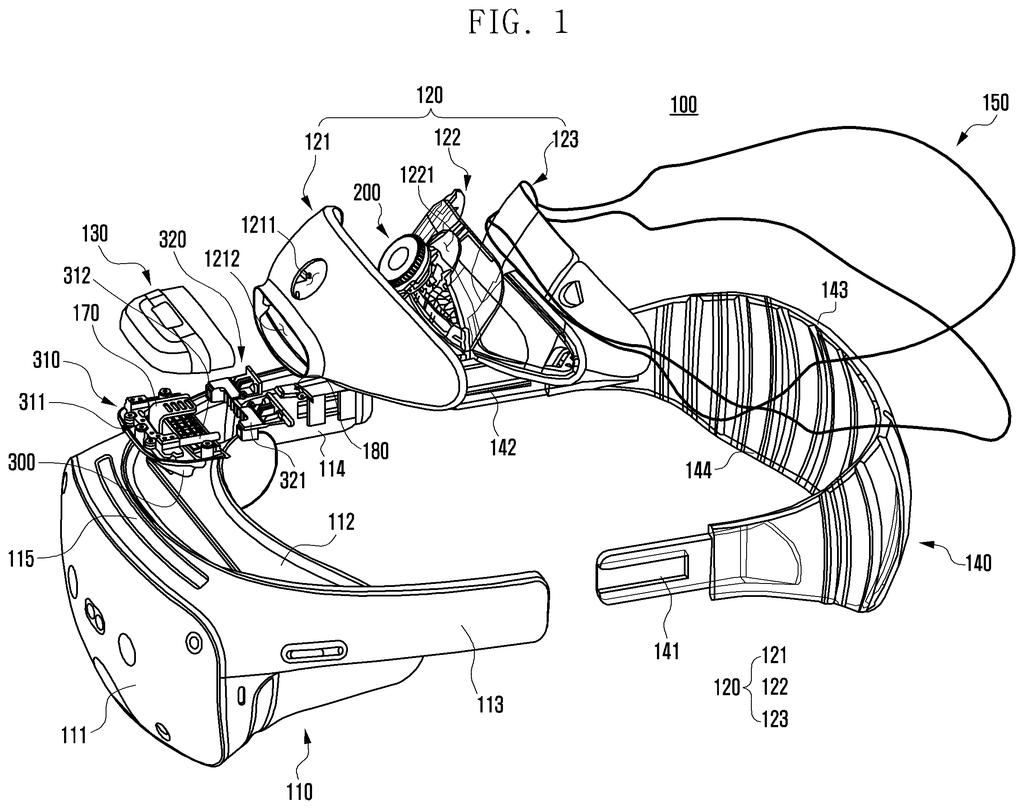
The patent covers a headset with a main body (where the display and lenses live) and a separate front case that rests on your forehead. A dial sits on the front case. A wire wraps around the dial and runs through the rear band, so turning the dial winds or unwinds the wire, pulling the band toward the forehead pad or letting it out.
The same dial also slides. Moving it in one direction presses a locking piece on the dial's side against a matching piece on the main body (the filing calls these the first and second fixing structures), which holds the body in place. Sliding the dial the other way releases them, and the main body can then glide forward or backward along a guide (a shaft sitting in a groove).
Moving the body changes the gap between the lenses and your eyes. That is how the headset handles a diopter adjustment, meaning a correction for people whose vision needs help. Since the forehead pad stays fixed and only the body moves, the distance between the pad and the strap doesn't change.
The filing also describes:
- A hook and latch that hold the dial in place after you slide it back
- Several notches so the body can lock at different positions
- A three-wheel gear dial with a button that frees the strap for fast removal, built to turn with little noise
- Crossed wire strands in the band to prevent tangling
- A forehead cushion divided into three areas
… a rear band connected to the wire, the rear band being configured to move relative to the front case based on rotation of the dial unit …
Translation: Spinning the dial winds or unwinds a hidden wire to adjust the strap against your head.
Why a single dial matters for VR headset comfort
If you wear a VR headset and need vision correction, setting it up can turn into a juggling act. The filing says that adjusting the lenses after setting the strap can make the headset slip off your head or press too hard, so you have to follow a certain order. The pitch here is that you set the strap once, then adjust the lenses while the headset stays where it is.
The patent doesn't name a product, and most of the detail is mechanical: gears, springs and sliding rails. But fit and comfort are what you notice from the first minute of wearing a headset, and they are the problems this filing says it is built to fix. It is still only a patent application, so it doesn't promise that Samsung will ship it.
Samsung's 63rd filing we've tracked since May on our AR glasses watchlist builds on their earlier work on grainy video fixes and dim-room camera brightening.
Claim 1 is built from plain mechanical parts: a body, a front case that slides against it, a dial, two locking pieces, a wire and a rear band. It never mentions lenses, eyesight or gears. The claim only requires that one dial can lock and free the sliding motion while also reeling in the strap, so it is fairly roomy. The wheels, springs and link arm described in the filing appear only in the later claims.
If granted, it would reach any headset where one dial pulls a wire to tighten a rear band and, when slid the other way, frees the front section to move. A rival could steer around it with two separate dials or a strap that doesn't use a wire.
Verdict: a practical piece of hardware engineering aimed at an everyday annoyance, with a claim wide enough to matter for the one design it describes.
Get our take in your Top Stories
Liked this breakdown? Add Patentlyze as a preferred source on Google, and our plain-English take shows up more often in your Top Stories the next time Samsung patent news breaks.
There are more where this came from
We read every patent application Big Tech publishes and send you the ones worth knowing. Plain English, free, every week.
The drawings
23 drawing sheets from US 2026/0310257 A1 · click any drawing to enlarge


Show the other 15 sheets


Want this weekly breakdown for a company we don't cover? Patentlyze Pro →
Be the first to weigh in