
Apple
Apple · AR / VR · Filed Mar 13, 2026 · USPTO published Oct 1, 2026 · Oct 1 release
Apple Patents a Display System That Sharpens Only What Your Eyes Are Aimed At
Apple is working on a display technique that skips sharpening most of your screen and focuses all that effort on the exact patch you're looking at. It's a clever workaround for one of the hardest problems in wearable displays: making things look crisp without burning through computing power.
- Publication number
- US 2026/0301125 A1(US20260301125A1)
- Applicant
- Apple Inc.
- Filed · Published
- Mar 13, 2026 · Oct 1, 2026
- Inventors
- James A. McCombe, Christian I. Moore, Joseph Cheung, Luke A. Pillans, Nathaniel C. Begeman, Seyedkoosha Mirhosseini, Simon Fortin-Deschenes, Zachary D. Corley
- Status when we published
- Waiting for an examiner
- Document
- 20 claims
- US classification
- 382/284
- Parent application
- Claims priority from a provisional application 63779771 (filed Mar 28, 2025)
What Apple's gaze-based sharpening actually does
Imagine you're watching a movie through an Apple Vision Pro-style headset. The picture looks great where your eyes are pointed, but the edges of the frame are a little blurry. Most people don't notice, because our eyes naturally focus on a narrow area at any given moment.
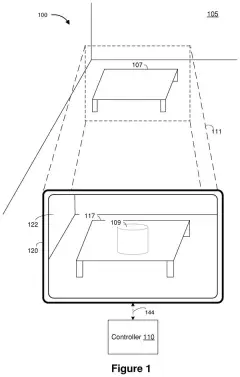
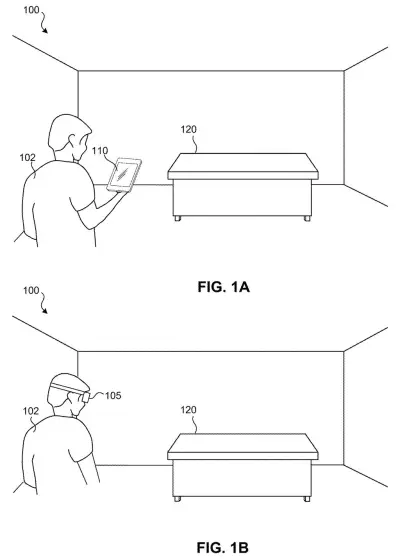
Apple's patent formalizes that biological quirk into a display strategy. The device tracks where your eyes are pointing and where your head is tilted, then uses that information to predict a small "region of interest" in the image. Only that patch gets upscaled to a higher resolution. The rest of the image stays at the original, lower resolution.
The end result is a combined image that looks sharp where it counts, without the device having to render every pixel at full quality. Think of it as the display equivalent of only mopping the part of the floor that guests will actually walk on.
… predicting a region of interest corresponding to an area of the source content based on the identified user gaze direction and the identified user head pose; upscaling the area of the source content to a second resolution that is greater than the first resolution; …
Translation: The system figures out where you are looking and sharpens only that specific spot.
How the device predicts where to spend its pixels
The patent describes a method that runs on a device with at least one display and a set of sensors. Those sensors feed real-time data about the user's gaze direction (where the eyes are pointing) and head pose (how the head is tilted and rotated in space).
Using both signals together is important. Your gaze tells the system where your eyes are aimed relative to your head, and your head pose tells it where your head is aimed relative to the world. Combined, they let the device predict a region of interest, a specific rectangular area of the source image that you're actually looking at right now.
The system then applies upscaling (a process that artificially increases an image's resolution, similar to zooming in digitally but with algorithms that fill in convincing detail) to just that patch. The surrounding area of the frame is left at the original, lower resolution. Both pieces are stitched together into a single combined image that gets sent to the display.
- Source image arrives at a base resolution
- Gaze and head data identify the focus area
- That area alone is upscaled to higher resolution
- The two areas are merged and displayed
… generate combined content by combining the upscaled area with a remaining area of the source content having the first resolution.
Translation: It stitches the sharp focused area back together with the rest of the lower quality image.
What this means for the next generation of Apple headsets
Rendering everything at full resolution is expensive. In a headset, it drains battery, generates heat, and demands powerful chips. This patent describes a way to deliver a perceived high-resolution experience while doing a fraction of that computational work, because you only sharpen the part your visual system can actually resolve at any moment.
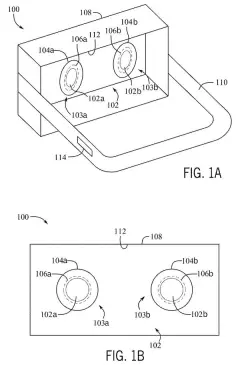
For Apple, this is particularly relevant to the Vision Pro and any future headsets that follow it. Those devices already use eye-tracking for UI interaction. Routing that same sensor data into a display rendering loop is a logical extension, and if it works as described, Apple's track record in display-efficiency patents suggests this is one piece of a longer effort to make spatial computing hardware lighter and longer-lasting.
Apple's 77th filing we've tracked since May on our AR glasses work adds to earlier applications like clearing grainy see-through footage and tracking objects without depth data.
Source: US 2026/0301125 A1 at the USPTO (PDF). Full patent text and figures are in the official publication.
Get our take in your Top Stories
Liked this breakdown? Add Patentlyze as a preferred source on Google, and our plain-English take shows up more often in your Top Stories the next time Apple patent news breaks.
Add Patentlyze on Google
One click.
There are more where this came from
We read every patent application Big Tech publishes and send you the ones worth knowing. Plain English, free, every week.
The drawings · 7 sheets
7 drawing sheets from US 2026/0301125 A1 · click any drawing to enlarge


More from Apple
All 748 Apple patents →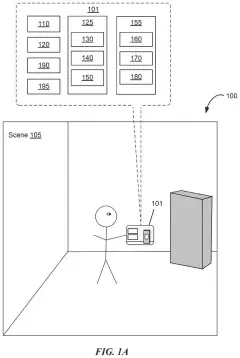
More in AR / VR
All 713 AR / VR patents →
Apple
Apple Patents a Two-Device System That Sharpens Only What Your Eyes Are Looking At
Apple
Apple Patents a Headset Frame That Lights Up Differently Depending on What You're Looking At
Apple
Apple Patents a Headset That Slides Its Screens to Match Your Eyes
Apple
No comments yet