
Qualcomm Files Patent for Radio Signals That Send Data and Detect Objects at Once
Qualcomm describes one radio signal that carries your data and spots a drone at the same moment, with only the start time of each pulse telling the two jobs apart.
What Qualcomm's two-jobs radio signal actually does
Imagine a cell tower with two chores at once: send your phone some data, and check whether a drone is flying through the area. Each chore wants its own slice of radio airspace, and long sensing signals that carry no data can waste a lot of it.
Qualcomm's patent application describes a way to do both with one signal shape. The tower sends repeating radio sweeps (think of a rising bird chirp) that all share the same frequency range and length. The only difference is when each sweep starts. Some start times are reserved for sensing, and the others carry data.
Your device gets a message telling it which start times are which. It then listens to the reflections to work out where an object is, and reads the data from the rest.
… receive a reflection of a set of FMCW sensing signals off of a target object; measure the received reflection of the set of FMCW sensing signals based on the first indicator; and calculate a location of the target object based on the measured received reflection.
Translation: The device catches bounced radio waves to figure out where an object is located.
How staggered start times split sensing from data
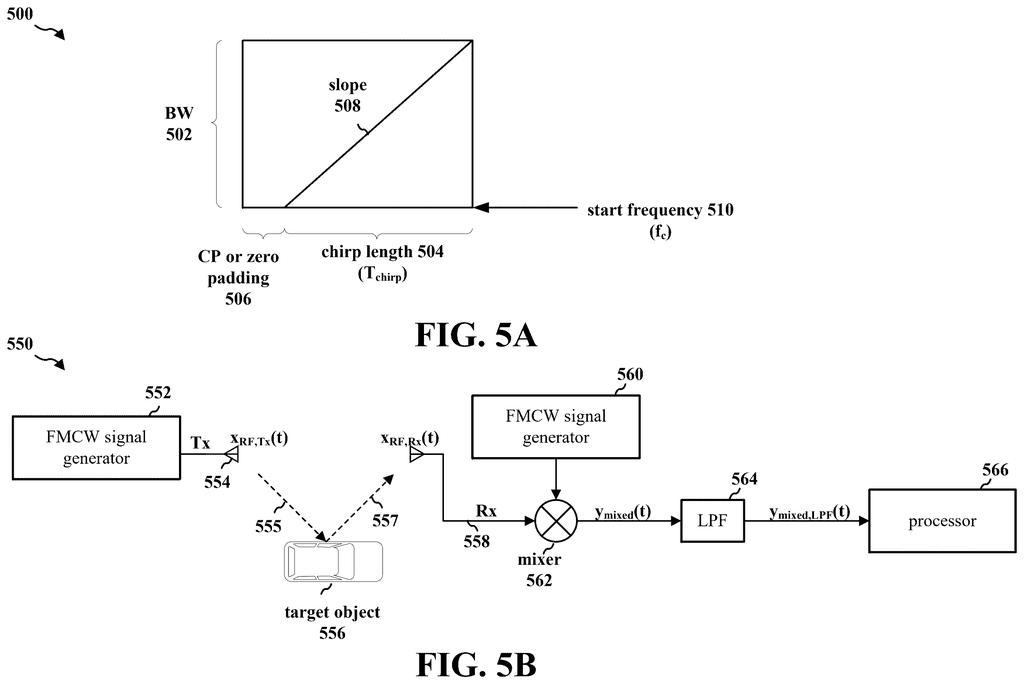
The core idea is a frequency-modulated continuous wave (FMCW) signal: a radio pulse whose frequency sweeps upward, called a chirp. Radar uses chirps because the delay of a reflected chirp reveals how far away an object is. Here, the sensing and data signals share one chirp length and one bandwidth (span of frequencies) but start at different offsets, meaning small time shifts.
A transmission grant message (the network's instruction sheet) lists which offsets are for sensing and which are for communication. The receiving device measures the reflection off a target object, calculates its location, then sends the result in a report or stores it. Data rides on which communication offset gets picked.
Beforehand, the two sides can tune the settings using a CSI-RS (a test signal the device measures and reports back on). The report can include:
- The sensing chirp length, worked out from the sampling rate and the farthest distance to sense
- The minimum spacing between communication offsets
- Signal quality and signal-to-noise ratio (how loud the signal is against background noise)
The filing's examples limit the sensing range to fit the setting: a drone ceiling of 120 meters, a road's edges, or a room's walls.
The UE may output a third indicator of the calculated location of the target object, for example by transmitting the third indicator or by storing the third indicator on a memory of the UE.
Translation: The device then saves or sends out the calculated position data.
Why cheap sensors and phones both stand to gain
For you, the payoff is mostly indirect. If a network can sense objects and carry data on the same slice of airwaves, that spectrum does more work, which matters when phones, cars and sensors all compete for it. The filing also says a low-end device could receive both kinds of signal, and that mid-range and high-end devices could use less power doing so.
That points toward wireless networks that can spot things like drones or vehicles while they keep carrying your calls and data. The filing lists drones in a regulated area, cars on a road and objects in a room as sensing examples. It is written in 5G standards language, which suggests it is aimed at network designs rather than a single gadget.
Qualcomm's tenth filing in the robotics patents we cover since June follows smart shelf price tags and a self-grading robot AI.
Every extra job you pack into one signal costs something. Here, each start time given to sensing is a start time that cannot carry data, so the split between the two jobs is a real tradeoff in capacity. The design also adds overhead: the devices swap test signals and reports so the sender can pick spacing wide enough that the overlapping signals do not blur together.
If that spacing is wrong, the scheme could fail in the exact place it promises to help, with a receiver mistaking sensing echoes for data or the reverse. A long sweep also helps range, so spotting far-off or faint objects ties up more airtime per measurement.
The filing's own logic says the trade is worth it. A long sensing signal that carries no data leaves airtime idle, and sharing it recovers that waste. The idea makes sense for light sensing jobs like a room or a stretch of road, while the overhead needs close watching anywhere traffic is heavy.
Get our take in your Top Stories
Liked this breakdown? Add Patentlyze as a preferred source on Google, and our plain-English take shows up more often in your Top Stories the next time Qualcomm patent news breaks.
There are more where this came from
We read every patent application Big Tech publishes and send you the ones worth knowing. Plain English, free, every week.
The drawings
14 drawing sheets from US 2026/0319064 A1 · click any drawing to enlarge


Show the other 6 sheets


Want this weekly breakdown for a company we don't cover? Patentlyze Pro →
Be the first to weigh in