
Qualcomm Patents a System for Networks to Control Drone Flight Paths
Qualcomm is laying out a framework that would let a cellular network remotely steer a drone's route, switch its flight mode, and override its behavior in an emergency, all over a standard wireless connection.
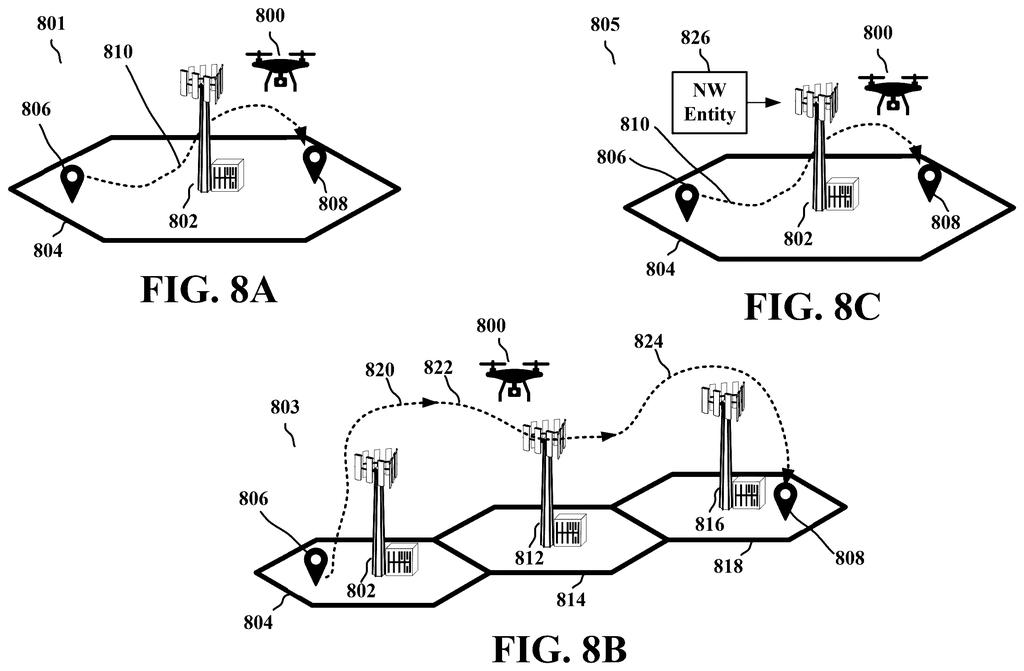
How Qualcomm's cellular drone control system works
You're watching a delivery drone fly overhead and wondering who's actually in charge of where it goes. Right now, most consumer and commercial drones follow routes programmed before takeoff, with limited ability for anyone on the ground to change things on the fly.
Qualcomm's patent describes a different model: the drone stays in constant contact with a cellular network, and that network can send it a driving mode that tells it to follow a planned route, shift to a different operational mode, or respond to an emergency override. The drone isn't just reporting its position; it's receiving active instructions.
Think of it like air traffic control for drones, but running over 5G instead of radio towers. The network entity, a base station or core network system, pushes commands down to the UAV and receives status data back up. That two-way link is the core idea here.
… receive, from the network entity, a message including a UAV driving mode, the UAV driving mode indicating the apparatus to fly on a planned route, the apparatus being a UAV.
Translation: Cell towers could soon tell drones exactly what route to fly using a special driving mode.
Inside the UAV routing message and driving-mode design
The patent describes a wireless communication architecture in which a UAV (uncrewed aerial vehicle) maintains both uplink (drone to network) and downlink (network to drone) data channels with a network entity, such as a 5G base station or a core network component.
The central mechanism is a UAV driving mode: a structured message the network sends to the drone that instructs it on how to fly. The patent covers several operational categories:
- Planned route mode: the network confirms or assigns a pre-approved flight path
- Operational configuration: settings like altitude limits or speed profiles that can be updated remotely
- Emergency overrides: commands that can supersede the drone's onboard instructions in safety-critical situations
The apparatus described is the UAV itself, which carries a processor and memory capable of parsing these network messages and acting on them. This is a software-and-protocol design, not a new chip; it defines the message format and control logic rather than new silicon. The approach builds on existing cellular standards (the kind of signaling protocols that 4G and 5G networks already use for devices), extending them to cover airborne nodes.
What this means for regulated drone airspace
Drone delivery and autonomous aerial operations are sitting in a regulatory holding pattern in most countries, partly because there's no reliable way for authorities or operators to intervene once a drone is airborne. A cellular-native command system could change that calculus for regulators, making it easier to approve large-scale drone operations if a network can enforce no-fly zones or reroute aircraft in real time.
For Qualcomm specifically, this fits a clear pattern: the company makes the modems and chips that go into connected devices, and a world where drones require persistent cellular links is a world that buys more Qualcomm silicon. The filing is still a protocol design, not a finished product, and it would need standardization through bodies like 3GPP before any drone maker could implement it, but it's the kind of foundational spec work that shapes those standards. Qualcomm's UAV routing approach is part of the broader wave of newest Big Tech patents pushing cellular infrastructure deeper into autonomous vehicle and airspace management.
The gap between this filing and a shippable product is measured in standards cycles. Before any drone OEM can implement this driving-mode protocol, it has to land in a 3GPP release, get adopted by network operators, and pass aviation-authority muster in each jurisdiction, a process that typically takes three to five years. What the patent does accomplish is staking out Qualcomm's preferred architecture early, which gives the company leverage when those standardization conversations happen. The shortest path to a product here runs through 3GPP long before it reaches a factory floor.
There are more where this came from
We read every patent application Big Tech publishes and send you the ones worth knowing. Plain English, free, every week.
The drawings
19 drawing sheets from US 2026/0238966 A1 · click any drawing to enlarge


Want this weekly breakdown for a company we don't cover? Patentlyze Pro →
Be the first to weigh in