
Nvidia Files Patent for a Check on Whether Your Graphics Chip Can Add Extra Frames
Before a game turns on AI-generated extra frames, it has to know your graphics chip can handle them. This Nvidia patent application covers the simple request-and-answer step that settles that.
What Nvidia's frame-support check actually does
You're opening a new game and the settings menu offers a switch that makes motion look smoother by adding extra frames, the still pictures that make up moving video, between the ones the game actually draws. Before the game lets you flip that switch, it needs to know one thing: can your graphics chip really do this?
This Nvidia patent application describes a built-in way to ask. The game sends a request to the chip and names a spot in memory where it wants the reply. The chip then writes a simple answer in that spot, saying whether it can use AI to invent the in-between frames.
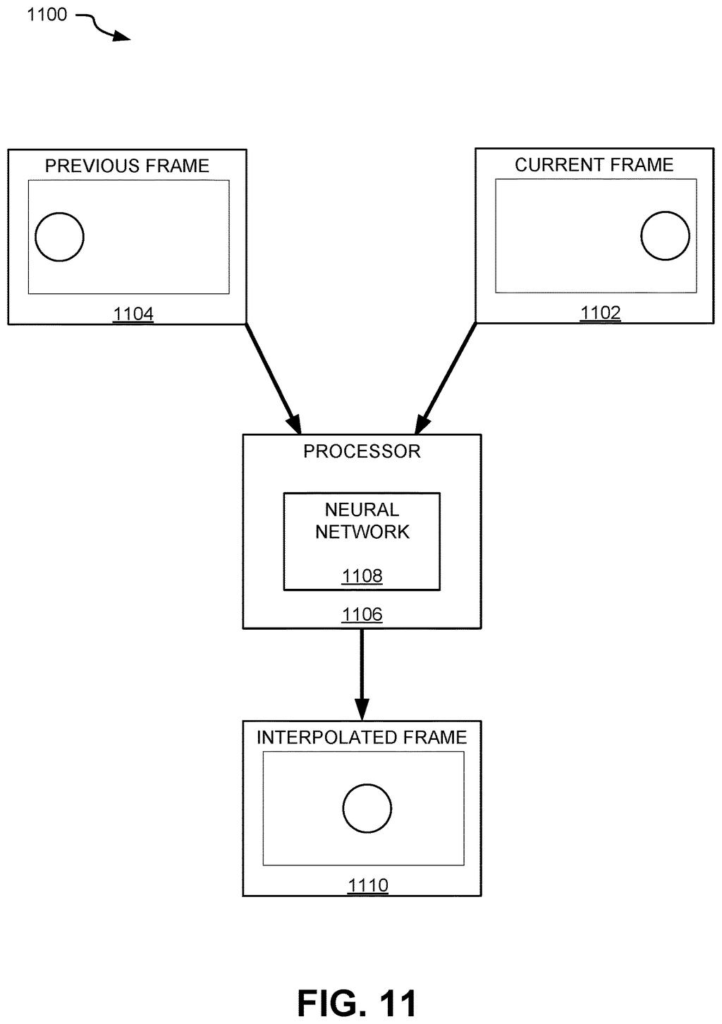
The extra frames themselves come from a trained AI model that studies two real frames and fills in the moment between them. The filing treats that as the setting, and the patent claim covers the checking step: ask, then store the answer.
receive, via an API call, one or more input values indicating a storage location to store a determination of support to use one or more neural networks to perform frame interpolation; and store a result to the storage location to indicate support to use one or more neural networks to perform frame interpolation.
Translation: Software asks the chip if it can use AI to generate extra video frames and saves the answer.
How a game asks the chip and gets an answer
The claim covers a processor with circuits that carry out an application programming interface (API), which is a standard way for one piece of software to ask another to do something. A program makes an API call and passes along an input value that points to a storage location, meaning a named spot in memory. The processor then stores a result in that spot indicating whether it supports using one or more neural networks to perform frame interpolation.
Frame interpolation means generating new frames between the ones a game engine renders. The description gives an example: if one frame is stamped 10.0 seconds and the next 10.1 seconds, the system can produce a frame at 10.05 seconds, or several at spots like 10.025 and 10.075. A neural network (a trained AI model) decides, pixel by pixel, how to blend versions of the frames shifted by different kinds of motion, such as motion data from the game engine and optical flow (a way of estimating movement from the pictures themselves).
The filing treats this check as one call in a family. Related calls turn the feature on, turn it off, report frame size, and trigger the work. The description says a support check can work by reading whether a flag is set to true or false, and it includes sample code with a mode setting and a number of frames to generate.
What this means for frame generation settings
For you, the payoff would show up in small ways: a settings menu that only offers extra-frame options on hardware that can handle them, and fewer toggles that do nothing. A game that can ask the hardware directly has less reason to guess.
For Nvidia, this is plumbing around frame generation, the feature its sample code calls DLSS_G. The filing sits beside applications for the on, off, size and run steps, so the support check is one piece of a toolkit game developers would call. It does not describe a new way to make frames, and nothing in it points to a product launch.
Nvidia's 42nd filing we've tracked in our GPU rendering race watchlist since July continues a push to clean up visuals, following work on focusing effort on blurry areas and reducing grain without full triangle counts.
Claim 1 is short and covers one narrow job: a processor with circuits that receive a request naming a storage location, then store a result there saying whether neural-network frame interpolation is supported. The claim says nothing about how frames get made, which chips qualify, or what the stored answer looks like.
That makes the wording broad in one direction. Any chip that answers such a request about AI-based frame interpolation falls within its words, whatever method sits behind the frames. In the other direction it is thin, because the claim covers only the question and the stored answer, and nothing in it touches the frame-making itself.
If granted, it would matter mostly to companies building their own version of this support check for AI frame generation. For everyone else it is routine software plumbing: useful, and about as exciting as a light switch.
Get our take in your Top Stories
Liked this breakdown? Add Patentlyze as a preferred source on Google, and our plain-English take shows up more often in your Top Stories the next time Nvidia patent news breaks.
There are more where this came from
We read every patent application Big Tech publishes and send you the ones worth knowing. Plain English, free, every week.
The drawings
85 drawing sheets from US 2026/0320741 A1 · click any drawing to enlarge


Show the other 52 sheets


Sheets 61 to 85 are in the full USPTO filing.
Want this weekly breakdown for a company we don't cover? Patentlyze Pro →
Be the first to weigh in