
Sony Files Patent for a Smartphone Clip-On Fan That Tracks Temperature and Energy Use
Your phone slows itself down when it gets too hot, and that usually happens at the worst possible moment mid-game. Sony's new patent describes a clip-on fan accessory for smartphones that tracks both the phone's temperature AND its power consumption to decide how fast to spin, instead of waiting for things to already be too hot.
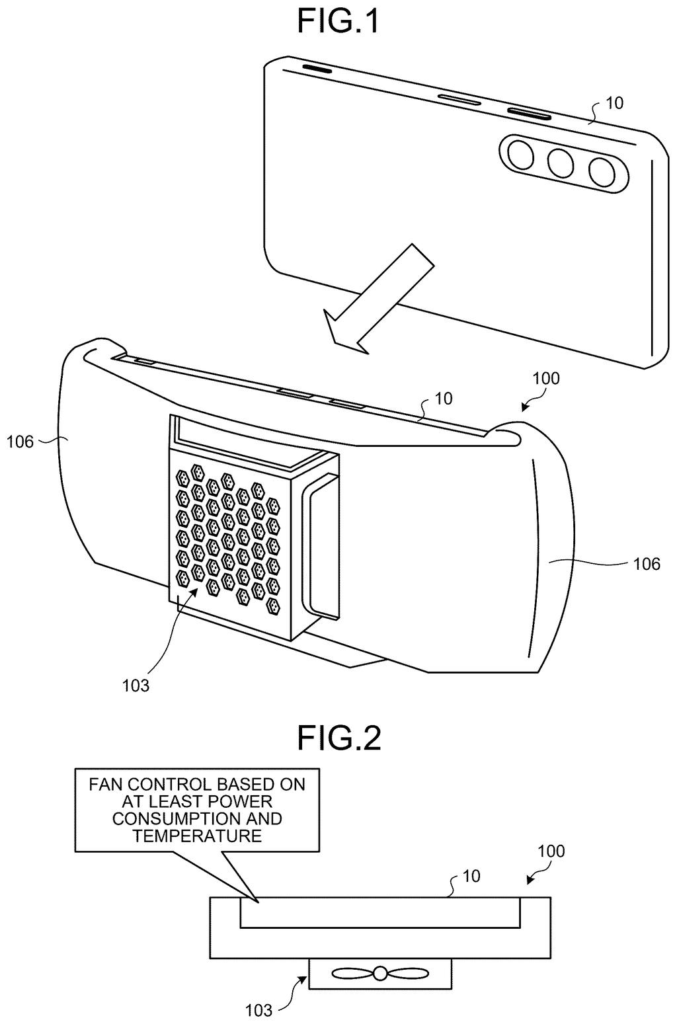
How Sony's phone fan accessory decides when to spin faster
Every modern smartphone has a self-defense mode: when the chip inside gets too hot, the phone automatically throttles its performance to cool down. For casual use, that's fine. But if you're playing a graphically intense game for an hour, the throttle can kick in right as the action peaks, and you get choppy gameplay and a phone that's still warm.
Sony's filing describes a detachable fan accessory that attaches to the back of a smartphone, with built-in grip handles so you're not directly touching the hot body of the phone. The key idea is how the fan decides its speed: instead of only reacting to temperature (which rises slowly), it also watches how much power the phone is drawing moment to moment. Heavy game scene loading? The fan ramps up before the heat even arrives.
The filing also covers a mode where having the fan attached raises the temperature threshold at which the phone starts throttling itself, since active cooling means the phone can safely run harder without damage. Users can also flip a "silent priority" or "low power" mode to keep the fan quieter or save battery.
a control unit that controls a rotation speed of the air cooling fan based on at least a temperature and power consumption of the information processing apparatus.
Translation: The fan automatically adjusts its speed by monitoring how hot the device gets and how much battery it uses.
How the controller combines power draw and heat into one fan speed
The core invention is a fan-speed control system that runs two parallel calculations at all times and acts on whichever one demands more cooling.
Power-draw calculation: The controller reads the phone's voltage and current sensors continuously, calculates actual power consumption in watts, then smooths that number over a rolling average (the filing suggests a per-minute window). Smoothing matters because games cause wild swings in power draw, a rapid camera pan or explosion effect can spike consumption briefly without actually building dangerous heat yet. The moving average catches sustained load rather than momentary spikes, then maps that average to a fan speed level.
Temperature calculation: Separately, the system reads temperature sensors placed around the phone (CPU area, battery, display) on a cycle of several minutes and maps those readings to a fan speed level using a lookup table. At 29°C the fan might be at level 1; at 36°C it steps to level 3.
The decision rule: The controller takes whichever of the two calculated speed levels is higher and uses that to command the fan. If power draw is spiking but the phone hasn't heated up yet, the fan pre-emptively spins faster. If the phone is already warm from a long session but current power draw is low, temperature wins.
Hysteresis control (a deliberate delay before slowing down) prevents the fan from hunting back and forth between speeds when load fluctuates. The system also adjusts fan behavior based on what app is running: games get the most aggressive cooling profile; non-game apps and screen-off states get quieter, more relaxed settings.
What this means for gaming phones and clip-on accessories
For people who play mobile games for extended sessions, phone throttling is a real annoyance. A fan that only reacts to heat is always playing catch-up: by the time temperatures rise enough to trigger a speed increase, performance has already dipped. Adding power-draw monitoring gives the fan a few seconds of lead time, which in theory keeps the chip running at full speed more consistently.
The detachable design is worth noting for what it signals about Sony's product direction. The filing explicitly describes a clip-on accessory with grip handles, USB connectivity to the phone, and the ability to pass through power from an external charger, so the phone can stay plugged in during play without bypassing the fan. Whether that becomes a product in the Xperia line or stays on paper, the architecture here maps directly onto the gaming-peripheral market that brands like Razer and ASUS have been building in for years.
Sony's 12th cell phone filing we've tracked since May follows ideas like a battery charging alert and paying for games via controller.
Claim 1 covers any portable device with a cooling fan where the fan's speed responds to both temperature and power consumption together. That pairing is the entire boundary: a product that uses only temperature, or only power consumption, falls outside it, but anything using both signals to set fan speed falls inside.
That scope has real consequences. Power consumption tells you how hard a device is working before heat has had time to build up, so a fan reading both inputs can respond earlier and more precisely than one chasing temperature alone. Claim 1 locks up that combined logic at the category level, not just one way of implementing it.
The dependent claims layer in specifics like steady fan speeds across small fluctuations and per-app behavior profiles, and those details reflect genuine product thinking. But Claim 1 is what determines who else can build in this space at all.
Get our take in your Top Stories
Liked this breakdown? Add Patentlyze as a preferred source on Google, and our plain-English take shows up more often in your Top Stories the next time Sony patent news breaks.
There are more where this came from
We read every patent application Big Tech publishes and send you the ones worth knowing. Plain English, free, every week.
The drawings
14 drawing sheets from US 2026/0319557 A1 · click any drawing to enlarge


Show the other 6 sheets


Want this weekly breakdown for a company we don't cover? Patentlyze Pro →
Be the first to weigh in