
Google Files Patent for a Shortcut That Ranks Millions of Ads Before You Search
Google's ad-serving systems score each item using a random ID tag that says nothing about what the item looks like. This patent trains a second model to guess those scores from the content itself, then uses it to pre-rank huge piles of ads and images before anyone searches.
What Google's ad pre-ranking model actually does
Every time a page loads or you run a search, Google has a split second to pick which ad or other piece of content to show you. Choosing well means scoring lots of candidates, and scoring eats computing power. With AI now able to churn out millions of new versions of images and text, the pile of candidates keeps growing.
This patent describes a cheaper stand-in. Google's current scoring system leans on a random ID tag stamped on each item when it is uploaded, and that tag says nothing about what the item actually looks like. So the patent trains a second model that never sees the tag. It judges items by what is in them, such as colors, layout and wording, and learns to give nearly the same scores as the original.
Once trained, the stand-in can rank enormous piles of content ahead of time, while nobody is waiting. When your request arrives, the original system only has to check a short list instead of the whole pile.
… training an offline evaluation model to generate an offline output that approximates an online output of an existing online production model, wherein the existing online production model is configured to generate the online output using at least one input parameter that is not used by the offline evaluation model to generate the offline output …
Translation: Google is building a cheaper copycat AI that mimics the company's real time ad ranking system without needing all the same data.
How the offline model learns to mimic the online one
Google's existing online model scores each candidate item (an image, text, video, often an ad) when a request comes in. It relies on an ID tag assigned at upload, plus logged history such as past clicks. The patent trains an offline model (one that runs ahead of time, with no user waiting) to reproduce those scores without the ID tag or the history tied to it.
Training works like this:
- Collect a set of items and a batch of past search queries, for example the previous month's top million.
- Pair every query with every item. With 1,000 images, that means 1,000 pairs for each query.
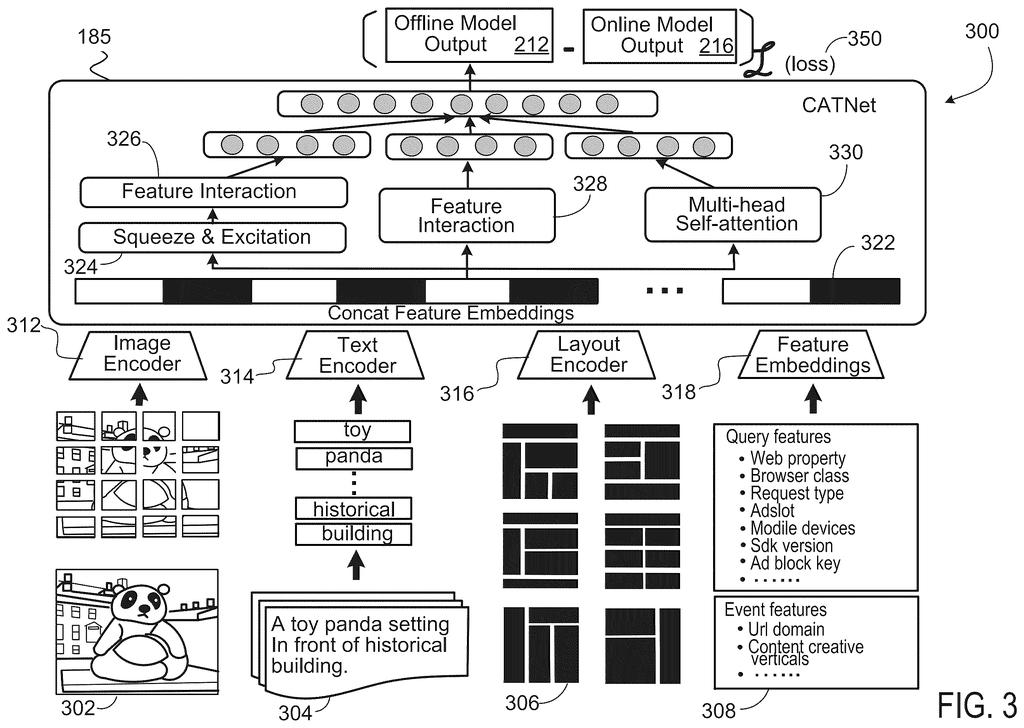
- Turn each item's image, text, layout and query details into embeddings (lists of numbers that capture meaning) and join them together.
- Let the offline model score each pair, compare its score to the online model's score, and adjust its feature weights (the dials that decide how much each clue counts) until the gap is small.
Afterward, the offline scores pre-rank items so the online model only checks around 20 candidates instead of 1,000 or more. The filing also describes scoring combinations, such as a text scored 0.6 and an image scored 0.8, by averaging or weighting their scores.
The scores can also flow back to a generative AI tool, which learns which features tend to rank higher and stops making content that would score poorly.
Why Google wants a cheap stand-in for its ad ranker
The practical payoff is speed and cost. The filing says content must be chosen in less than a second, and slow choices can leave blank spots on a page or deliver content after you have already moved on. Checking about 20 candidates instead of thousands cuts that risk and trims the computing bill behind it.
It also helps with brand-new content. A freshly uploaded or AI-made image has no click history, so the current approach is weak on it. A model that judges by what is inside the item can score it right away. As AI produces millions of variations in minutes, the filing argues that running them all through the full system stops being practical. For you, the effect could be mostly invisible: pages that fill in a little faster, with less wasted computing behind them.
Google's 106th filing in the Language AI patents we cover since May follows earlier applications like an AI news impact analyst and a deep research search tool.
Every shortcut costs accuracy, and this one is no different. The stand-in model only copies what the main system would have said, so any blind spot or bias in the main system gets copied too. If the stand-in wrongly scores a good item low, that item never makes the short list, and the main system never gets the chance to rescue it.
The filing also admits that training the stand-in takes serious computing power up front. The bet is that you pay once and save on every request afterward, which sounds like a fair trade at Google's scale.
The riskiest piece is the feedback loop into AI content makers. Telling a generator to make more of whatever the scorer likes can nudge everything toward the same look. Still, for plumbing that stays out of view, trading a little accuracy for a lot of speed reads as worth it.
Get our take in your Top Stories
Liked this breakdown? Add Patentlyze as a preferred source on Google, and our plain-English take shows up more often in your Top Stories the next time Google patent news breaks.
There are more where this came from
We read every patent application Big Tech publishes and send you the ones worth knowing. Plain English, free, every week.
The drawings
5 drawing sheets from US 2026/0320374 A1 · click any drawing to enlarge


Want this weekly breakdown for a company we don't cover? Patentlyze Pro →
Be the first to weigh in