
Disney Patents an AI That Designs Custom Character Mugs, Then Checks Its Own Work
Search a Disney shop for a mug with characters from two different movies and you might get nothing. This patent application describes AI that would design one for you on the spot, then check it against the studio's own character rules.
What Disney's custom-merchandise AI actually does
Imagine typing 'a lunch box with my favorite princess' into a shop's search bar and getting back a design nobody at the company ever drew, built around you. That is the idea in this Disney patent application.
Today, custom merchandise usually means picking from a menu of colors or uploading your own photo. Disney's filing describes AI that comes up with many ideas using your location, past purchases and the shows you've watched. It then paints pictures of the best ones and writes the product descriptions.
Before you see anything, a second round of AI checks each design for drawing mistakes, like a character with an extra arm, and for whether it follows Disney's rules about how a character may look and behave. You can then react ('make her bigger,' 'something cheaper') and the system tries again.
generating, via one or more machine learning models based at least on information associated with a user, candidate product data …
Translation: An AI creates personalized merchandise ideas using data about the buyer.
How one AI dreams up designs and another vets them
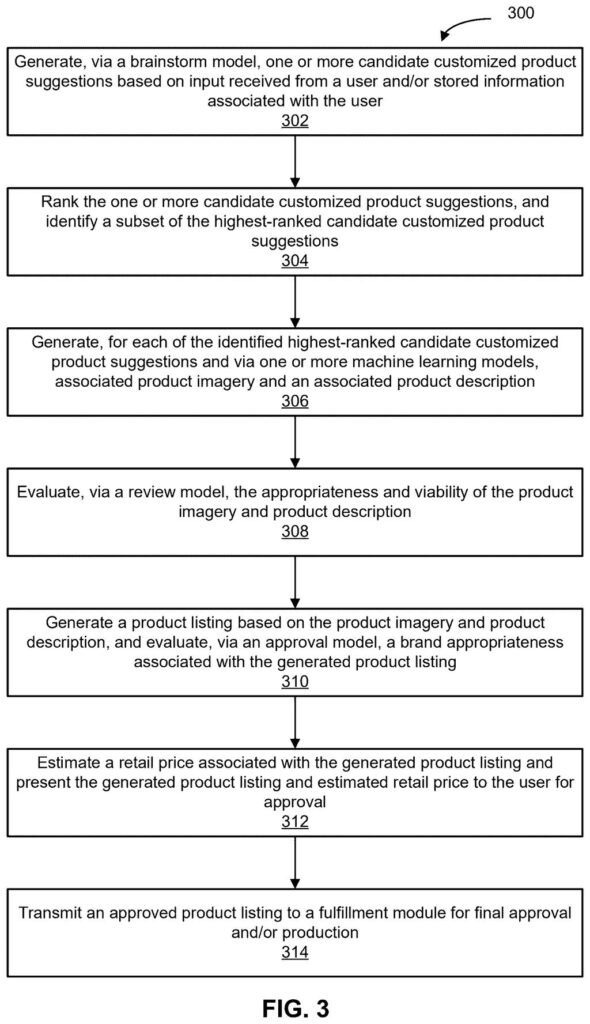
The system is a chain of AI models, each with one job. It first gathers what the shop knows about you (region, past purchases, favorite characters, shows you've watched) plus anything you typed. It turns that into a prompt for a brainstorm model, an AI text generator that proposes product and design pairings, such as a blanket with a particular character.
The rest of the chain:
- Ranking: scores each suggestion on predicted popularity, profit, relevance and price, using how similar past products sold, and keeps the top group.
- Image and description: a diffusion model (an AI image generator) places the design on the product, and another model writes the listing text.
- Review: flags designs that don't fit the product's surface, characters with missing or extra limbs, or text that describes a mug as if it were fabric.
- Approval: a multimodal model (AI that reads images and text) compares the listing with 'character bibles,' brand documents spelling out what each character may or may not do.
- Pricing: estimates a retail price from similar existing products.
Rejected designs go back to the brainstorm model as feedback. Approved ones reach you, and your reactions trigger another round. A human supervisor can step in at several points. The claims cover the core idea: one set of models generates suggestions, images and descriptions, and a second set filters them against evaluation criteria.
… determining, via one or more additional machine learning models based on the candidate product data, at least a subset of the one or more candidate customized product suggestions that meets a set of evaluation criteria …
Translation: A second AI reviews the designs to see if they pass quality standards.
Why Disney wants merch that no one drew by hand
If this ever reached a shop website or in-store kiosk, searching for a product would stop being a lookup in a fixed catalog. Ask for a mug with characters from two different stories and you could get a mock-up and a price on the spot, instead of an empty results page. Designs you like could also be added to the store's inventory for other shoppers.
For Disney, the commercially interesting part is control. Rules about how characters look and behave have to survive automation, and the filing builds that into the pipeline with an approval step and optional human sign-off. The patent describes a design. It does not say Disney has built it or plans to.
Disney's fourth Language AI filing we've tracked since July builds on earlier work, including a search system that splits questions and plain-language database queries.
The problem is easy to picture. Search a Disney shop for a mug with characters from two different movies and you may get nothing, because every product on the shelf was drawn, reviewed and approved by people first. That manual pipeline caps how many designs can exist.
The filing goes after that cap directly, and the fix matches the size of the problem. Generating thousands of ideas is cheap. Deciding which ones are safe to sell has always been the costly part, so most of the filing's effort goes into that gate: a ranking step for likely sales, a review step for drawing flaws, an approval step built on character rules, and an optional human supervisor.
The open question is whether an AI reviewer can catch the subtle mistakes a brand cares about, like a character doing something out of character. The patent describes the checks and reports no results, so the design is sensible and the proof is still missing.
Get our take in your Top Stories
Liked this breakdown? Add Patentlyze as a preferred source on Google, and our plain-English take shows up more often in your Top Stories the next time Disney patent news breaks.
There are more where this came from
We read every patent application Big Tech publishes and send you the ones worth knowing. Plain English, free, every week.
The drawings
4 drawing sheets from US 2026/0311236 A1 · click any drawing to enlarge


Want this weekly breakdown for a company we don't cover? Patentlyze Pro →
Be the first to weigh in