
Google Files Patent for an AI That Looks Up Facts Without a Second Model
Google's AI could stop passing your question to a second system every time it needs a fact. This patent application folds the searching and the answering into one model that does both.
What Google's single lookup-and-answer model does
You ask your phone, "Where can I get tacos for dinner tomorrow night?" Behind the scenes, the AI that writes the answer often has to stop, hand your question to a different AI that searches for restaurants, and wait for the results to come back. That handoff takes time.
Google's patent application folds both jobs into one model. When the writing half hits a gap in what it knows, it drops in a special marker that means "I need more information." The built-in search half then pulls up relevant documents, such as nearby taco spots with their menus and reviews, and feeds them straight back in.
Because everything happens inside a single system, nothing has to be rewritten into a new request or re-read from scratch. The goal is a quicker reply and a smaller model, so the answer on your screen shows up sooner.
… determining whether the one or more output tokens includes a need to retrieve (N-t-R) token, wherein the N-t-R token indicates the generative portion of the NatRAG model requires additional information; …
Translation: The AI checks its own work to see if it needs to look up missing facts.
How the model signals it needs more facts
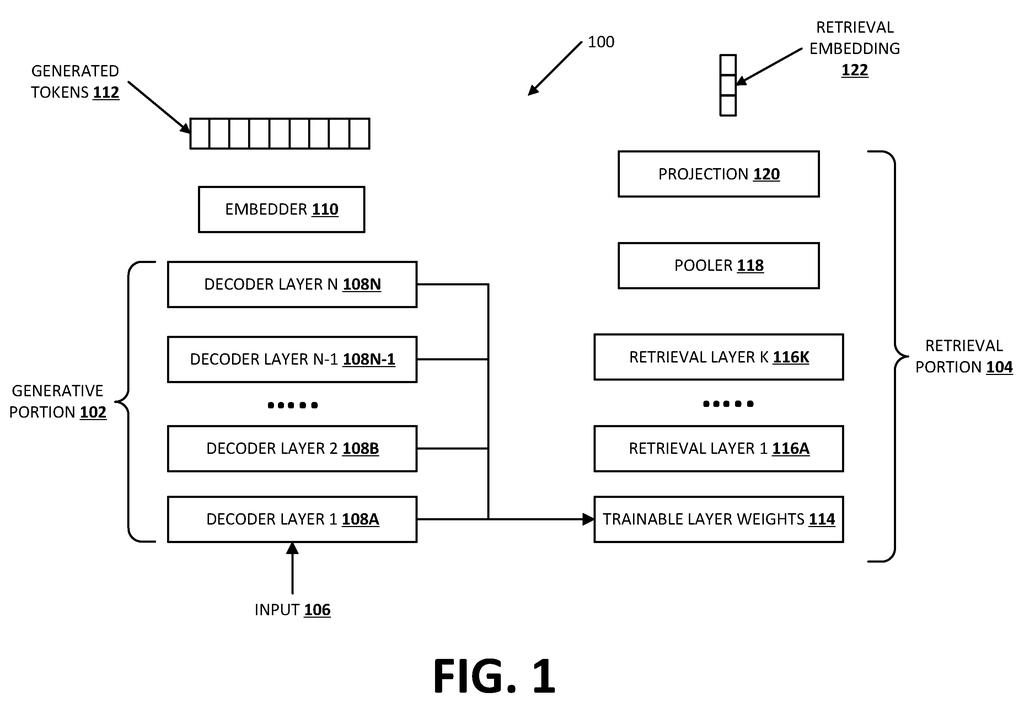
The filing describes a native retrieval augmented generation model, or NatRAG. Retrieval augmented generation (RAG) means a chatbot looks up outside information, like current news, before it answers. Today that usually takes two separately trained models: one to write and one to search. NatRAG combines them into one.
The writing half is based on a pre-trained decoder-only model (the common kind of language model that produces text one small chunk, called a token, at a time). Its core attention settings are frozen, meaning they are not changed during training, so the model keeps what it already knows. The search half adds trainable layer weights, learned numbers that set how strongly the model's internal layers are blended together.
The process works like this:
- The writing half generates tokens until it produces a need to retrieve (N-t-R) token. This token says more information is needed but does not spell out what to look for, so no separate search request is written.
- The search half reads the writing half's internal layers, condenses them through pooling and projection layers, and identifies relevant documents in an index.
- Tokens from those documents are appended to the cached input, so the earlier text is not re-encoded.
- If another N-t-R token appears, the loop repeats.
The index can hold text, emails, spreadsheets, audio, video and more. The final output can be shown as a reply or used to trigger another action on the device.
Processing involves generating NatRAG input, processing it with the generative portion to produce output tokens, and determining if a “need to retrieve” (N-t-R) token is present.
Translation: The system generates text and triggers a search when it hits a knowledge gap.
Why one model could make AI answers arrive faster
If you use an AI assistant to answer questions that need fresh or personal information, the wait between asking and getting a reply is the part you feel. The filing says its main aim is to cut that delay by sharing work between searching and writing, and to shrink the overall model size by merging two models into one.
The filing lists phones, tablets, laptops, cars, watches and glasses as places this could run. A smaller, faster model matters most on those devices, where memory and battery are limited. For Google, whose assistants depend on looking things up, shaving time off every lookup adds up across a huge number of queries.
Google's 28th filing we've tracked since May in our AI teams working together watch builds on ideas like grading each AI search and AI-built targeted ads.
The ship path here is short. It needs no new hardware, only software: a language model that already exists, a retrieval half trained to sit on top of it, and an index of documents to search. The filing describes freezing the original model's core settings, which suggests the new part can be added without retraining everything from scratch.
What has to exist first is the training work. The filing explains the design and promises lower waiting times, but it gives no speed measurements, so the benefit is a claim on paper for now. Someone has to build it, train it, and check that answers stay as good as the two-model setup.
If that checks out, the shortest route to a product is a behind-the-scenes swap inside an assistant or search feature you already use. You would notice only that answers arrive faster. That makes this a sensible engineering patent with a believable path to your phone, and one you would probably never see announced.
Get our take in your Top Stories
Liked this breakdown? Add Patentlyze as a preferred source on Google, and our plain-English take shows up more often in your Top Stories the next time Google patent news breaks.
There are more where this came from
We read every patent application Big Tech publishes and send you the ones worth knowing. Plain English, free, every week.
The drawings
7 drawing sheets from US 2026/0310702 A1 · click any drawing to enlarge


Want this weekly breakdown for a company we don't cover? Patentlyze Pro →
Be the first to weigh in