
Nvidia Files Patent for Mapping Robot Routes by Treating the Floor Plan Like a Photo
Before a warehouse robot can plan a route, someone has to decide where its stopping points go. Nvidia's filing does that by treating the robot's map like a photo and running image-processing steps on it.
What Nvidia's robot route-map patent actually does
You're standing in a big warehouse, and a delivery robot needs to get from the loading dock to a shelf on the far side. It can't think about every square foot of floor at once, so it uses a route map: a handful of dots connected by lines, a bit like a subway diagram.
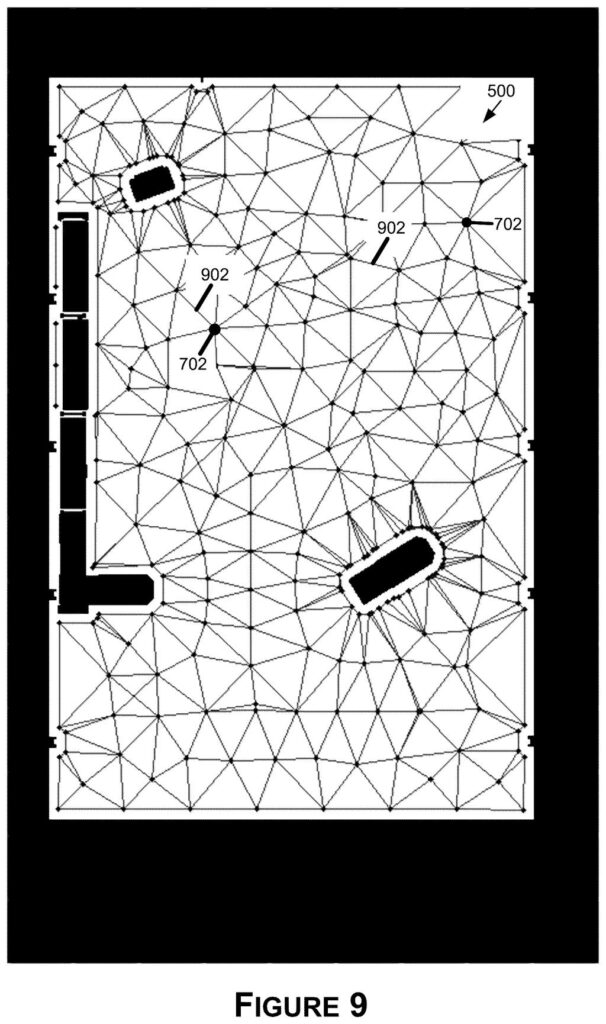
Nvidia's filing describes a way to build that map automatically. It starts with a picture of the floor plan, where obstacles show up as dark shapes. Dots go along the edges of those shapes first. Then the system hunts for the emptiest stretches of open floor, the spots farthest from any dot, and drops new dots there until nothing is left far from the network. Lines then connect nearby dots without clipping anything in the way.
A final cleanup merges dots that crowd together, so the robot has fewer choices to sift through and finds a route faster.
… positioning, based at least on the one or more first locations of the one or more first nodes, one or more second nodes of the waypoint graph at one or more second locations in the image corresponding to the one or more unoccupied areas …
Translation: It places navigation points in open areas based on where the walls and obstacles are located.
How Nvidia places route points on a map image
The input is an occupancy map (a top-down grid showing which spots are blocked and which are open), treated as a 2D image. The system first runs a distance transform (a calculation that gives each open pixel its distance to the nearest obstacle) and applies a safety threshold, which swells every obstacle by a buffer zone. The threshold can vary, with a bigger buffer near machinery or places people are expected.
Then it builds a graph (a set of nodes, meaning points, joined by edges, meaning lines) in stages:
- Nodes go on obstacle outlines, at corners and along long edges. The description also places nodes along a skeleton, a one-pixel-wide centerline thinned down from the open space.
- A second distance map measures how far each open spot is from the nearest node. Spots farther away than their neighbors (local maxima) get a new node if the distance beats a threshold. This repeats until no gaps remain.
- Edges come from Delaunay triangulation (a standard method that links nearby points into non-overlapping triangles), keeping only straight lines that avoid obstacles and respect the safety margins.
Cleanup removes isolated nodes and small disconnected clusters, and merges nodes that sit too close together into one while keeping their connections. The finished graph goes to the robots, which search it with pathfinding methods such as A* or Dijkstra's algorithm (classic ways of finding the shortest route through a network). It can also be shared across a whole fleet.
… analyze occupancy maps as 2D images to generate skeletons of free-space and obstacle contours, and strategically place nodes of the waypoint graph along these features.
Translation: The software treats a floor plan like a picture to automatically map out safe paths for a robot.
Why lean route maps matter for warehouse robots
If you've ever watched a warehouse robot pause or take an odd detour, route planning is part of the reason. A smaller, tidier route map means less to search, so robots can pick paths faster. The method also gives the same result every time, which the filing contrasts with random-sampling approaches that can produce different maps on each run. That predictability matters in spaces shared with people.
The filing says the same map can serve single robots, vehicles, or fleets coordinating on shared routes, and can be tested in simulation first, naming Nvidia's Isaac Sim among the options. Keep in mind this is an application: the examiner's first review rejected the claims as filed, which is routine at this stage and usually followed by amendments, so the final scope could shrink.
Nvidia's 52nd filing in robotics patents we cover since May follows indoor robot localization and maps that update in place.
Every shortcut in a route map costs something. By keeping only a few well-placed points, the robot gives up the near-perfect routes that checking every floor tile could find, so some paths will run a bit longer than they need to. The safety buffer adds another price: swelling every obstacle on the map could close off a tight doorway or narrow aisle that a robot could actually squeeze through.
The map is also a flat picture, so anything it misses, like a forklift that just rolled into an aisle, has to be handled by other software. The filing says as much, pairing the map with a second layer that reacts to surprises.
The trade looks sensible for warehouses, where repeatable routes matter more than saving a few feet. The steps use standard geometry, which makes this a routine piece of engineering with a sensible set of costs.
Get our take in your Top Stories
Liked this breakdown? Add Patentlyze as a preferred source on Google, and our plain-English take shows up more often in your Top Stories the next time Nvidia patent news breaks.
There are more where this came from
We read every patent application Big Tech publishes and send you the ones worth knowing. Plain English, free, every week.
The drawings
25 drawing sheets from US 2026/0318688 A1 · click any drawing to enlarge


Show the other 17 sheets


Want this weekly breakdown for a company we don't cover? Patentlyze Pro →
Be the first to weigh in