
Sony Files Patent for Putting Game Characters in Your Living Room
Sony's filing describes pulling two fighters out of a video game and standing them in your living room, with no changes to the game itself. Walk around them, and your controller even rewires itself so left still means left.
What Sony's living-room fighting game idea does
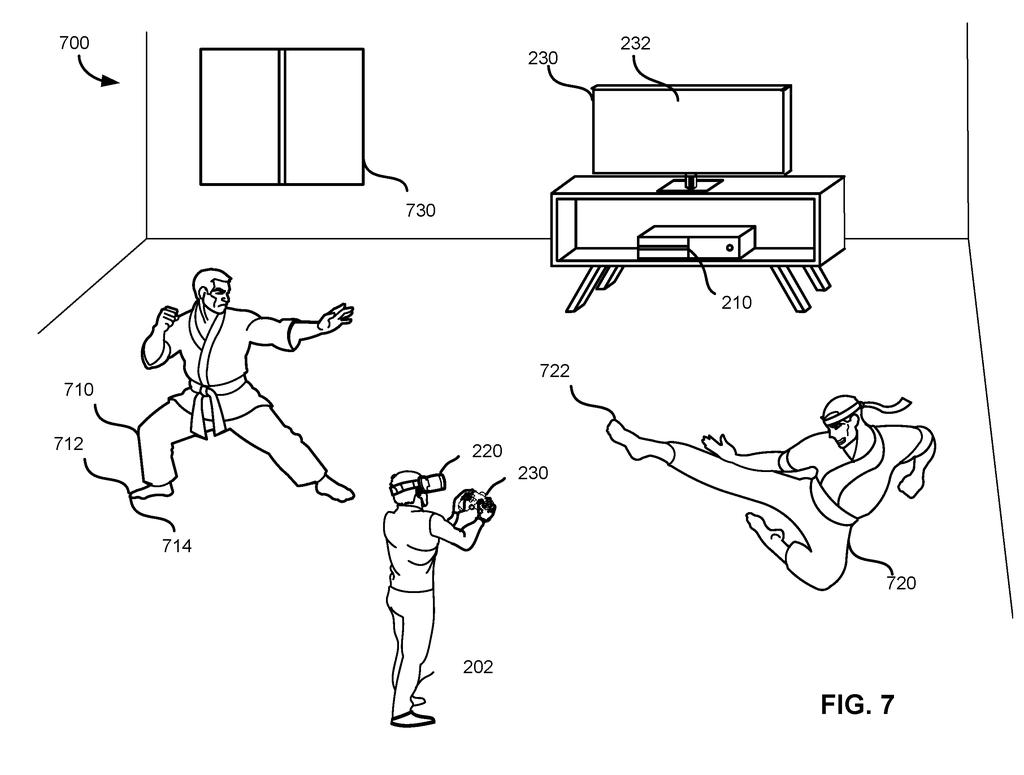
Right now, a video game lives inside your screen. The fighters, the arena floor, the walls and the ceiling are all drawn as one scene, and you watch it from a fixed camera angle. Sony's patent application describes a way to pull just the fighters out of that scene and stand them in your actual living room, seen through a headset or through the camera on a handheld device.
The game itself runs unchanged, on a cloud server or on your console. A piece of added circuitry watches what the game asks the graphics chip to draw and forwards only the characters (and things like boxing gloves) to your device. Everything else, such as the arena, gets thrown away, which cuts down the data that has to travel.
Walk around the fighters and a problem shows up: pushing your joystick left might suddenly send your character toward you. So the patent also describes rewiring your controls as you move, so left stays left from wherever you stand.
… if the API call is for at least one game asset in a first set of game assets, then, with the intercept circuit, transmitting the API call to a client device; otherwise ignoring the API call.
Translation: A special circuit watches game commands and only forwards specific character data to your headset.
How Sony's server picks which graphics to send
The filing bundles three related ideas, one per independent claim. The first is the server side. A game running in the cloud sends requests to a graphics chip, called API calls (for example, draw this 3D character). An intercept circuit (hardware or software sitting in that path) watches those requests. If a request is for an asset on a chosen list, such as a character's geometry, it is sent over the internet to your device. Anything else is ignored. The game never notices, so it needs no changes.
The second idea is the display side. Your device takes the received models and transforms them into an alternative space (the coordinate system of the room you are actually in), then renders and shows them. That space can be a headset's pass-through camera view or a handheld screen. The filing says characters' feet can be lined up with your real floor, and distances can shrink: fighters 6 meters apart in the game might be drawn 4 meters apart, with their speed scaled down to match.
The third idea is control remapping:
- A first function is mapped to a joystick or D-pad.
- The system tracks the arc you walk around the characters.
- Once that angle passes a threshold (the claims give 45 degrees as one example), the control gets a second function, so the same stick motion moves your fighter in a different direction.
The filing also describes optional extras, like AI-generated images of a window shattering over your real window.
An example can extract one or more characters or other 3 D models from an executing game program, transform them to an alternative space, and render them in the alternative space for viewing using an augmented-reality headset or other display device.
Translation: The system pulls 3D models out of a standard game so you can view them through an augmented reality headset.
What this means for headset and handheld gaming
If this idea reached a product, you could play an existing fighting game with the characters standing in your room, and because the game itself is not modified, older titles could work too. Sending only the characters from a cloud server also means far less data crossing your internet connection than streaming a full video of the scene.
The filing names a DualSense controller and a PlayStation Portal handheld as example hardware, with a headset as the main display it describes. The control remapping matters for anyone who has tried to steer something while walking around it. As with any patent application, nothing here says a product is coming.
Sony's 36th filing we've tracked since July in the AR glasses race connects to earlier applications like a headphone orientation fix and a laser lens dimming idea.
Most of this filing is invisible plumbing. You would never see the intercept circuit. You would only notice that an old fighting game suddenly has two fighters standing between your couch and your TV.
The detail you would actually feel is the control remapping. Take a quarter turn around your fighter with a normal setup and pushing left sends them toward you, which would be frustrating within a minute. Rotating the controls as you move fixes that before you ever run into it.
The catch is scope. The filing leans on fighting games, where two characters stay on a single line, because that keeps the data small and keeps fighters from walking through your furniture. Games with lots of scenery to interact with would ask much more of this idea.
Get our take in your Top Stories
Liked this breakdown? Add Patentlyze as a preferred source on Google, and our plain-English take shows up more often in your Top Stories the next time Sony patent news breaks.
There are more where this came from
We read every patent application Big Tech publishes and send you the ones worth knowing. Plain English, free, every week.
The drawings
15 drawing sheets from US 2026/0315916 A1 · click any drawing to enlarge


Show the other 7 sheets


Want this weekly breakdown for a company we don't cover? Patentlyze Pro →
Be the first to weigh in