
Sony Files Patent to Fix Headphones That Lose Track of Where You're Facing
Headphones that pin game sound to fixed spots around you slowly lose track of which way you're facing. Sony's answer is to treat a button press, or a glance at the screen, as proof you're looking straight ahead, and reset from there.
What Sony's headphone drift fix actually does
A player sits on the couch in a pair of headphones, and a gunshot in the game sounds like it's coming from the left side of the TV. She turns to answer a friend, checks her phone, then turns back. Now the gunshot sounds like it's coming from somewhere off the edge of the screen.
That's drift. The tiny motion sensors in headphones slowly lose track of which way you're facing, so sounds that are supposed to stay pinned to the screen start to wander. One known fix is a magnet, but a magnet near a console or TV can add noise or even stop it working.
Sony's patent skips the magnet and watches what you do instead. When you press a button, the system assumes you're looking at the screen. If the headphones think you're only a few degrees off straight ahead, it resets them to exactly straight ahead.
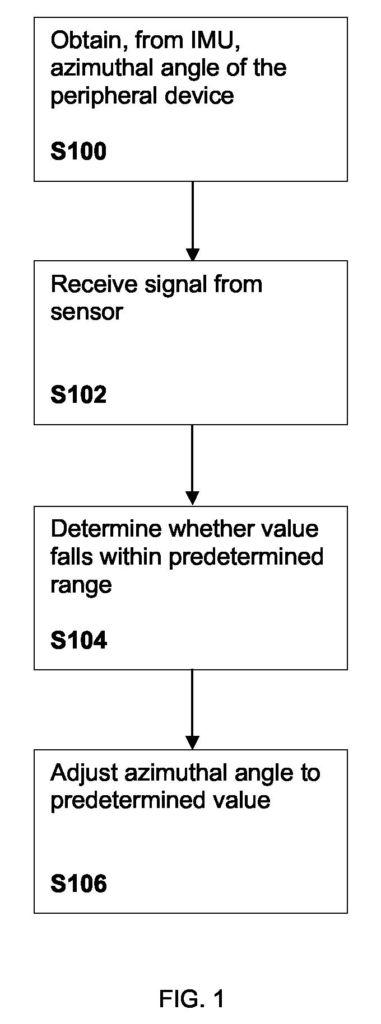
obtaining, from the IMU, an azimuthal angle of the peripheral device; receiving a signal from a sensor, the signal being generated by the sensor in response to user interaction with media content; …
Translation: The system tracks your head direction while you interact with your media.
How a button press or screen glow resets the angle
The patent describes a method where a console or computer reads the azimuthal angle (how far left or right a device is turned, also called yaw) from an inertial measurement unit, or IMU (a small chip with accelerometers and gyroscopes that tracks motion). The IMU can sit in headphones, earphones, a game controller, a phone and similar gadgets. The correction runs in four steps:
- Read the current angle from the IMU.
- Wait for a signal that you're engaging with the content, such as a button press or a light sensor picking up the screen's glow.
- Check whether the angle falls inside a preset range, for example -3 to +3 degrees from straight ahead.
- If it does, set the angle to the preset value, such as 0 degrees.
Because lamps and sunlight can fool a light sensor, the system can check the signal's color or brightness first. The filing also describes slipping a calibration frame (an image with preset colors) in after every N frames of video. At typical frame rates, each one flashes for 0.02 seconds or less, which the filing says viewers typically don't notice.
There are extra safeguards. The system can check that the device is barely rotating before resetting it. It can average recent readings, say the last 30 seconds, and shift the straight ahead baseline if your posture changes, for instance by 10 degrees. It can also ease the correction in gradually so the sound doesn't jump.
… adjusting the azimuthal angle to a predetermined value if the value falls within the predetermined range.
Translation: It snaps the directional tracking back to the correct place when you hit a specific control.
Why Sony's magnet-free fix matters for game audio
If you've used headphones that make sound seem to come from fixed spots around you, you know the effect works until it doesn't. The sound slides out of place and you have to recenter it by hand. This patent aims to fix that in the background, using moments you're already creating, like pressing a button. It also avoids magnets, which the filing says can degrade audio and video quality or stop a console or TV from working.
The claims cover headphones, earphones and bone conduction headphones, plus controllers, remotes, phones and laptops as the source of the trigger. The examiner's first review rejected the claims as filed, which is routine at this stage and usually followed by amendments, so the final scope could be narrower than what's published.
Sony's 35th filing we've tracked since July in the AR glasses race adds to a run that includes a dimming laser lens and a camera-tracked controller headset.
Of everything in this filing, the button-press version sits closest to something you could ship. Headphones with motion sensors already exist, and a console already knows when you press a button. The filing itself says the method can run on conventional hardware with software changes, so the shortest route is an update.
The light-sensor version has a longer road. Headphones would need a photodiode or camera, and games would have to insert those brief flash frames, which means the hardware maker and every game's display pipeline have to cooperate.
Verdict: a small, practical idea. People usually look at the screen when they press a button, and the few-degree window limits how much a wrong guess can throw things off. It won't change how you play, but it could save you from recentering your headphones by hand.
Get our take in your Top Stories
Liked this breakdown? Add Patentlyze as a preferred source on Google, and our plain-English take shows up more often in your Top Stories the next time Sony patent news breaks.
There are more where this came from
We read every patent application Big Tech publishes and send you the ones worth knowing. Plain English, free, every week.
The drawings
2 drawing sheets from US 2026/0319595 A1 · click any drawing to enlarge


Want this weekly breakdown for a company we don't cover? Patentlyze Pro →
Be the first to weigh in