
Sony Patents a Lens That Dims Eye-Projecting Laser Glasses Without a Filter
Most lens designs try to catch as much light as possible. A new Sony filing does the opposite on purpose, so glasses that beam images into your eye can skip the dimming filter.
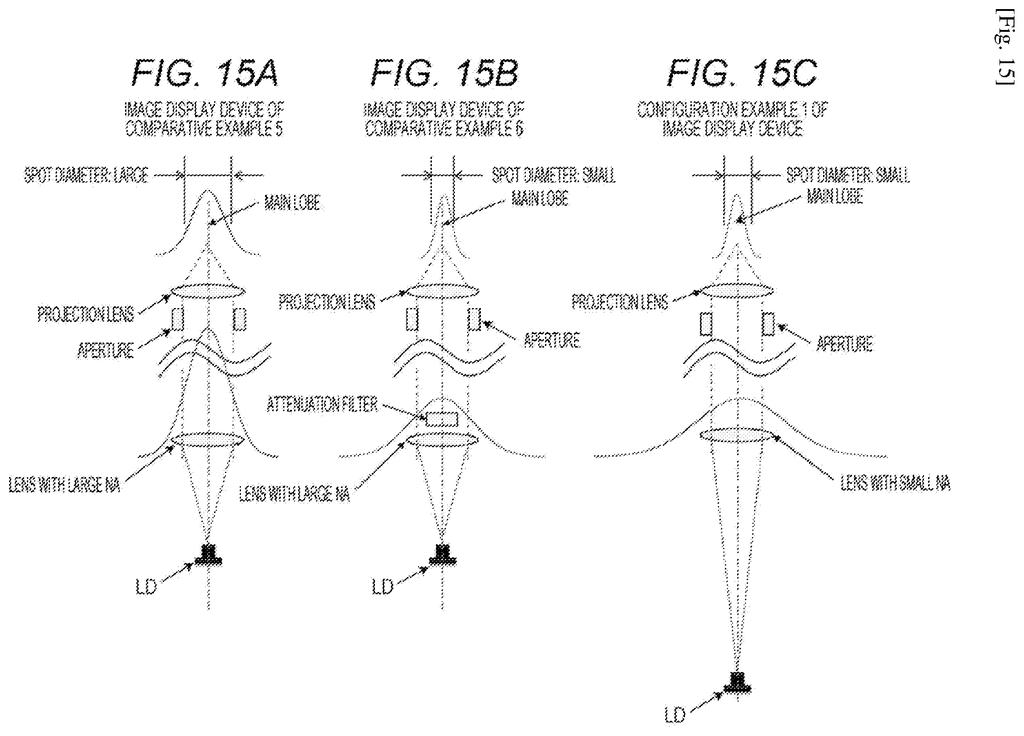
What Sony's weaker-lens laser display does
Imagine wearing glasses that paint a movie straight onto the back of your eye. The laser inside has to be bright enough to make a clear picture, yet gentle enough to be safe for your retina. The usual fix is to stick a dimming filter in front of it.
Sony's filing takes a different route. Instead of adding a part, it pairs a laser whose beam fans out widely with a lens that deliberately catches only some of that light. Most projector lenses are built to grab as much light as possible, so this flips the usual design goal.
In the example the filing gives, only about 8% of the laser's light made it through the lens, and the picture also came out sharper because the spot of light shrank. Fewer parts, less dimming, and a crisper image.
… wherein the lens has a numerical aperture of 0.16 or less, and wherein the light source has a radiation angle sum, the radiation angle sum being a sum of a first radiation angle measured with respect to a first direction and a second radiation angle measured with respect to a second direction orthogonal to the first direction.
Translation: The lens and light source must meet very specific mathematical limits for angle and aperture.
How the laser's spread and the lens opening interact
The patent covers a light source: a laser plus a lens in the beam's path. The lens has a numerical aperture (NA, a measure of how wide a cone of light it can catch) of 0.16 or less. The filing says lenses in projectors and optical drives typically run from about 0.17 up to 0.60, so this is a deliberately narrow lens.
The laser matters too. A laser diode's beam spreads at one angle in one direction and another angle in the direction at right angles to it. The filing adds the two together and calls the total the radiation angle sum. One independent claim sets it at 14 degrees or more, and other claims go to 23 degrees or more with an NA of 0.09 or less. According to the description, a wider spread plus a narrower lens lets less light through: 95% or less at 14 degrees, 80% or less at 22 degrees, and 50% or less at 37 degrees.
A second independent claim builds a full display: the light source, a part that forms the image (a scanning mirror, a digital mirror chip, or liquid crystal panels), and a projection system. A dependent claim adds an eyepiece that guides light into the user's eye.
The filing admits the tradeoffs:
- A narrow lens is touchier about alignment; an NA of 0.05 or more keeps the light change from misalignment to about 1%.
- It makes the device longer; an NA of 0.03 or more keeps volume to 4 times a reference design.
- It creates stray light, handled with an anti-reflective housing and an aperture.
Why this matters for glasses that project to the eye
If you ever wear a display that shoots light into your eye, you want the maker to have thought hard about brightness. This filing offers a way to hold the light down through the lens and laser choice alone. That means one fewer part to buy and fit in a pair of glasses where every millimeter counts. The description says the same idea suits projectors used in dark rooms, where there is no need for full laser power.
Sony says a sharper image is a bonus: a smaller spot of light means finer detail, without bigger lenses or extra optics. The catch is on the factory floor. Because a narrow lens is fussy about alignment, makers would need to position the laser and lens very precisely, and the filing steers designs away from the combinations where that is worst.
One more thing to know: the patent office has already approved this application. Once Sony pays the final fee, it should be issued as a granted patent, and the final claims may read a little differently from the version described here.
Sony's 34th filing we've tracked in the AR glasses race since July builds on earlier applications like tracking a controller with a camera and gesture control from a headset.
This one sits close to the factory floor. It needs no new chip or exotic material, just a lens and a laser picked to match, which an optics team could test on a bench with parts that already exist in projectors.
The hard part comes after. Glasses that put an image on your retina also need a tiny scanning mirror, an eyepiece and a frame to hold it all, and the filing shows those only as drawings. A narrow lens is also fussy about alignment and makes the device longer, so assembly would have to be precise at very small scale.
The shortest route to a product is the projector versions the filing describes, where cutting excess light helps in dark rooms. Eye-worn displays have a longer road. Either way, the idea works as a design rule that saves a part, so you would never see it on a feature list.
Get our take in your Top Stories
Liked this breakdown? Add Patentlyze as a preferred source on Google, and our plain-English take shows up more often in your Top Stories the next time Sony patent news breaks.
There are more where this came from
We read every patent application Big Tech publishes and send you the ones worth knowing. Plain English, free, every week.
The drawings
39 drawing sheets from US 2026/0310058 A1 · click any drawing to enlarge


Show the other 31 sheets


Want this weekly breakdown for a company we don't cover? Patentlyze Pro →
Be the first to weigh in