
Sony Patents a VR Headset With a Camera Pointed at Your Controller
Sony's idea is to track your controller from the one spot that always travels with you: your own face. A camera on the underside of the headset points down at your hands and follows them wherever your head goes.
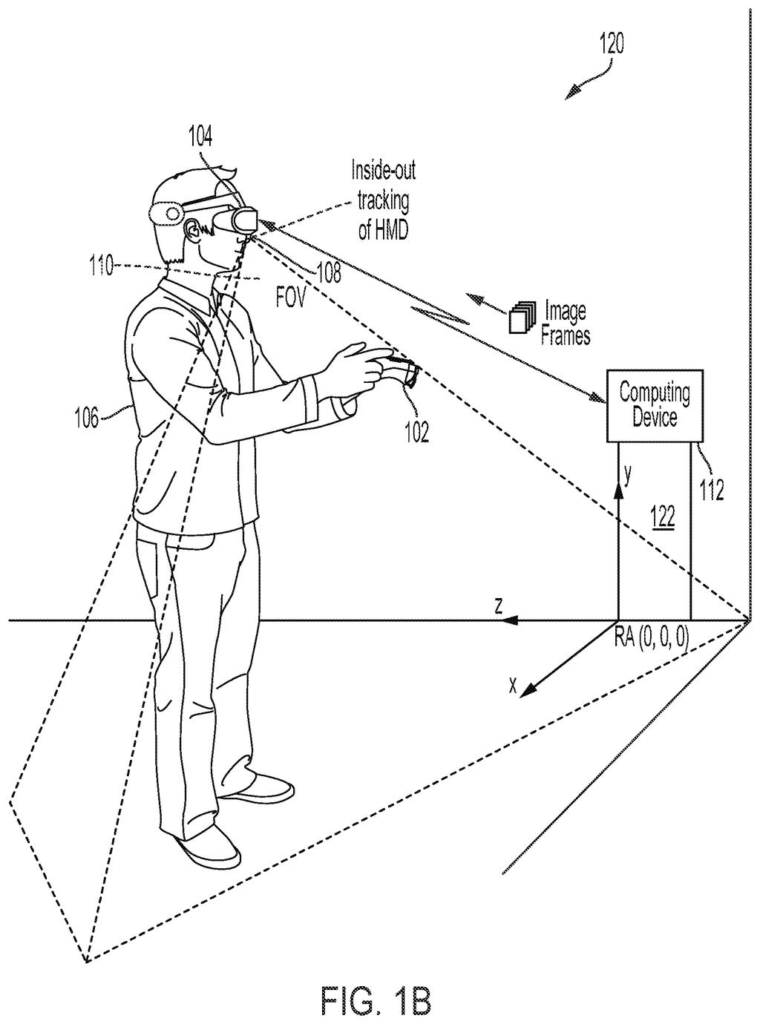
What Sony's downward-facing headset camera does
Imagine you're deep in a VR shooting game, aiming your controller low at your hip, when the game suddenly loses track of your hand because it slipped out of view of the camera across the room. Your virtual gun freezes and the moment is ruined.
Sony's patent application goes after that by putting a camera on the bottom of the headset, pointed down at where your controller usually is. Because the camera rides on your head, it moves with you and keeps looking at your hands. A second camera on the front of the headset adds another angle, and it also watches the room so the headset knows where you are standing.
The headset's view of the controller and its sense of your own position are combined, and the game reacts to both. The scene shifts as you move, and your aim follows the controller.
… a first camera, wherein the first camera has a first field-of-view (FOV) directed downward from the HMD and is configured to capture a first plurality of images of a hand-held controller (HHC) when the HHC is within the first FOV …
Translation: A downward facing camera watches the handheld controller.
How two headset cameras find the controller
The core claim covers a headset with two cameras that have different views. One sits in the lower region (the underside, below the screens) and points down, so it can see a hand-held controller when you hold it low. The other sits on the front of the headset and looks out from a different angle.
Pictures from either camera do two jobs:
- They show where the headset is and how it is moving through the room, based on the surroundings the cameras capture.
- They show the controller's orientation (which way it is tilted and pointing) relative to the headset.
The headset then displays scenes from an application, such as a game, that respond to both. In the description, the game runs on a remote cloud server, and the controller carries a light bar and a marker that make it easier to spot in the pictures. If the controller leaves every camera's view, the filing describes falling back on the controller's own motion sensors (a method called dead reckoning, which estimates where something is from its last known spot and its speed) until the cameras see it again.
The dependent claims add status lights on the headset, clocks synced between headset and controller, and microphones that locate where a sound comes from. Separate claims cover the same idea as a method and as stored software instructions.
The position and orientation of the HMD and the position and orientation of the HHC are used to change to state of an application executed on a game cloud.
Translation: Cloud games react to the exact positions of your headset and controller.
Why controllers could stay in view longer in VR
If you have ever watched your virtual hands freeze because you reached out of view of a camera, this is the problem the patent targets. A camera on the headset follows your head, so the controller stays in its view more of the time. The filing says it can capture movement at moments when a camera facing the headset from across the room cannot.
It also points toward setups with less gear in the room. The description shows the headset working out its own position from its own cameras, with no outside camera required. For you, that could mean less to set up in your living room and a game that keeps up when you swing a controller low or off to the side. The filing names Sony's DualShock controller and PlayStation Camera as examples, which hints at the PlayStation VR line.
Sony's 33rd filing we've tracked in the AR glasses race since July follows work on gesture camera control and fixing blurry lens edges.
Claim 1 is built around a specific hardware layout: one camera on the underside of the headset pointing down, plus a second camera on the front looking in a different direction. A headset with only one of those cameras would fall outside the wording as written.
Inside that layout, the claim is wide open. Either camera, or both, can be used to work out where the headset is and which way the controller is tilted, and the claim says nothing about how that math is done or where it runs. Cloud servers show up in the description, and add-ons like status lights and synced clocks sit in the dependent claims, but claim 1 needs none of them.
So the filing stakes out a camera arrangement and says little about the software. The idea is simple and sensible: put a camera where your hands tend to be. Whether it matters depends on whether headset makers adopt that layout, and this document alone cannot say.
Get our take in your Top Stories
Liked this breakdown? Add Patentlyze as a preferred source on Google, and our plain-English take shows up more often in your Top Stories the next time Sony patent news breaks.
There are more where this came from
We read every patent application Big Tech publishes and send you the ones worth knowing. Plain English, free, every week.
The drawings
29 drawing sheets from US 2026/0310286 A1 · click any drawing to enlarge


Show the other 21 sheets


Want this weekly breakdown for a company we don't cover? Patentlyze Pro →
Be the first to weigh in