
Samsung Files Patent for a Post-Crash Phone Screen That Gives Paramedics Your Medical Details
After a crash, your phone could show paramedics your allergies and hold back your full medical history until you reach the hospital. Samsung's patent application splits your health data into three tiers and opens each one to the right person.
What Samsung's crash-triggered QR code does
Every time paramedics reach a crash and find an unconscious driver, they're treating a stranger. They don't know about the drug allergy, the blood thinner, or the heart condition that could change what they do next. Putting all of that on your lock screen would help them, but it would also show your medical history to anyone who picks up the phone.
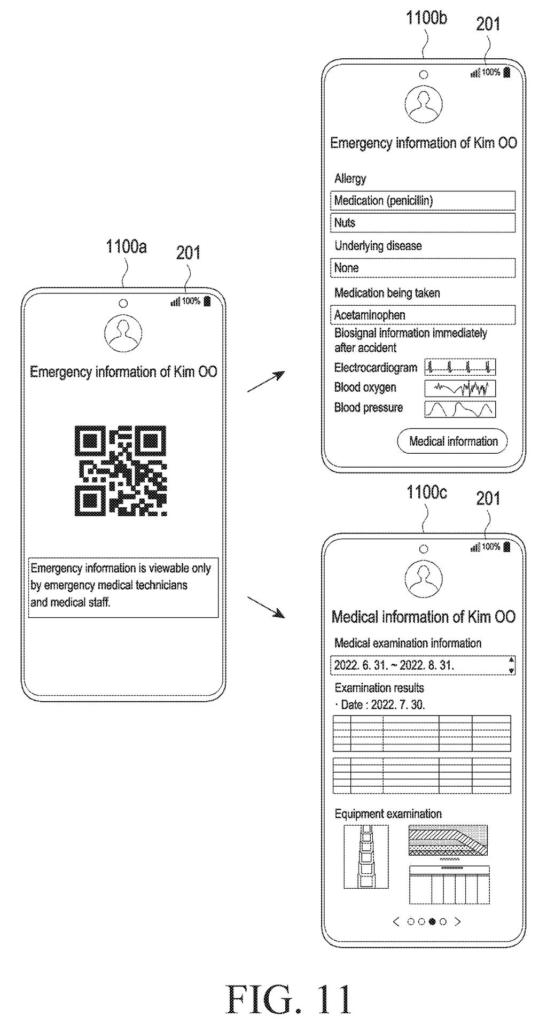
Samsung's filing tries to solve both problems. When your phone senses a crash, it puts a QR code on the screen. A paramedic scans it and proves who they are, and the phone shows only what their role allows. A paramedic sees things like your allergies and medications. Hospital staff, once you arrive, can see your full electronic medical records.
If you wear a smartwatch, it can check your heart rate and blood oxygen and call for help if something looks wrong. Both devices can show the same code, so rescuers know the phone and the watch belong to the same person.
display an indicator for providing status information of a user on the display, based on an occurrence of a vehicle accident being detected while monitoring a driving state of a vehicle using the at least one sensor …
Translation: After detecting a crash, the phone puts a special notice on the screen about the driver's condition.
How Samsung's three-tier access works
The phone first works out that you're in a car, using a Bluetooth link to the vehicle, GPS speed, or air-pressure changes when a door opens and closes. While you drive, it watches for a crash: a sharp jolt on the accelerometer (the sensor that feels sudden motion), GPS speed dropping fast, and a crash-like sound. A big air-pressure swing, like a window breaking or an airbag firing, counts too. GPS helps rule out false alarms, such as a ride at an amusement park.
Once a crash is detected, the phone shows accident details and an indicator, described mainly as a unique encrypted QR code (a URL or barcode also works). If a connected watch reports abnormal readings such as heart rate, blood pressure or blood oxygen, the phone places an emergency call.
The core of the claims is a disclosure level system, which decides what each person scanning the code can see:
- Level one: personal details like name, gender and height.
- Level two: health information you entered, such as conditions, medications and allergies, for emergency medical technicians.
- Level three: electronic medical records, such as test results and surgeries, for hospital staff.
The phone can also pick the level by working out whether you're being transported or have arrived at a hospital, using its sensors and GPS location. Rescuers verify themselves through keys issued by a server.
… in response to an access to the status information of the user in the vehicle by an external electronic device using the indicator, provide at least a part of the status information of the user …
Translation: When rescuers tap that notice with their own device, the phone shares the victim's medical details.
Why Samsung's QR code balances rescue and privacy
If this ever reaches a product, the change would show up on the worst day of your life. Your phone could hand a paramedic your allergies and medications within seconds of a crash, and later hand a hospital your full records, even if you can't speak. The filing describes health details that you enter yourself, with medical records coming from a medical institution's server.
For Samsung, the hardware pieces already sit in people's pockets and on their wrists: a phone with motion sensors and a watch that reads heart rate and blood oxygen. The patent links them into one emergency flow, from crash detection to the emergency call to the handoff at the hospital. The privacy design matters most, because people will only store medical details on a phone if they trust it to keep them private.
Samsung's 28th filing we've tracked since June in our on-device AI privacy watchlist follows its work on custom wake words and TVs that stop listening.
Unconscious crash victims can't tell anyone about a blood thinner or a drug allergy, and treating them blind can do harm. Phones already hold or can reach much of that information, so putting it within rescuers' reach is a sensible aim.
The second half of the problem is just as big. Nobody wants their full medical history readable by whoever grabs the phone at a wreck. Splitting the data into three tiers, and tying the top tier to hospital arrival, fits that tension well. A paramedic gets allergies, and a hospital gets the full chart.
The weak spot is logistics. The plan depends on rescuers having the right app and credentials, and on the phone surviving the crash. The filing does cover a phone that ends up away from its owner, by showing a matching code on the watch. Whether real ambulance crews would ever scan a phone is something the patent can't answer.
Get our take in your Top Stories
Liked this breakdown? Add Patentlyze as a preferred source on Google, and our plain-English take shows up more often in your Top Stories the next time Samsung patent news breaks.
There are more where this came from
We read every patent application Big Tech publishes and send you the ones worth knowing. Plain English, free, every week.
The drawings
18 drawing sheets from US 2026/0321125 A1 · click any drawing to enlarge


Show the other 10 sheets


Want this weekly breakdown for a company we don't cover? Patentlyze Pro →
Be the first to weigh in