
Google Files Patent for Phone AI That Uses Your Location but Hides It From Apps
Google's patent describes a phone service that feeds details like your location and calendar into AI models, then hands apps only the answer. The apps never see the raw details.
What Google's shared on-device AI service does
Ever wished an app could make a better guess about what you need, without also knowing exactly where you are and what's on your calendar? That is the tension this Google patent tries to settle.
Instead of every app carrying its own AI, a shared service built into the phone does the guessing. An app sends over its request. The service adds details about your situation, such as your location, the time of day, or whether you're plugged in, runs the AI model, and returns only the result. The app never gets to read those extra details.
The phone checks each app's permissions first, and every app gets its own walled-off space inside the service. Over time, the phone can also retrain these models on your own habits in the background, without shipping your data off to a server.
accessing an enclave on a computing device for implementing operations of an on-device platform for implementation of machine-learned models on behalf of an application operating on the computing device …
Translation: The system uses a secure hardware vault to run AI models for apps.
How the enclave keeps context away from apps
The patent covers a shared machine learning service built into a phone. Instead of every app bundling its own AI model, apps ask this on-device platform (a system-level program that runs models locally) for an answer. The model runs on the phone rather than on a remote server.
The core claim is about context. A context provider (a component that collects facts about the device's situation) adds details such as location, calendar, detected activity, Wi-Fi state, power connection or weather to the app's request before the model sees it. Those details stay inside an enclave (a walled-off area within the platform), so the app can't read them directly.
The claims describe this sequence:
- The app proves its identity and gets access to its own enclave.
- The app sends its data through the platform's interface.
- The platform checks the app has permission for each type of context.
- The context is added on the service side, the model produces an inference (a prediction), and only the output goes back to the app.
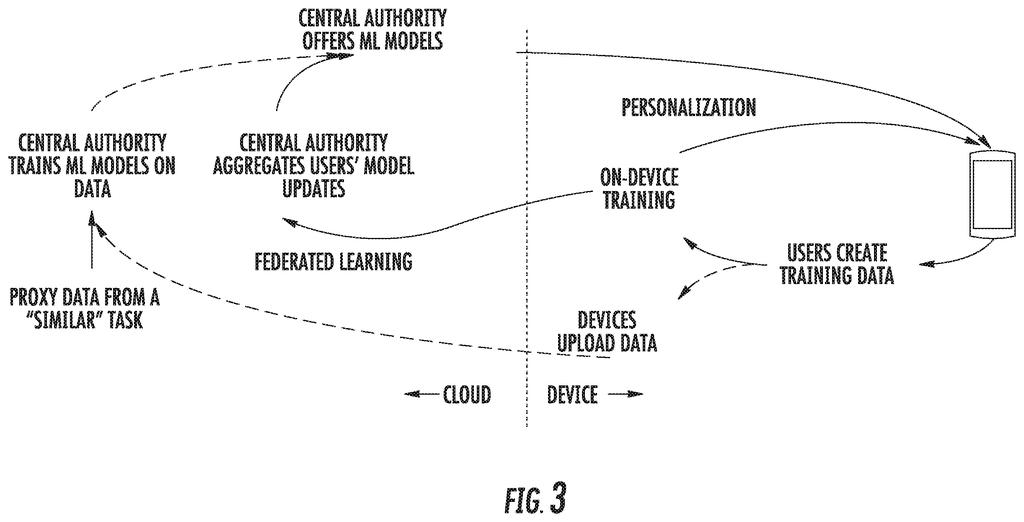
The filing also describes optional extras: storing training examples with context attached, retraining models in the background when the device is idle and charging, and sharing only model updates for federated learning (many devices improving one shared model without uploading personal data).
… context provider that securely injects context features into collected training examples and/or client-provided input data used to generate predictions/inferences …
Translation: Location and device details are fed into the AI without the app ever seeing them.
What this means for app privacy on your phone
For you, the practical upshot is that apps could make predictions that account for where you are or what you're doing, without each app holding that information itself. The filing says that if an app's permission changes, the platform can delete the stored context tied to that app and retrain the model on what remains.
For developers, the platform means no need to bundle and update their own AI engines, which the filing says keeps apps smaller and cuts update downloads. The filing is a division of an application first filed in 2017, and it names Android and says the platform could live inside the operating system itself.
Google's 56th filing we've tracked since May builds on earlier applications like turning off face recognition and ads chosen without your data, all part of our on-device privacy watchlist.
The cost of this design is visibility. Apps get answers without seeing the ingredients, so a developer can't easily tell why a prediction came out the way it did. When something goes wrong, they are debugging blind.
The platform also becomes the one place holding your location, calendar and activity, so a flaw there matters more than a flaw in any single app. Keeping context fresh has its own price: one mode needs an always-on service, and the filing itself weighs battery use between its two ways of fetching context.
Still, the trade reads as worth it. Giving up some developer insight to keep your location out of every app's hands is a fair price, as long as the permission checks hold up.
Get our take in your Top Stories
Liked this breakdown? Add Patentlyze as a preferred source on Google, and our plain-English take shows up more often in your Top Stories the next time Google patent news breaks.
There are more where this came from
We read every patent application Big Tech publishes and send you the ones worth knowing. Plain English, free, every week.
The drawings
9 drawing sheets from US 2026/0311067 A1 · click any drawing to enlarge


Want this weekly breakdown for a company we don't cover? Patentlyze Pro →
Be the first to weigh in