
Samsung Files Patent for a Projector That Takes the Keyboard and Pop-Ups Off Your TV Screen
Typing a password into a TV with arrow buttons is nobody's idea of fun. Samsung's patent has a projector throw the keyboard onto a nearby surface and read your finger taps instead.
What Samsung's touch-projector patent does
Ever tried typing a Wi-Fi password into a smart TV with nothing but arrow buttons? You hop from letter to letter, one slow click at a time, while a search box covers the movie you were watching.
Samsung's patent describes a fix. When a TV is linked to a projector, the TV pulls things like keyboards, search windows and pop-ups off its own screen, so your show keeps playing undisturbed. Those pieces get sent to the projector, which shines them onto a nearby surface such as a table or wall.
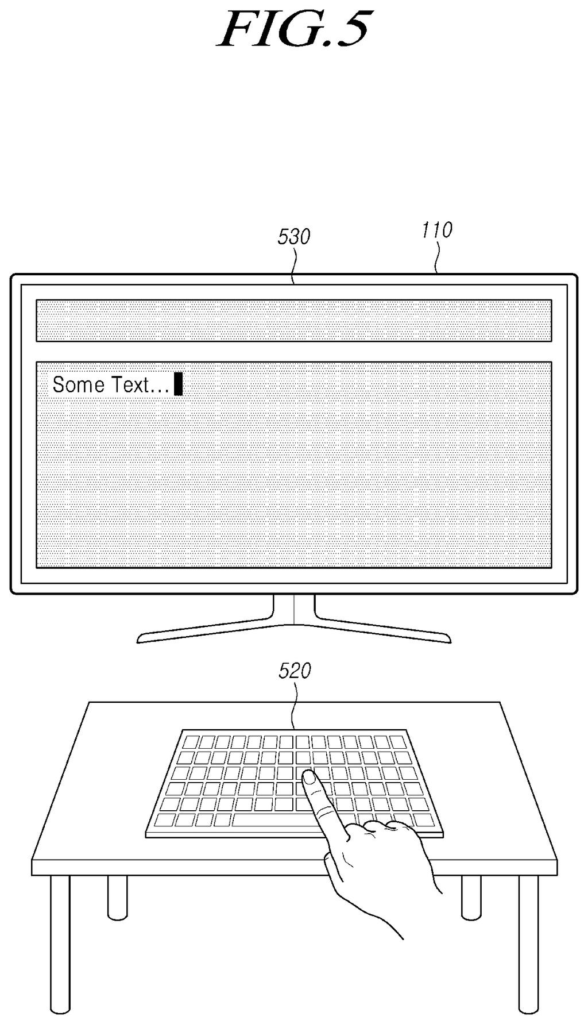
Then you just tap. A camera in the projector watches your finger, works out which key or button you touched, and sends that touch back to the TV. The TV reacts as if you had pressed the button on a remote.
determine whether at least one user interface object is included in a first output screen; based on the at least one user interface object being included in the first output screen, generate a second output screen except for the at least one user interface object from the first output screen …
Translation: The TV checks if there are pop-ups or keyboards on screen, then creates a clean version without them.
How the TV hands its menus to the projector
The patent covers two halves of one system: a display device (usually a TV, though the filing also lists phones, tablets and kiosks) and a projector. First, the display checks whether a projector is connected. If it is, the display looks at the screen it was about to show for user interface objects (on-screen controls such as a search window, a text box or a pop-up). It builds a second screen with those objects removed and shows that one. It then builds a third screen containing only the objects and sends it to the projector.
The projector shines that screen onto a surface. Its camera, which the filing says can include infrared, 3D or ultrasonic sensors, tracks your hand and judges how far your fingertip is from the surface. That tells it which object or key you touched. It then sends control data back to the display: touch coordinates, or a code for a specific key or button.
The filing also describes some variations:
- The TV can send its aspect ratio (the shape of the screen, such as wide 16:9 or tall 9:16) so the projected image matches.
- Instead of a finished picture, the TV can send short ID tags for each control, and the projector draws them itself.
- For typing, the TV can simply say "standard keyboard" and name a layout such as QWERTY, AZERTY or Korean. The projector draws it and reports which key you hit.
… project an image of the third output screen, obtain a touch input with respect to the third output screen, and transmit third control data corresponding to user touch input to the display device …
Translation: The projector displays that clean screen externally and sends your finger taps right back to the TV.
Why your TV remote might lose its job
The practical win is that your TV stops interrupting itself. Search boxes, keyboards and pop-ups would live on a separate surface, so the show keeps playing full screen while you type or browse. You also get a touch interface without walking up to a giant TV, and the filing points out that building touch into big screens is costly.
The catch is that you would need a projector near you and linked to the TV. That suits people who already own both, or a bundled setup. The filing names no product, and it is a patent application, so nothing here says it will ship.
Samsung's 398th filing in the Display topic we've tracked since May adds to work like hidden video wall markers and rollable screen lubricant sealing.
This sits close to shippable. The filing relies on parts a projector can carry today: a lens, a camera and a wireless chip. The trickiest piece, judging how close a fingertip is to the surface, uses a camera that the filing says can include infrared, 3D or ultrasonic sensors.
The shortest route to a product is mostly software: a TV update that sorts screen controls from the show, plus a projector with the right camera. The new work is that handoff, deciding what counts as a control and sending it elsewhere.
The hurdle is habit. Typing on a TV with a remote is annoying, yet the remote is already in your hand, and a projector has to sit on your coffee table and stay linked to the TV. Expect this to appeal to people who own both devices.
Get our take in your Top Stories
Liked this breakdown? Add Patentlyze as a preferred source on Google, and our plain-English take shows up more often in your Top Stories the next time Samsung patent news breaks.
There are more where this came from
We read every patent application Big Tech publishes and send you the ones worth knowing. Plain English, free, every week.
The drawings
10 drawing sheets from US 2026/0319658 A1 · click any drawing to enlarge


Show the other 2 sheets


Want this weekly breakdown for a company we don't cover? Patentlyze Pro →
Be the first to weigh in