
Qualcomm Files Patent for an Earbud Sensor That Hears Your Voice Through Bone
When you talk, your voice also shakes your head, and Qualcomm has filed for a sensor that listens to that shaking. The twist is a row of tiny diving-board-like beams, each tuned to a different pitch, that push on each other through trapped air.
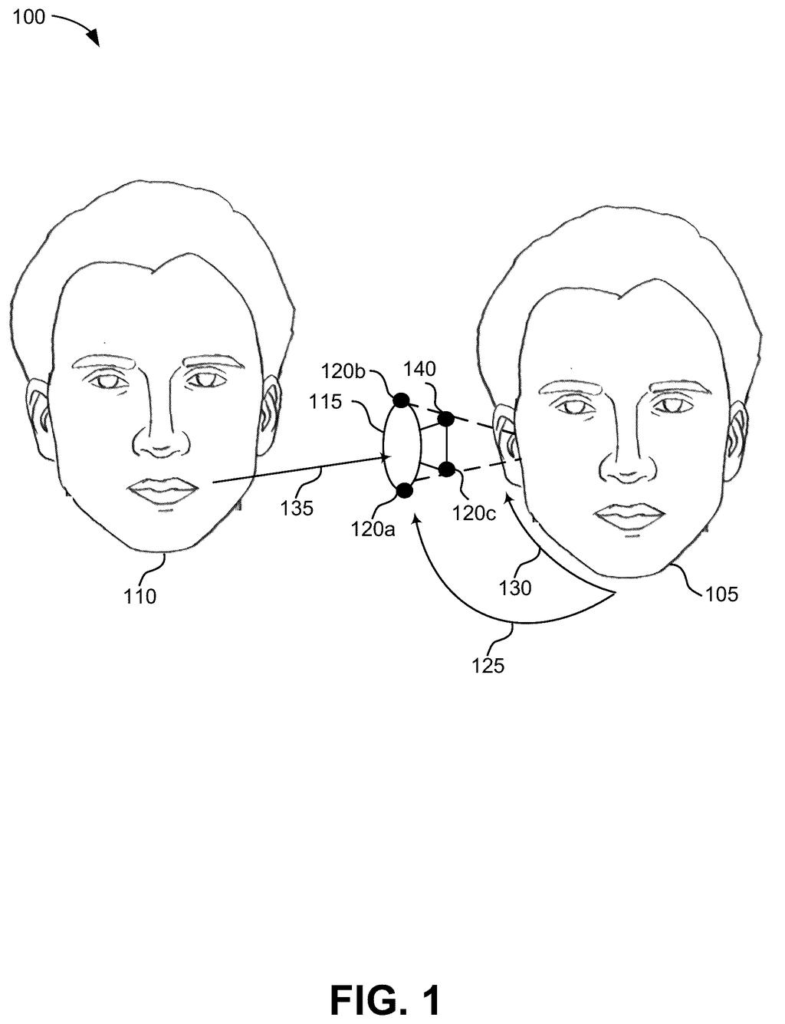
What Qualcomm's bone-conduction voice sensor does
Every time you take a call with earbuds in, your voice reaches the microphone two ways: through the air, along with traffic and chatter, and through the bones and soft tissue of your head. The second route is much cleaner, which is why some devices carry a voice accelerometer, a sensor that feels your voice vibrate instead of hearing it.
Qualcomm's filing goes after a weakness in the chip-sized versions of these sensors. Many existing designs use identical sensing beams tuned to one pitch, placed outside the range of the human voice, which can leave them less sensitive to the sound you actually want. Qualcomm instead tunes a row of tiny beams, a bit like diving boards of different lengths, so together they cover the voice range evenly.
The beams also sit so close together that the air trapped beneath them links their movements. That air link helps shape how the whole sensor responds.
… a back cavity enclosed by the plurality of sensing elements and a substrate of the voice accelerometer, wherein a volume of the back cavity extends between the plurality of sensing elements and the substrate …
Translation: An internal air chamber sits between the sensors and the base to help them move together.
How the tuned beams share one pocket of air
The patent covers a voice accelerometer, a sensor that measures vibrations carried through bone and tissue rather than sound in the air. It is built from several cantilevers, tiny beams fixed at one end and free to vibrate at the other. The beams are piezoelectric, meaning they produce a small electric signal when they bend.
Each beam has its own resonance frequency (the pitch at which it vibrates most strongly), and those pitches sit inside the voice range of roughly 100 hertz to 1 kilohertz. One example splits that range into nine bands, each 100 hertz wide. Many existing designs use identical beams with a single peak near 4 kilohertz, outside the voice range.
The beams enclose an air pocket called the back cavity. As they move, they squeeze and release that air, so each beam feels two forces: the vibration from your voice and a pressure push from its neighbors. The gaps between beams must stay below a threshold for this to work, and the gap size also sets the damping (how quickly a vibration dies out). One example cavity measures 1 mm by 0.5 mm by 0.25 mm.
The claims also call for wiring that merges every beam's output into one signal for a single processing chip (an ASIC), with the wiring balanced to match that chip's electrical input.
What this means for earbuds and smart glasses
If you wear earbuds or smart glasses, a sensor that reads your voice through your head could help calls and voice commands stay clear in wind, traffic or a loud room. The filing lists wearables such as true wireless earbuds, AR/VR headsets and smart glasses, plus features like a transparent mode, where your earbuds let your surroundings through so you still sound natural to yourself.
The description also says the design could pick up voice energy above 1 kilohertz, which would make the signal sound less muffled. In one comparison, even a version without the air linking showed more than 20 decibels better sensitivity across the voice range than a single-peak design. This is a component-level filing, so any real-world gain depends on whether it gets built into products.
Qualcomm's second filing we've tracked in our body-sensing wearables watchlist since October builds on their radio-signal workout tracker application.
Every choice in this design costs something. Tuning many beams to different pitches means packing a lot of beams onto a tiny chip, and the filing admits that some beams get left unwired just to keep the air linking and the electrical balance intact. That wastes space on a part where space is tight.
The air coupling gives up independence for control. The beams no longer move alone, so each one's behavior depends on its neighbors and on gap sizes that must be held tight during manufacturing. Merging everything into one output keeps the chip simple to pair with a processor, but it gives up separate handling of each band afterward.
Those costs look worth paying. A sensor that hears your voice evenly, with less noise from the air around you, is what earbud makers want, and engineers usually accept a bigger chip for that. The open question is whether those tight gaps can be built consistently at scale, and the filing doesn't say.
Get our take in your Top Stories
Liked this breakdown? Add Patentlyze as a preferred source on Google, and our plain-English take shows up more often in your Top Stories the next time Qualcomm patent news breaks.
There are more where this came from
We read every patent application Big Tech publishes and send you the ones worth knowing. Plain English, free, every week.
The drawings
11 drawing sheets from US 2026/0332939 A1 · click any drawing to enlarge


Show the other 3 sheets


Want this weekly breakdown for a company we don't cover? Patentlyze Pro →
Be the first to weigh in