
Qualcomm
Qualcomm · Wearable · Filed Mar 12, 2026 · USPTO published Oct 1, 2026 · Oct 1 release
Qualcomm Patents a Fix for the Tiny Errors Shrinking Audio Files Leaves Behind
Every time audio gets compressed and sent to a speaker or headset, tiny rounding errors creep in. Qualcomm's new patent describes a way to measure those errors at the source and ship a small correction code alongside the audio so the receiving device can undo the damage.
- Publication number
- US 2026/0301752 A1(US20260301752A1)
- Applicant
- QUALCOMM Incorporated
- Filed · Published
- Mar 12, 2026 · Oct 1, 2026
- Inventors
- Richard Turner, Megan Lucy Taggart, Derrick Rea, Laurent Wojcieszak
- Status when we published
- Waiting for an examiner
- Document
- 20 claims
- US classification
- 704/500
- Parent application
- Claims priority from a provisional application 63781033 (filed Mar 31, 2025)
What Qualcomm's audio correction offset actually does
You're wearing wireless earbuds during a phone call, and somewhere between your caller's microphone and your ears, the audio gets squeezed into a smaller file to travel faster. That squeezing process (called compression) introduces small errors, and what you hear is a slightly imperfect copy of what was originally recorded.
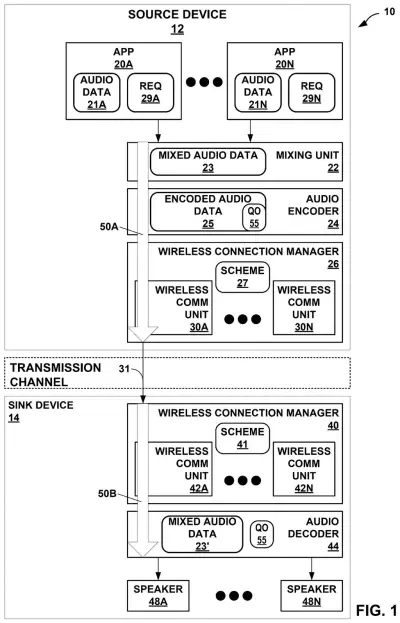
Qualcomm's patent tackles this at the decoding end. When the device unpacks the compressed audio, it also reads a small correction value baked into the file. That value tells the device exactly how far the decompressed sound has drifted from the original, and the device nudges it back. The result is audio that better matches what was sent in the first place.
The correction travels inside the same audio file, so there's no extra wireless traffic or processing delay for you to notice. The fix happens automatically, before the audio reaches your speakers.
… obtain, from the encoded audio bitstream, a quantization offset; apply the quantization offset to the decoded audio data to obtain corrected audio data, wherein the quantization offset corrects for any bit differences between original audio data that was encoded to obtain the encoded audio bitstream and the decoded audio data; …
Translation: The device extracts a math correction from the file and applies it to fix rounding errors made during compression.
How the quantization offset patches decoded audio data
Audio compression works by rounding off tiny details in a sound signal to save space. The problem is that rounding always introduces small differences between the original signal and the unpacked version. Over time, or across multiple processing steps, those differences add up.
Qualcomm's system adds a quantization offset (a pre-calculated correction number) to the encoded audio file at the point of encoding. Think of it as a note left for the decoder that says: "Here's exactly how much rounding error we introduced; please subtract it."
On the decoding side, the processing chip:
- Unpacks the compressed audio as normal
- Reads the embedded correction value from the bitstream (the digital audio file)
- Applies the offset to the decoded signal to produce corrected audio
- Renders the corrected audio into speaker feeds for playback
The correction is embedded inside the standard audio bitstream, which means it works within existing transmission pipelines without requiring a separate channel or extra bandwidth.
What this means for wireless audio and hearing devices
For most casual listening, compression errors are inaudible. But in applications where precision counts, such as hearing aids, professional audio monitors, or spatial audio headsets where tiny channel imbalances affect perceived direction, even small rounding errors can degrade the experience. A built-in correction mechanism means the device doesn't have to guess or average its way to accuracy.
Qualcomm supplies audio chips to a wide range of headset, hearing device, and mobile manufacturers. A correction technique embedded at the codec level could improve quality across all of them without any change to the hardware. You probably wouldn't notice a dramatic shift, but the worst-case audio scenarios (already-compressed source material re-encoded for wireless transmission) would hold up better.
Qualcomm's fifth filing in the wearable tech patents we've tracked since July builds on ideas like GPS-locked spatial audio and wireless earbud noise control.
Source: US 2026/0301752 A1 at the USPTO (PDF). Full patent text and figures are in the official publication.
Get our take in your Top Stories
Liked this breakdown? Add Patentlyze as a preferred source on Google, and our plain-English take shows up more often in your Top Stories the next time Qualcomm patent news breaks.
Add Patentlyze on Google
One click.
There are more where this came from
We read the new patents from Big Tech, carmakers and more and send you the ones worth knowing. Plain English, free, every week.
The drawings · 9 sheets
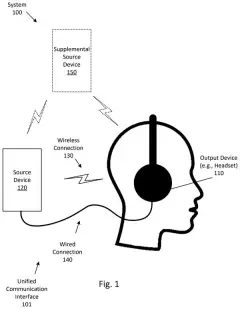
9 drawing sheets from US 2026/0301752 A1 · click any drawing to enlarge


Show sheet 9

More from Qualcomm
All 637 Qualcomm patents →
More in Hardware
All 2,375 Hardware patents →
Sony
Sony Patents a Wearable Tracker That Tells Your Game Controller Where You Are
Samsung
Samsung Patents an AI System That Tells Your Exoskeleton How Hard to Push You
Google
Google Patents a Way to Measure Blood Pressure Using Radar and a Wearable Together
Apple
No comments yet