
Qualcomm Patents Headphones That Use GPS to Keep Audio Locked in Place
Your earbuds already know when you turn your head. Qualcomm's new patent asks a sharper question: did you turn your head, or did your whole body change direction? The answer determines whether the sound around you should shift.
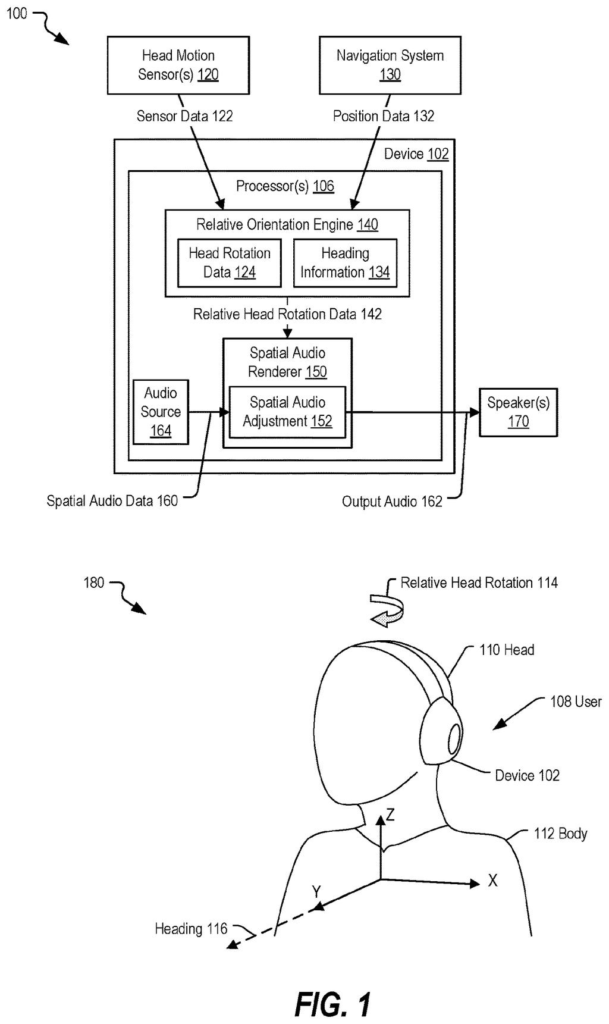
What Qualcomm's GPS-plus-head-rotation audio system actually does
You're walking down a street listening to music with spatial audio turned on, a feature that makes sounds feel like they're coming from fixed points around you, the way a movie theater does. When you glance left at a shop window, the audio should stay anchored to the world, not spin with your head. But if you actually turn and walk in a new direction, the audio's reference point needs to update.
The problem is that headphones today can't always tell the difference. Your earbuds sense your head moving, but they don't know whether your whole body changed course or you just looked sideways. Qualcomm's patent describes a system that cross-checks head-movement sensor data against GPS navigation data to figure out which one happened.
By comparing where your body is heading (from GPS) to where your head is pointing (from motion sensors), the device decides whether a spatial audio adjustment is actually needed. The goal is audio that stays convincingly rooted in the real world around you, whether you're glancing around or genuinely changing direction.
determine heading information based on position data from a navigation system; determine head rotation data based on sensor data associated with motion of a user's head; and determine, based on a comparison of the heading information and the head rotation data, whether to perform a spatial audio adjustment for audio playback.
Translation: The headphones track where you are walking using GPS and compare it to where you are turning your head to decide how to adjust the sound.
How the device compares navigation data to head sensor readings
The patent describes a processor-based system, likely inside a phone, chip, or pair of headphones, that pulls from two independent data sources at once.
Navigation heading comes from a GPS or similar positioning system. This tells the device which direction your body is traveling or facing in the real world.
Head rotation data comes from motion sensors, such as accelerometers and gyroscopes, that track how your head moves independently of your body.
The core logic is a comparison step: the processors look at both inputs together. If your head rotation matches a direction change already reflected in the navigation data, that means you physically turned and walked a new way, so the spatial audio reference frame needs to update. If your head rotated but your navigation heading stayed the same, you just glanced around, and the spatial audio should stay put.
The patent's claim is intentionally broad: it covers the decision of whether to perform an adjustment, not just how to perform one. That framing leaves room for the system to apply to any audio playback device with access to both a navigation system and head-motion sensors.
What this means for spatial audio in earbuds and headsets
Spatial audio is already shipping in AirPods, Galaxy Buds, and other premium earbuds, and head-tracking is a standard feature. The weak point has always been distinguishing a quick glance from a full change in direction, which causes the virtual sound stage to drift or jitter in ways that break the illusion.
Qualcomm makes the chips inside a huge share of Android phones and wireless earbuds. A fix at the chip level, baked into the audio processing pipeline, could clean up spatial audio across a wide range of devices without requiring manufacturers to write their own algorithms. For you as a listener, it would mean spatial audio that actually stays put when you look around, rather than subtly wobbling every time you do.
Qualcomm's 49th filing we've tracked in the AR glasses race since July builds on its work with blending sharp and blurry VR zones and dual views from one chip.
The design bets that your phone's location signal is accurate enough to help your earbuds figure out which direction you're facing. That bet works outdoors, in a moving car, anywhere the sky is open. It breaks in office buildings, subway stations, and dense city blocks, which happen to be the places most people actually wear wireless earbuds.
The patent does not describe what happens when the location signal goes weak or wrong. Users inside could silently get a worse or inconsistent audio experience with no feedback about why, and that gap matters more the wider the intended audience.
The underlying idea is still sound: cross-checking two independent sources of information produces more reliable results than relying on head movement alone. But the price is a real dependency on a signal that routinely disappears, and whether that trade is acceptable depends almost entirely on whether this product is meant for commuters or hikers.
There are more where this came from
We read every patent application Big Tech publishes and send you the ones worth knowing. Plain English, free, every week.
The drawings
11 drawing sheets from US 2026/0304060 A1 · click any drawing to enlarge


Want this weekly breakdown for a company we don't cover? Patentlyze Pro →
Be the first to weigh in