
Microsoft Files Patent for a Search Engine That Picks the Best AI Answer Format
Microsoft's filing has AI write three different answers to your search at once, then lets a referee model choose which one you actually see. Ask about a composer and you might get a magazine-style page; ask a simple question and you might get one short answer.
What Microsoft's three-draft search answers do
Ever typed a simple question into a search box and gotten a long essay back? Or searched for a famous composer and wished you had a photo-rich profile instead of a block of text? Search tools that write their own answers often use one layout for everything, and the filing says a poor format sends people back to search the same thing again.
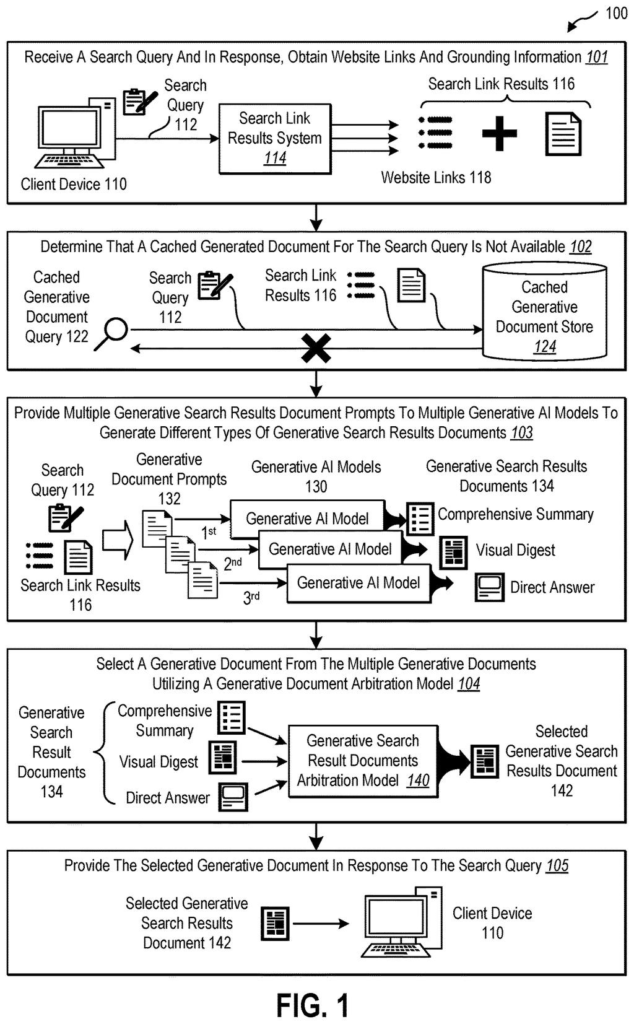
Microsoft's patent application takes a different route. After your search pulls up its usual web links, three AI models each write a different version of the answer at the same time: a long summary with sections, a magazine-style visual page, and a short direct answer. A separate scoring step then picks the version that suits your question and shows only that one.
If none of the drafts is good enough, or the topic is unsafe, you would get an enhanced list of links instead. And if someone already asked something similar, the system can reuse a saved answer rather than writing a new one.
… generating multiple generative search results document prompts to provide to multiple generative AI models for generating multiple generative search results documents concurrently from the search query and the search link results; …
Translation: The system asks several AI models at the same time to create different answer drafts using search data.
How the referee model picks one search answer
The system starts with an ordinary search. When your query arrives, the search system returns website links plus grounding information (the content and summaries attached to those links, which the AI can read and cite). Before doing any writing, it checks a store of saved answers by comparing the query and the links, or a hash of the links (a short digital fingerprint).
If nothing matches, it writes separate prompts (written instructions) for several AI models and sends them out concurrently. The claims name three document types:
- Full summary: a direct answer plus topic sections, media and cited sources.
- Visual digest: a magazine-style layout that changes with the topic, such as a person, weather or stocks.
- Direct answer: a short, to-the-point reply with a few related topics.
An arbitration model (a referee that compares the drafts) then scores each one on presentation quality for your query. It can be a small machine learning model, a set of rules, or an AI model asked to grade the drafts. Drafts below a minimum score are dropped, and the highest scorer wins.
The winning page goes to your browser, is saved with the query and links, and comes with suggested follow-up questions and a follow-up box. New answers get added below it, and each can use a different format.
… the generative document system generates and utilizes a generative document arbitration model to determine, based on the search link results, which of the generative search results documents to provide in response to the search query.
Translation: A special judge AI reviews the drafts and picks the single best one to show the user.
Why your search results page could change shape
You may notice this as search pages that stop looking the same for every question. Ask for a famous person and you could get a photo-heavy profile; ask a quick factual question and you could get one short answer with links; ask something broad and you could get a sectioned summary with sources. Follow-up questions can add new pages below, each in whatever format fits.
For Microsoft, the bigger story is cost and speed. Writing several drafts per search is expensive, so the filing leans on saved pages for repeat questions, parallel runs to cut waiting, and a plain-links fallback when no draft is good enough or the topic is unsafe. That is a plan for running AI answers at search-engine volume.
Microsoft's 43rd filing we've tracked since May on AI agents working together connects to one on reducing grading work and one on code review priorities.
Writing three answers and throwing two away is an expensive habit. Every search burns several AI runs, and the filing leans on parallel runs and saved pages to keep the bill and the wait down. That trade looks sensible for popular searches, where one saved page gets reused again and again, and weaker for odd one-off questions that pay full price every time.
The referee adds its own risk. It scores presentation quality, which mixes looks with usefulness, so a bad call hands you a plain summary when you wanted photos, or the reverse. Reusing a saved page also means you may see an answer written for a similar question rather than yours.
The trade reads as worth it. A search box that fits its answer to your question beats one that pours everything into a single template, and the fallback to enhanced links gives it a safe floor when the AI drafts fall short.
Get our take in your Top Stories
Liked this breakdown? Add Patentlyze as a preferred source on Google, and our plain-English take shows up more often in your Top Stories the next time Microsoft patent news breaks.
There are more where this came from
We read every patent application Big Tech publishes and send you the ones worth knowing. Plain English, free, every week.
The drawings
11 drawing sheets from US 2026/0329949 A1 · click any drawing to enlarge


Show the other 3 sheets


Want this weekly breakdown for a company we don't cover? Patentlyze Pro →
Be the first to weigh in