
Microsoft Files Patent to Cut the Human Grading Needed to Train AI
Teaching an AI chatbot what a good answer looks like usually means paying people to grade thousands of examples. Microsoft's filing describes a way to let an AI do most of the grading and call in humans only for the cases it keeps getting wrong.
What Microsoft's AI-grades-AI patent actually does
Every time a company wants a chatbot to write better summaries, someone has to read thousands of pairs of answers and click on the better one. It is slow, it costs real money, and when the material is private, like HR questions or legal documents, you may not want outsiders reading it at all.
Microsoft's patent application describes a shortcut. One AI makes a first pass at picking the better answer in each pair. A second AI then scores how confident each pick looks and sorts everything from obvious to shaky. The obvious picks are kept as they are. The shaky ones go to human experts, who settle them.
Then the process runs again with the corrected examples, and again after that. The filing says this reaches the quality of fully human grading with only 6-7% of the human effort, and the chatbot is then tuned on the cleaned-up data.
prompting a first generative artificial intelligence (AI) model to label an unlabeled dataset into a plurality of preference pairs based on instructions of a task and one or more preference judgement criteria; …
Translation: An AI first labels raw data based on specific rules.
How the score curve picks which answers go to people
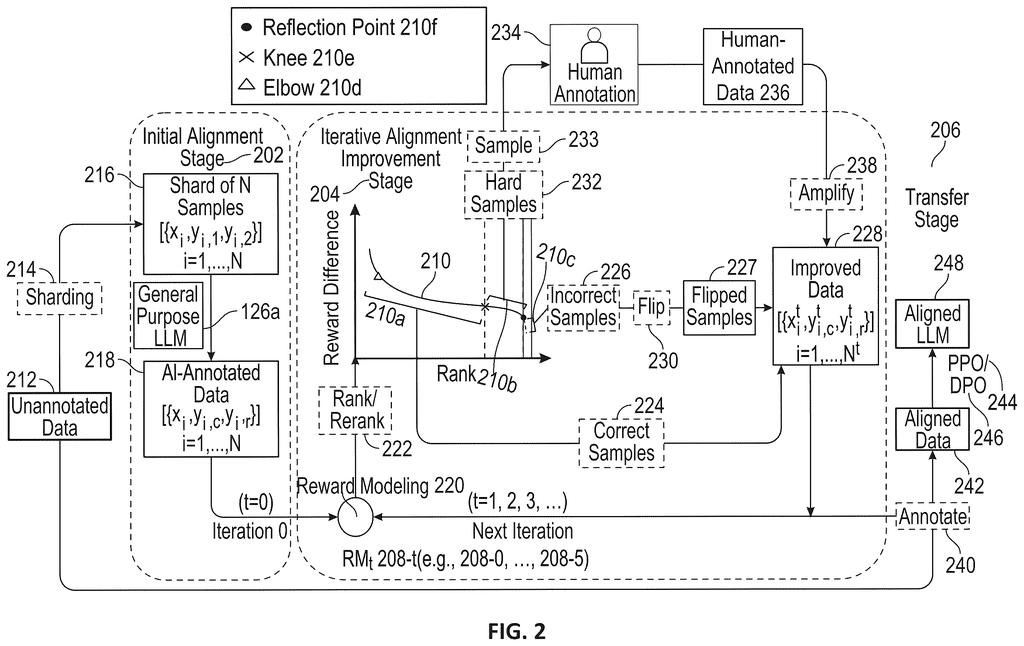
The claims describe a loop built around two AI models. The first model (the one you eventually want to improve) is given a task, such as summarizing a Reddit post, plus judging criteria like clarity and accuracy. It labels preference pairs: two candidate answers, with a pick for the better one.
A second model is then adapted into a reward model (a scorer that gives each answer a number for how well it matches what people want). Only small add-on layers called adapters are trained, so the main model stays untouched. Each pair gets a score gap, and ranking the pairs by that gap draws a reward distribution curve.
The curve decides who handles what:
- Pairs with a big positive gap (above the 'elbow') were easy for the first model, so they go straight into the next training round.
- Pairs near the bottom (below the 'knee') are the hard ones, and these go to human annotators.
- Pairs furthest down are very likely mislabeled, so the filing describes flipping the pick instead of paying a person.
Human answers can also be copied several times so they carry more weight. After several rounds (the example uses five), the final scorer guides the first model through a reinforcement loop called PPO, or its labeled data feeds a simpler method called DPO, which teaches the model directly from preferred and rejected answers.
identifying on the curve a first portion including first pairs hard for the first model to correctly label, and a second portion including positive pairs ranked higher than the first pairs, …
Translation: The system finds which data the AI struggles with most so humans can review it.
Why cheaper human feedback matters for company AI
If this works as described, you would see it indirectly: workplace assistants that handle company-specific questions, like HR policy or legal documents, could be tuned faster and for less money. The filing also stresses an 'eyes-off' setup, where an outside team tunes a model for a customer while the customer's own experts do the human checking, so the data stays in-house.
For Microsoft, the pitch is cost and trust. Human grading is the expensive part of tuning a model, and a method that needs only 6-7% of it (the company's own figure, from its tests) makes custom tuning easier to sell. The description names Microsoft 365 Copilot as one example of an app where this could sit, though the filing covers the training method, not a specific product.
Microsoft's 42nd filing we've tracked since May in our AI models that work in teams watch follows an AI code reviewer and chat that thinks mid-reply.
You will never see this work directly. You may notice the result: a work assistant that answers questions about your company's own rules like someone who actually read them. The patent aims at that gap by spending human attention only where the AI is most likely to be wrong.
That targeting is the useful part. A chatbot trained on another chatbot's grades picks up the first chatbot's blind spots, and you only find out when it confidently gives a wrong answer about your benefits or a contract clause. Sending the shakiest cases to real experts is aimed squarely at that failure.
The 6-7% figure comes from Microsoft's own tests, so it is a claim to check. Still, cheaper expert feedback means more specialized assistants could get tuned for niche jobs, and that is where you would feel the difference.
Get our take in your Top Stories
Liked this breakdown? Add Patentlyze as a preferred source on Google, and our plain-English take shows up more often in your Top Stories the next time Microsoft patent news breaks.
There are more where this came from
We read every patent application Big Tech publishes and send you the ones worth knowing. Plain English, free, every week.
The drawings
6 drawing sheets from US 2026/0330192 A1 · click any drawing to enlarge


Want this weekly breakdown for a company we don't cover? Patentlyze Pro →
Be the first to weigh in