
Samsung Files Patent to Keep Headset Hand Gestures Accurate While Your Head Moves
Turn your head while swiping in a headset and the camera can't tell which of you moved. Samsung's filing uses the stationary walls behind your hand as a ruler to sort it out.
What Samsung's moving-headset gesture fix does
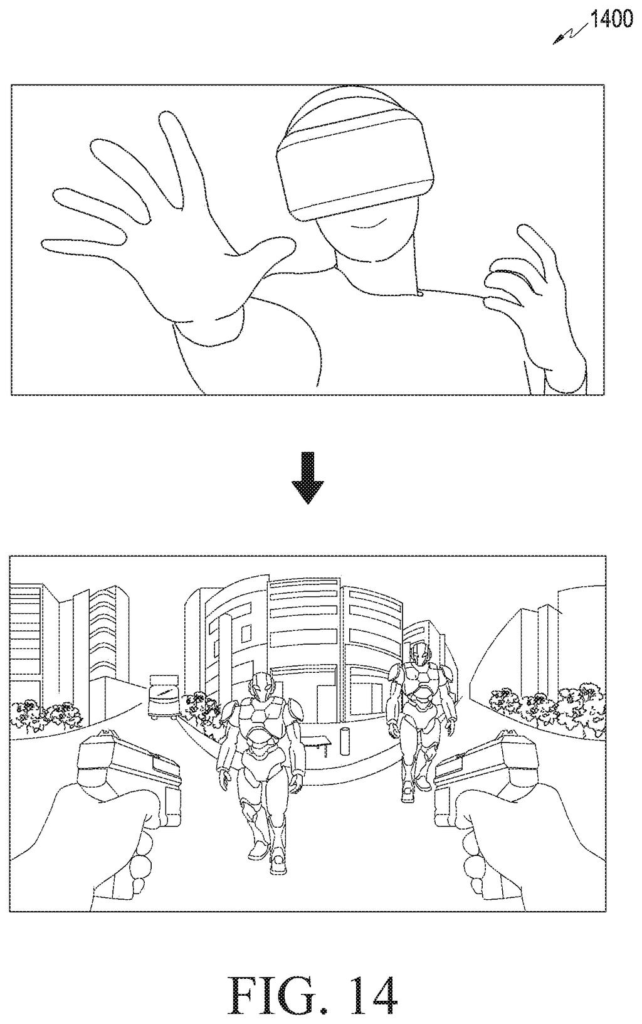
You're wearing a headset in a VR shooting game. You turn your head to line up a target, and your hand snaps forward to fire. Both are moving at once, and the camera on your face sees the whole thing as one confusing blur.
That's the problem Samsung is going after. If the camera moves along with your hand, a simple swipe can look like a different gesture, or like nothing at all. A backward lean of your head might even be read as a grab.
Samsung's fix is to look at what's behind your hand. Flat surfaces like walls stay still in the real world, so if they appear to slide across the camera's view, that's your headset moving. Subtract that motion, and what's left is what your hand actually did. The filing describes this as a correction step that runs before the gesture is decided.
… estimating, by the electronic device, a plurality of background planes for each frame of the plurality of frames; based on the estimation, identifying, by the electronic device, a movement of the plurality of background planes; …
Translation: The headset maps what is in the background of each video frame to track how the room shifts around.
How walls behind your hand reveal your head moving
The claims cover a method, a device and stored software that all follow the same basic recipe. A camera on the device (a headset in most of the examples) captures a series of frames that include part of your body, such as your hand.
From there, the system works in four steps:
- Find the background planes. In each frame it estimates the flat surfaces behind your hand, using surface normal estimation (working out which direction points straight out from each flat surface). It spots features like image corners, and the filing says a trained AI model can do the estimating.
- Track their movement. It follows how those planes shift from frame to frame and saves that as a reference.
- Work out the device's motion. The way the planes shift tells it which direction the headset itself is moving.
- Decide the gesture. It measures your hand's movement relative to the device's movement.
A second independent claim adds a check that the device is moving along with the body part, then lines up the surface information with the plane movement to get the relative motion between device and hand.
The description fills in the math: it measures how much each surface's direction rotates between frames, averages the planes that agree, and uses that to correct the hand's estimated position. The first frame goes through uncorrected. The filing says the method still works when only flat planes are in the background.
… estimating, by the electronic device, a movement direction of the electronic device, and based on the estimated movement direction of the electronic device, determining, by the electronic device, the gesture of the user …
Translation: The device figures out which way your head is turning so it does not mistake head motion for a hand signal.
Why gesture controls on headsets need this
If you wear a headset for games, virtual desktops or lessons, you will turn your head mid-gesture all the time. The filing's own examples are playing a virtual piano with a tutor, dragging items between windows spread across your view, and aiming with your head while firing with your hand. A headset that misreads those moments produces wrong notes, dropped windows and missed shots.
The patent names headsets, see-through headsets, VR, AR and mixed reality devices as targets, though it also lists phones and tablets. It gives no accuracy figures or test results, so how much better this works is unknown. What it shows is Samsung treating head-and-hand motion as a core part of making hand controls dependable.
Samsung's 69th filing we've tracked since May in the AR glasses race follows earlier applications on shrinking display pixels and sharpening dark backdrops.
Hand controls on a headset depend on one thing: telling your hand's motion from your head's. People turn their heads while they use their hands constantly, so the problem shows up in nearly every game, desktop window drag and virtual instrument the filing mentions.
Using the room's flat surfaces as a fixed reference fits a problem that common. The headset already has cameras pointed at the room, and a correction step added ahead of gesture recognition asks for no new hardware.
The filing gives no test numbers, so the size of the improvement is unknown. Still, the approach matches the size of the problem: a modest fix aimed at something every headset user runs into.
Get our take in your Top Stories
Liked this breakdown? Add Patentlyze as a preferred source on Google, and our plain-English take shows up more often in your Top Stories the next time Samsung patent news breaks.
There are more where this came from
We read every patent application Big Tech publishes and send you the ones worth knowing. Plain English, free, every week.
The drawings
15 drawing sheets from US 2026/0330876 A1 · click any drawing to enlarge


Show the other 7 sheets


Want this weekly breakdown for a company we don't cover? Patentlyze Pro →
Be the first to weigh in