
Google Files Patent to Stop AI Searches From Missing Close Matches
Google's patent files every item in a giant collection under two different labels on purpose, so a search gets a second chance to find what the first label missed.
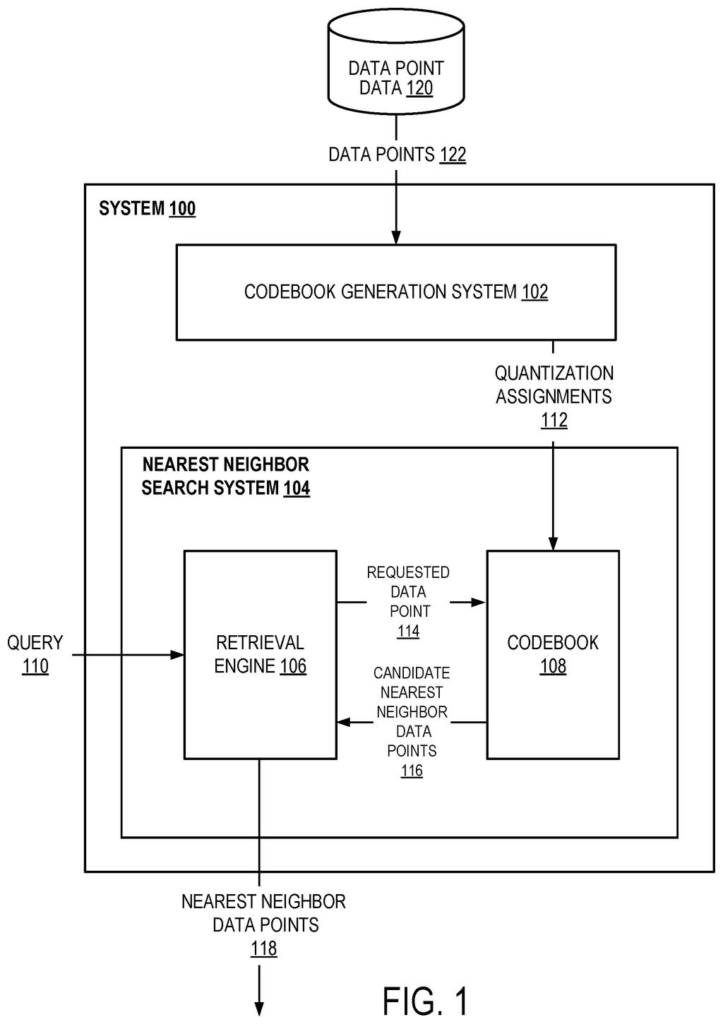
What Google's two-label search trick does
A shopping app holds millions of product photos. You tap one and ask for look-alikes. The app can't compare your photo against every other photo each time, so it sorts the collection into groups ahead of time and only checks the few groups nearest to your pick.
The weak spot is the edges. A photo that sits between two groups gets filed in just one, and if the search looks in the other group, a great match gets skipped. Google's patent files every item twice: once in its closest group, and once in a second group chosen with care.
That second pick is the clever part. It is chosen so that whatever the first filing gets wrong, the second tends to get right. When you search, the system looks in both places, throws out duplicates, and ranks what's left. The goal is the same quality of results while checking fewer groups.
… maintaining data representing a codebook, wherein the codebook is associated with a first set of vector quantization assignments and a second set of vector quantization assignments …
Translation: The system keeps two separate categorization lists for every piece of data to ensure nothing gets overlooked.
How the second group gets picked
Everything in the collection (a photo, a song, a web page) is first turned into a vector, a long list of numbers describing it. The system sorts these vectors into partitions, each represented by a center, and keeps the list of centers in a codebook.
Each item gets two assignments. The first goes to its closest center. The second goes to a different center, picked by minimizing a loss function (a scoring formula for how bad a choice is). That formula penalizes a second center whose error points the same direction as the first center's error. The two errors end up roughly perpendicular, so a query that the first group misses is more likely to land near the second. The filing calls this an orthogonality amplified residual loss.
At search time the system does three things:
- Finds the centers closest to your query using a maximum inner product score (a measure of how well two lists of numbers line up).
- Collects every item assigned to those centers by either assignment.
- Removes duplicates, then ranks the rest and returns the top k matches.
In the filing's tests on a million-item set and two sets of roughly a billion items, the approach hit a target accuracy while checking fewer partitions and using less memory bandwidth. The filing also says items can go into more than two partitions.
… where the first set of vector quantization assignments assigns each data point to an index of a closest center of the multiple centers and the second set of vector quantization assignments assigns each data point to an index of another center of the plurality of centers …
Translation: One list maps items to their absolute closest match, while the second list maps items to an alternative secondary match.
Why faster similarity search matters for AI
If you use image search, recommendations, or any tool that finds things by similarity, a step like this works behind the scenes and sets how fast results come back and how often a good one gets skipped. The filing says this lookup can bottleneck a whole system, and at a billion items every extra check costs real computing time and money. The examiner's first review rejected the claims as filed, a routine early step that usually brings amendments.
The approach adds a bit of storage for the second filing, in exchange for checking fewer groups per search. The accuracy and speed charts in the filing come from Google's own tests against other search libraries, so outside results would be the real check. Anyone running a giant vector database would look at this closely.
Google's 111th filing in the Language AI patents we've tracked since May builds on earlier work like turning plain English into robot code and adding words to searches automatically.
Every AI feature that finds things by similarity, from photo search to recommendations, hits the same wall: comparing against everything is too slow, and shortcuts miss good answers. The filing says this search step can bottleneck the whole system, and at a billion items every wasted check costs real computing time and money.
The fix is modest in size, which fits the problem. Filing each item a second time adds some storage but needs no new hardware or new AI model, and the filing's charts show the same accuracy with fewer groups checked. Those charts come from Google's own tests, so independent results would tell us more.
For you, the payoff is invisible: results that show up a little faster and miss a little less. The idea is sensible and well matched to a real cost, even if most people will never notice it.
Get our take in your Top Stories
Liked this breakdown? Add Patentlyze as a preferred source on Google, and our plain-English take shows up more often in your Top Stories the next time Google patent news breaks.
There are more where this came from
We read every patent application Big Tech publishes and send you the ones worth knowing. Plain English, free, every week.
The drawings
6 drawing sheets from US 2026/0329875 A1 · click any drawing to enlarge


Want this weekly breakdown for a company we don't cover? Patentlyze Pro →
Be the first to weigh in