
Samsung Files Patent for AI Text Replies That Know Who You're Talking To
Samsung's patent application describes an AI that drafts your chat replies from your own photos, places and purchases. The twist is that it decides how much of your life to mention by checking who you're texting.
What Samsung's chat-reply assistant actually does
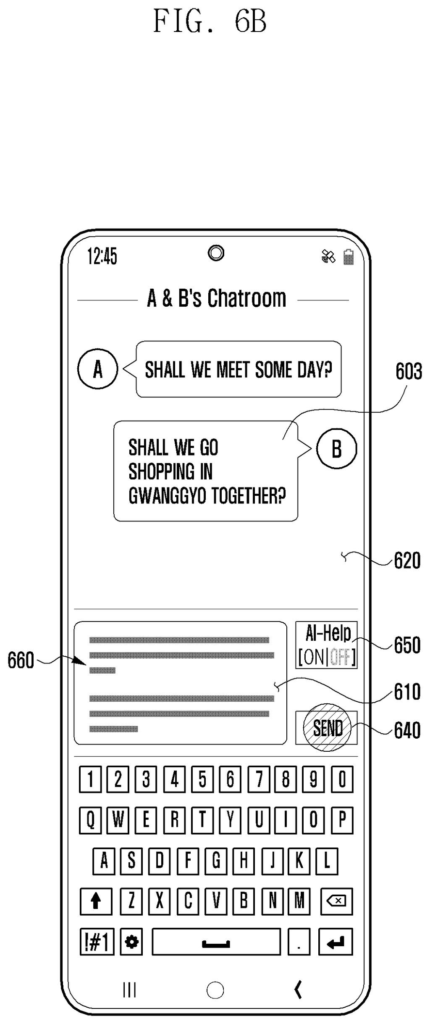
Imagine a message pops up that mentions a shopping trip to a particular part of town. Before you type a word, a draft reply is already waiting in the text box. It mentions a mall you visited last month and a newly opened one that people are talking about.
Here's the twist. The phone first looks up who you're chatting with in your contacts and works out how close you are. Family might get a reply drawing on nearly everything the phone knows about you. A coworker might get one that skips your photo gallery entirely. Someone the phone can't place gets the most restricted treatment.
You stay in charge. You can edit the draft, send it as is, or turn the feature off with a small on/off switch next to the text box. You can also dial the amount of personal detail up or down before you hit send.
… determine relationship information with at least one counterpart user participating in the interactive service, determine an access level for user information based on the relationship information …
Translation: The system figures out how close you are to the other person and sets privacy limits based on that connection.
How the phone decides what it may mention
The patent covers a chat app that watches the conversation for a feature point, meaning a meaningful word (a place, an activity, a date) or an object in a shared image. When it spots one, it switches on an AI-based answer function and shows a small status indicator with a toggle so you can turn it off.
Next it works out your relationship with the other person by matching their name, number or account against your contacts, cloud account and social accounts. That produces a relationship level (high, medium or low), which sets an access level: how much of your personal data the AI may look at. The filing's examples say family could get access to all personal information, while a coworker could be blocked from your gallery. You can also set different rules for different contacts, and exclude whole categories even for your closest people.
The AI then pulls two kinds of material:
- User information: things on your phone or cloud account tied to the topic, such as photos, payments, places visited, music played and chat history.
- General information: public facts found through web search.
It combines these into a draft placed in your input field. You can retype it, move a slider that changes how much detail it discloses, or swap a detail from a list of alternatives that appears above the keyboard. The system also marks which parts you edited and which the AI wrote.
… detecting a feature point from content inputted while performing the interactive service, determining relationship information with at least one counterpart user participating in the interactive service …
Translation: It scans what you type in a chat and checks your relationship with the person you are messaging.
Why your chats could get a privacy dial
If this ever shipped in a messaging app, the practical change is that AI-written replies would sound like you, using real details from your life, without you digging through old photos or receipts to find them. The relationship check is what would make that tolerable. An assistant that mentions your recent trip to a close friend is helpful, but one that mentions it to a stranger or a boss is a problem.
For Samsung, the filing shows one way to make AI feel more personal without making it feel invasive. Whether people would trust a phone to decide who counts as family or coworker is another matter. The patent leans on contacts and account data to decide, so the quality of that data matters. Like any patent application, this one describes an idea, not a product.
Samsung's 26th filing we've tracked since June on our assistants that remember you watchlist extends ideas from longer chatbot memory and TVs borrowing voice memory.
The useful part for you is the guardrail. An AI that can read your photos, payments and location history is unnerving when it drafts a message. The promise that it would hold back personal details when you're texting your boss is what would make most people willing to switch it on.
You would notice it the first time a draft mentions a restaurant you actually visited, or the first time it leaves out something personal. The failure it prevents is the awkward one: a casual reply to a coworker that references a vacation photo you never meant to share.
The filing leaves one big question open: how the phone knows a contact is family or a colleague in the first place. It reads your contacts and account information, so a mislabeled contact means the wrong level of access. The per-contact settings and the on/off switch are the parts that would decide whether you'd trust it.
Get our take in your Top Stories
Liked this breakdown? Add Patentlyze as a preferred source on Google, and our plain-English take shows up more often in your Top Stories the next time Samsung patent news breaks.
There are more where this came from
We read every patent application Big Tech publishes and send you the ones worth knowing. Plain English, free, every week.
The drawings
47 drawing sheets from US 2026/0320217 A1 · click any drawing to enlarge


Show the other 39 sheets


Want this weekly breakdown for a company we don't cover? Patentlyze Pro →
Be the first to weigh in