
Nvidia Files Patent for an AI That Answers Plain-English Questions Across Many Databases
Getting an answer that lives in several different systems usually means writing code for each one and stitching the results together by hand. This Nvidia patent application describes an AI that does both steps from a single typed question.
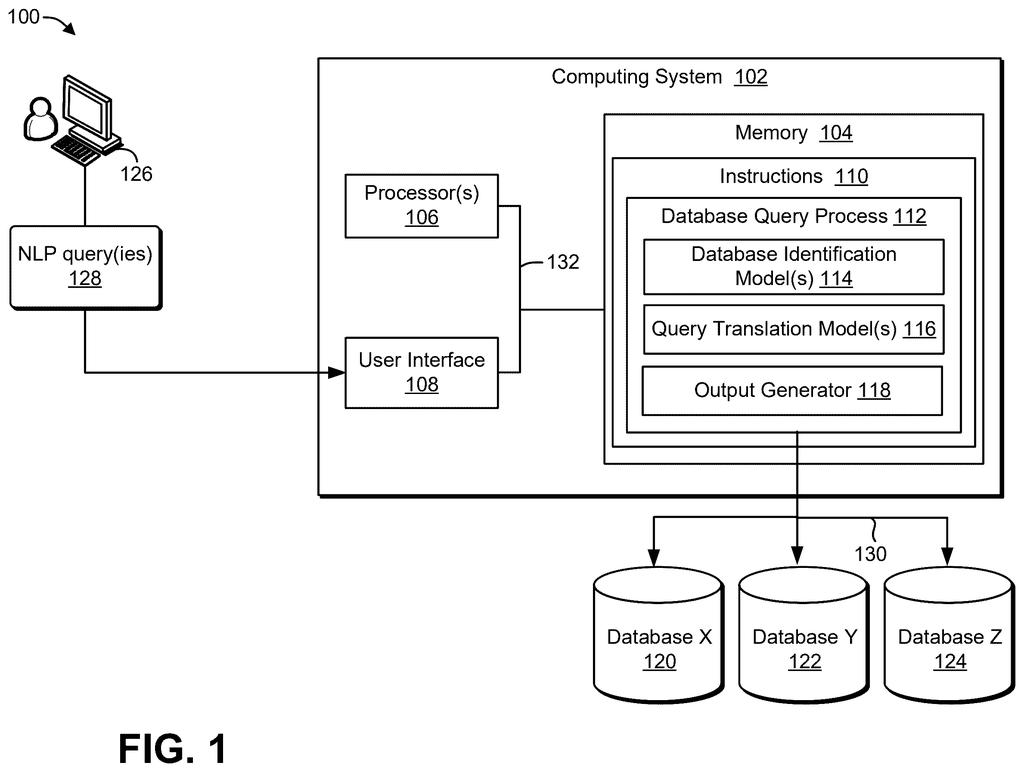
What Nvidia's multi-database question tool does
Ever tried to answer a simple work question when the facts are scattered across several different systems? Say you want every test a colleague ran last month, plus any bugs those tests turned up. One list lives in one system, the bugs live in another, and each speaks its own technical language.
Nvidia's patent application describes an AI that handles the legwork. You type the question the way you would ask a coworker. The AI works out which databases hold the pieces, splits your question into one smaller question per database, and rewrites each one in the format that database understands.
Then it runs them, collects what comes back, and lines everything up in a single table, so the test results sit right next to the bugs they caused. You never touch the technical syntax, and you skip the copy-and-paste step.
… translate, using the one or more neural networks, the two or more sub-queries into two or more database queries according to respective input formats of the two or more databases …
Translation: The AI converts your plain question into the specific language needed for each different database type.
How one question becomes several database queries
The system works as a pipeline of AI models, mostly large language models (the same family of AI behind modern chatbots). First, a model reads your question and decides which databases hold the answer. The filing says these can be different types of databases, and the model is trained on database layouts, called schemas (basically each database's list of tables and column names), so it knows where things live.
Next, it splits the question into sub-queries, one per database. It can use named entity recognition (spotting names and items in your sentence) and column classification (labeling what kind of data each column holds) to do this. A second model then translates each sub-query into the exact language that database expects, such as SQL.
Then comes execution:
- Independent sub-queries can run in parallel, overlapping in time.
- Dependent ones run one after another, for example when the first database's answer decides what to ask the second.
Finally, the results merge into a fusion table, a single table built around the relationships your question implied. The output can be shown on screen, saved, exported as a PDF or spreadsheet, or emailed, and user feedback can be used to retrain the system.
… the obtained data is mapped to a data structure, such as a table, to present the results from the data sources correlated based on the natural language query …
Translation: Information gathered from separate systems is organized into a single neat table for easy reading.
Why Nvidia's database filing hit a rejection
For anyone who has waited on a data team to pull numbers from two systems, the pitch is simple: ask once, get one table. The filing's own example is software testing, matching a developer's test runs to the bugs they caused. It also lists follow-up uses such as spotting anomalies in data and improving software quality. It describes packaging the models as an inference microservice (a ready-to-deploy bundle of model and software), such as NVIDIA NIMs, which ties the idea to Nvidia's business AI offerings.
The patent examiner has issued a final rejection of this application, so nothing here is granted, though Nvidia can still amend the claims or appeal. Until then, treat it as a sketch of how Nvidia thinks business data questions could be answered, not a product you can use.
Nvidia's 31st filing we've tracked in Language AI since May adds to a body of work that includes a raw data to model translator and an AI search quality checker.
The trade here is trust for convenience. Once an AI decides which databases to ask and how to link the answers, you may never see the questions it wrote. A wrong guess about which columns match can produce a tidy table full of wrong pairings.
The filing's fixes carry their own cost. The models are trained on each company's database layouts, and user feedback can retrain them, which means setup work before anyone gets a one-sentence answer. Running queries side by side saves time, yet some questions need one answer before the next can start, so the speed gain shrinks when the questions get more interesting.
For a business with data spread across several systems, the trade reads as worth making, provided someone can check the generated queries. The final rejection suggests Nvidia may have to rework its claims if it wants to keep any of this protected.
Get our take in your Top Stories
Liked this breakdown? Add Patentlyze as a preferred source on Google, and our plain-English take shows up more often in your Top Stories the next time Nvidia patent news breaks.
There are more where this came from
We read every patent application Big Tech publishes and send you the ones worth knowing. Plain English, free, every week.
The drawings
11 drawing sheets from US 2026/0320036 A1 · click any drawing to enlarge


Show the other 3 sheets


Want this weekly breakdown for a company we don't cover? Patentlyze Pro →
Be the first to weigh in