
Adobe Files Patent for an AI That Turns Plain English Into Marketing Campaign Rules
Adobe's marketing software lets companies map out customer journeys with branching rules, and writing those rules takes some coding skill. This patent application trains an AI on a company's own past rules so you can describe what you want in a sentence instead.
What Adobe's campaign-rule writing AI does
Imagine you run email marketing for a shoe store. You want shoppers who opened your sale email to get a follow-up offer, while everyone else gets a gentler reminder. Today, you would have to write that branching rule in a special code your software understands, using the exact names your company gave its customer data.
Adobe's patent application describes teaching an AI to do that translation for you. It learns from rules your team has already built, since each decision point in a past campaign usually pairs a plain-language label with the actual rule behind it.
Once trained, you type something like check if the customer opened the promotional email and get back one or more suggested rules. The system also checks the data names in each suggestion against your company's own list, so the AI can't make up a field that doesn't exist. You review the options and pick one.
… training a generative model using the training data to provide a trained generative model that converts natural language inputs to condition expressions.
Translation: The system trains an artificial intelligence to translate plain text sentences into formal rules.
How Adobe trains the model on past campaigns
In Adobe's setup, a journey is a series of steps a customer goes through, such as getting an email, visiting a site, and buying. A condition node is a fork in that path. Each node holds a condition expression (the coded rule that decides which way a customer goes) and usually a condition description (a plain-language label for it).
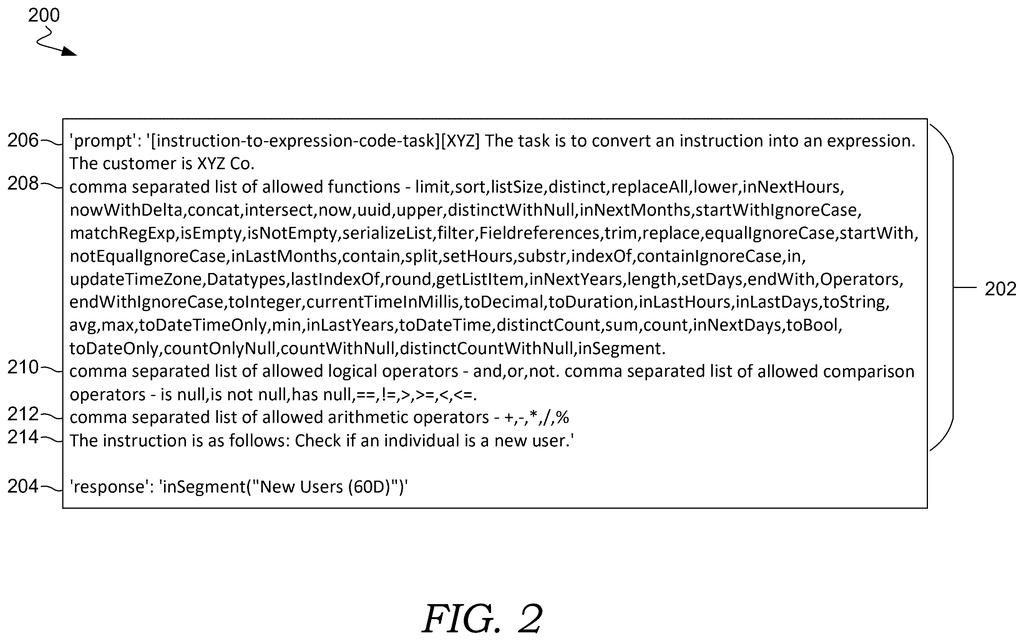
To train the model, the system pulls those pairs out of existing journey files. The description becomes the question and the expression becomes the right answer. A separate text-generating model can also reword each description several ways, so the AI learns that many phrasings mean the same thing. Each training prompt can also list the allowed functions and operators, which steers the AI toward valid code.
During training, the model writes its own version of the rule, the system measures how far off it is from the real one (the loss), and the model's internal settings are adjusted to shrink that gap.
After training, some clean-up steps run on the output:
- Ranking: if the model offers several candidate rules, they are sorted by how closely they match what you typed.
- Name fixing: any field or segment name (a named group of customers, like frequent buyers) that isn't in your company's data schema gets swapped for the closest real one, found by comparing embeddings (numeric fingerprints of meaning).
- Pattern checks: output is compared against acceptable rule formats.
Once trained, the generative model is employed to automatically convert natural language inputs to condition expressions.
Translation: After learning, the AI automatically translates everyday speech into structured campaign rules.
Why marketers could skip the rule syntax
For marketers, the pitch is less time wrestling with code and fewer broken rules. The filing says off-the-shelf chatbots fall short here because each platform has its own rule syntax and each company has its own data names. A model has to learn both, and the company's own existing campaigns are where both are already written down.
For Adobe, it shows one way to turn the campaigns customers have already built into training material for a built-in assistant. You would still review every suggestion before it goes live, and the patent application does not say which Adobe product would carry the feature.
Adobe's 33rd filing in the Language AI patents we've tracked since May follows earlier applications like one on document question suggestions and one on plain-English data queries.
Claim 1 asks for three steps. Gather decision-point data from many customer journeys, turn each rule and its plain-language label into a training example, and train a model that converts everyday sentences into rules. It names no particular model type. Ranking suggestions and fixing field names appear only in later claims.
That leaves the opening claim wide inside its own narrow corner. Many model choices and training details would fit the wording, but the claim stays tied to training on pairs pulled from condition nodes. It says nothing about general chatbots or code assistants.
The idea is sensible and modest: reuse the labels people already typed next to their rules. It reads as a practical product feature, and nothing in the claim promises more than that.
Get our take in your Top Stories
Liked this breakdown? Add Patentlyze as a preferred source on Google, and our plain-English take shows up more often in your Top Stories the next time Adobe patent news breaks.
There are more where this came from
We read every patent application Big Tech publishes and send you the ones worth knowing. Plain English, free, every week.
The drawings
8 drawing sheets from US 2026/0320378 A1 · click any drawing to enlarge


Want this weekly breakdown for a company we don't cover? Patentlyze Pro →
Be the first to weigh in