
Nvidia Files Patent to Help Self-Driving Radar Spot How Fast Things Move Sooner
Nvidia's filing teaches a car's radar AI to grade its own homework. It guesses how fast things are moving, rebuilds the radar signal that guess implies, and checks that against what the sensors really saw.
What Nvidia's radar speed-guessing patent does
Every time your car's radar sends out a pulse, it gets back a scatter of dots from whatever the signal bounced off. Somewhere in the software, a decision has to be made about which dots belong to a moving car, and how fast that car is going.
Today's systems often work that out slowly. They box up the dots, follow the box over several moments, and only then calculate speed. Nvidia's filing describes an AI model that estimates speed straight from the radar readings, without waiting for that tracking to catch up.
The training trick is a self-check. The model guesses speeds, works backward to what the radar should have read if those guesses were right, and compares that with what the radar really read. The gap tells it how to improve. Nobody has to label the data by hand.
comparing training RADAR data to reconstructed RADAR data, wherein the reconstructed RADAR data was reconstructed based at least on one or more previously estimated velocities previously estimated based at least on the ML model processing the training RADAR data …
Translation: The system learns by checking its past speed guesses against real radar data to improve over time.
How the model checks its own speed estimates
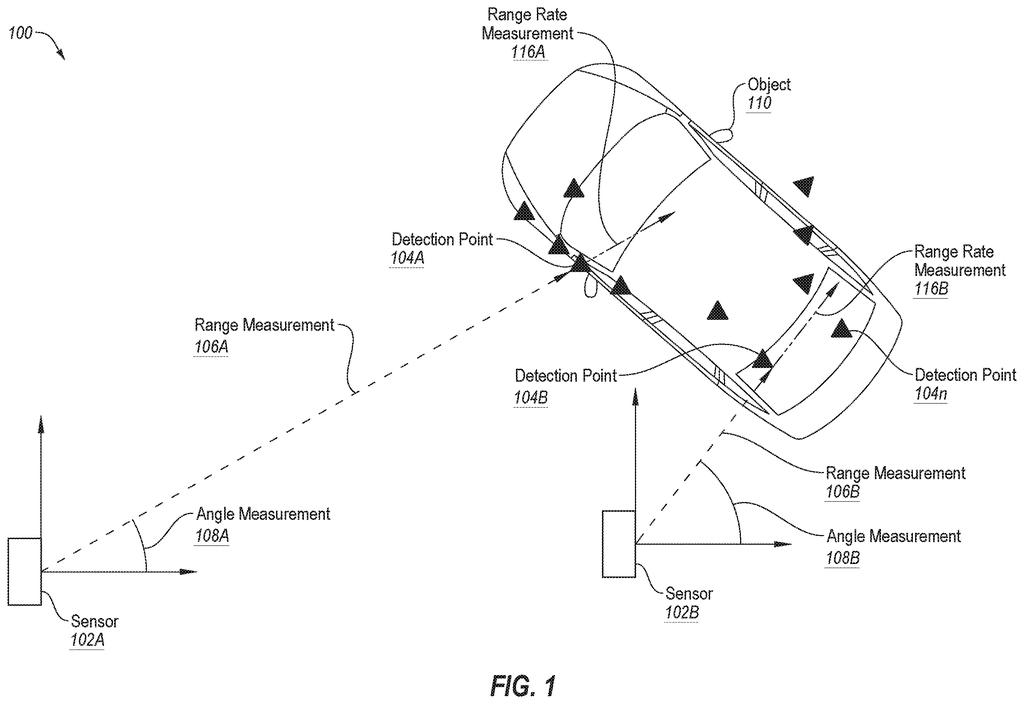
The core is a self-supervised training method (the model learns from the raw data itself, with no human labeling every example). A neural network takes in frames of radar data. Each detection point carries a range (distance), an angle, and a range rate (how fast that point is moving toward or away from the sensor). From those, the model estimates a velocity, meaning a speed and direction, for each cell of a top-down grid of the surroundings.
Then comes the check. Using reverse calculations, the system works out what the radar readings would have to look like if those estimated velocities were true, accounting for sensor positions, sampling rates and other metadata. That expected data has the same format as the real data, so the two can be compared directly.
Training then loops:
- The difference becomes a loss value (a score of how wrong the model was).
- The model adjusts its internal settings to shrink that score.
- It repeats until the error falls below a set threshold.
Once trained, the model runs on live readings, including data from several radar sensors captured within roughly 10 to 50 milliseconds of each other. The filing says velocity can be estimated before the box-tracking approach could produce it, and a control module can then turn the speeds into commands like slowing down or steering.
Training sensor data may be provided to the ML model, and the ML model may estimate one or more object properties based on the training sensor data. Reconstructed sensor data may be generated based at least on the estimated object properties.
Translation: The software learns on its own by trying to recreate raw sensor inputs from its own velocity guesses.
Why faster speed readings matter on the road
If you ride in a car that relies on radar, or share the road with one, the gap between something starting to move and the car knowing how fast it's going matters. The filing's own background says speed estimates in tracking-based systems lag behind the other things the system works out. This approach aims to get speed earlier and more accurately.
The training side matters too. Because the model checks itself against the radar data it already has, it can learn from raw recordings instead of hand-labeled ones. The filing lists cars, trucks, robots, warehouse vehicles, drones, boats and aircraft as places the idea could run, on chip setups that combine CPUs, GPUs and accelerators.
Nvidia's 98th filing we've tracked since May in the self-driving sensing race adds to a run that includes one on camera-view pixel cleanup and one on labeling-free object recognition.
Claim 1 is tight. It covers a machine acting on the output of a radar-based AI, where that AI was trained by comparing real radar readings with radar readings rebuilt from its own earlier speed estimates. Radar, speed and the rebuild step are all written into the wording.
The other two independent claims loosen the grip. They drop radar and speed in favor of any sensor data and any object property, as long as the model was trained against data rebuilt from its own earlier estimates. They also list CPUs, GPUs and hardware accelerators on the equipment side.
If granted, the broad version would reach well past cars, since a later claim names robots, drones, boats and aircraft. The rebuild-and-compare step carries the whole filing, and every claim leans on it. That makes this a focused idea with a wide net, and the width is where most of the interest lies.
Get our take in your Top Stories
Liked this breakdown? Add Patentlyze as a preferred source on Google, and our plain-English take shows up more often in your Top Stories the next time Nvidia patent news breaks.
There are more where this came from
We read every patent application Big Tech publishes and send you the ones worth knowing. Plain English, free, every week.
The drawings
12 drawing sheets from US 2026/0328905 A1 · click any drawing to enlarge


Show the other 4 sheets


Want this weekly breakdown for a company we don't cover? Patentlyze Pro →
Be the first to weigh in