
Nvidia Files Patent to Teach Self-Driving Cars to Recognize Objects Nobody Labeled
Nvidia is filing for a way to teach a car's laser sensors what a tow truck is without a human ever labeling one. The system builds its own training labels from video, then lets engineers name new objects in plain text.
What Nvidia's unlabeled-data LiDAR training does
You're riding in a self-driving car, and a tow truck sits half in your lane, partly hidden behind a parked van. The car's laser sensor only sees a slice of it. Worse, if nobody ever taught the car's software what a tow truck is, it may not know what it's looking at.
Nvidia's filing goes after both problems. Instead of paying people to label thousands of scenes by hand, the system labels its own training data. It tracks objects through camera video, matches them to laser-scan points, and builds a complete 3D outline of each one, then attaches a kind of meaning tag and groups similar tags into rough categories.
A neural network then trains on laser scans alone, learning to guess the full shape and meaning of what it sees. Later, the car's software can be asked about new things in plain text, like debris, without being retrained.
generating, based at least on applying a representation of LiDAR data to a neural network, one or more predicted three-dimensional (3D) masks representing one or more detected object instances and one or more semantic embeddings of the one or more detected object instances; …
Translation: The system uses laser sensor data to spot objects and guess what they are in a 3D space.
How the AI learns from its own guessed labels
The claims cover a training loop. A neural network (software that learns patterns from examples) takes a LiDAR scan (a cloud of laser points that measures distance) and outputs two things per object: a 3D mask, the volume of space the object fills, and a semantic embedding, a string of numbers that captures what the object is.
Each guess is then checked against automatically made labels:
- The system pairs each predicted mask with a reconstructed mask from the training set, using Hungarian matching (a classic method for pairing two lists one-to-one).
- It compares the predicted embedding with the automatically labeled one and adjusts the network's settings based on the gap.
- Voxels (small 3D blocks of space) outside labeled masks are ignored, so the network isn't punished where no label exists.
The labels come from a separate pipeline in the description. It tracks objects through camera video with existing segmentation models, lifts them into 3D, stacks observations over time, and cleans them up using accumulated laser data. The embeddings are clustered into prototypes (rough pseudo-categories), and a prototype head predicts which cluster each voxel falls in. The filing mentions using as few as 6 clusters, or about 18.
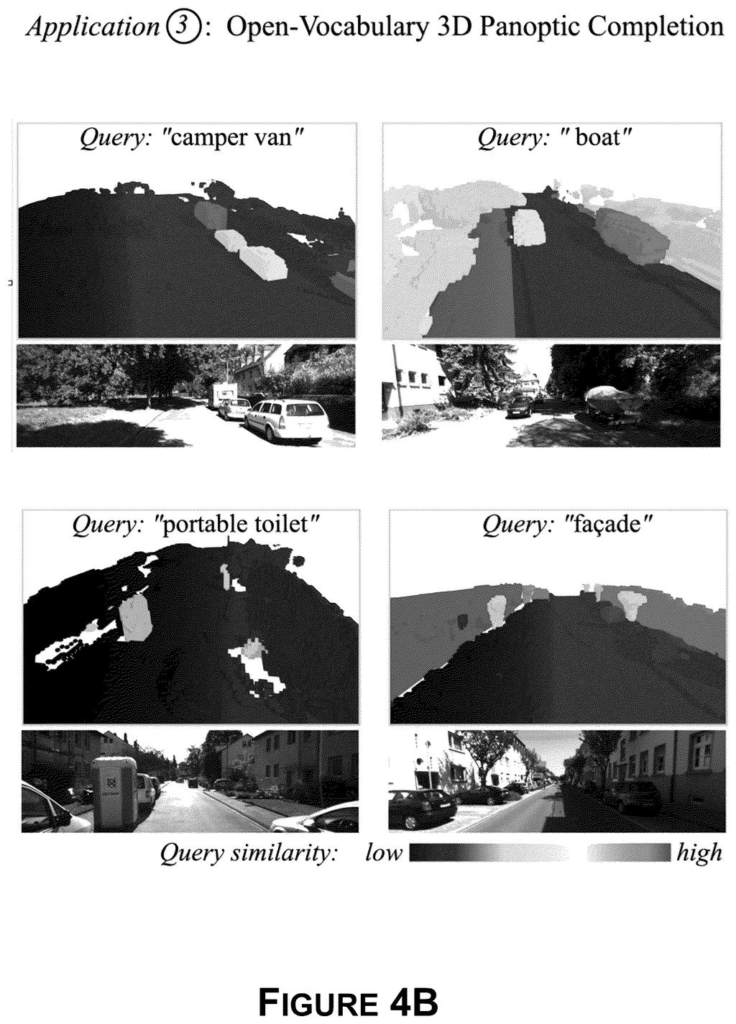
Once running, only LiDAR is needed. Text like 'pedestrian' or 'tow truck' is compared against each object's embedding to find matches.
To facilitate training on unlabeled data, class prototypes or pseudo-classes may be used in lieu of class labels.
Translation: The software teaches itself by sorting objects into temporary categories instead of relying on human labels.
Why a text-queried LiDAR model could matter on roads
If it works, cars and robots that use laser sensors could recognize odd things, such as construction barriers or debris, without engineers building a new hand-labeled dataset each time. The filing says current scene-completion methods top out at roughly 20 object classes, far fewer than the variety on a real road or warehouse floor.
For you, the benefit would show up indirectly: a driver-assist system or delivery robot that is less likely to treat an unfamiliar object as empty space. The filing also describes swapping word lists by setting, such as highway versus urban driving, or 'pallet' and 'forklift' in a warehouse. It remains a patent application describing a training method, not a shipping feature.
Nvidia's 96th filing we've tracked since May in our self-driving sensing race watch extends its camera work, building on seeing through rain and dim light and localization self-checks.
Roads are full of odd things: a couch on the highway, a tow truck half in your lane, a cone knocked sideways. The filing says today's best scene-completion methods handle only about 20 classes of object, and a system with that short a list will meet something outside it sooner or later.
Hand-labeling every rare object costs a fortune and never ends. Letting video and laser data label themselves matches the size of that problem well, and the text-query step is the sharpest part. Adding 'debris' to a word list is far cheaper than retraining a model.
The weak spot is the labels. They are machine guesses, and a model trained on guesses can repeat the mistakes. The portion of the filing we reviewed gives no accuracy numbers, so this reads as a sound plan that still needs proof.
Get our take in your Top Stories
Liked this breakdown? Add Patentlyze as a preferred source on Google, and our plain-English take shows up more often in your Top Stories the next time Nvidia patent news breaks.
There are more where this came from
We read every patent application Big Tech publishes and send you the ones worth knowing. Plain English, free, every week.
The drawings
17 drawing sheets from US 2026/0330644 A1 · click any drawing to enlarge


Show the other 9 sheets


Want this weekly breakdown for a company we don't cover? Patentlyze Pro →
Be the first to weigh in