
Sony Files Patent for Slimmer Display Glasses That Track Where You Look
Glasses that beam a picture into your eye usually need a thick slab of glass to carry the light. Sony's patent application shrinks that slab by watching where you look and sending only the slice of the picture you are looking at.
What Sony's gaze-following glasses display does
A man in a pair of video glasses keeps nudging them back up his nose after an hour. The glass that carries the picture is thick, and thick glass is heavy, sits too close to his eyes, and leaves no room for his own prescription glasses. If you have worn a headset for a long stretch, you know the feeling.
Sony's patent application goes after that thickness. A wide picture normally demands a thick plate, so Sony makes the plate thin and shows a narrower picture at any moment. A sensor watches your eye, and when you look left, the glasses swap in the left part of the scene.
The light is also aimed at the pivot point of your eyeball, so the image still enters your pupil as your eye turns. In Sony's worked example, the plate shrinks from 5.7 mm to 2.1 mm.
an eye tracking device that generates eyeball information of an eyeball of a user of the system; an image output device that outputs light to the eyeball of the user; and an image generator that generates and actively adjusts light traveling along an optical path to the image output device based on the eyeball information.
Translation: Sensors monitor your eyes so the hardware can dynamically alter the visuals directed at your face.
How Sony aims light at the pivot of your eye
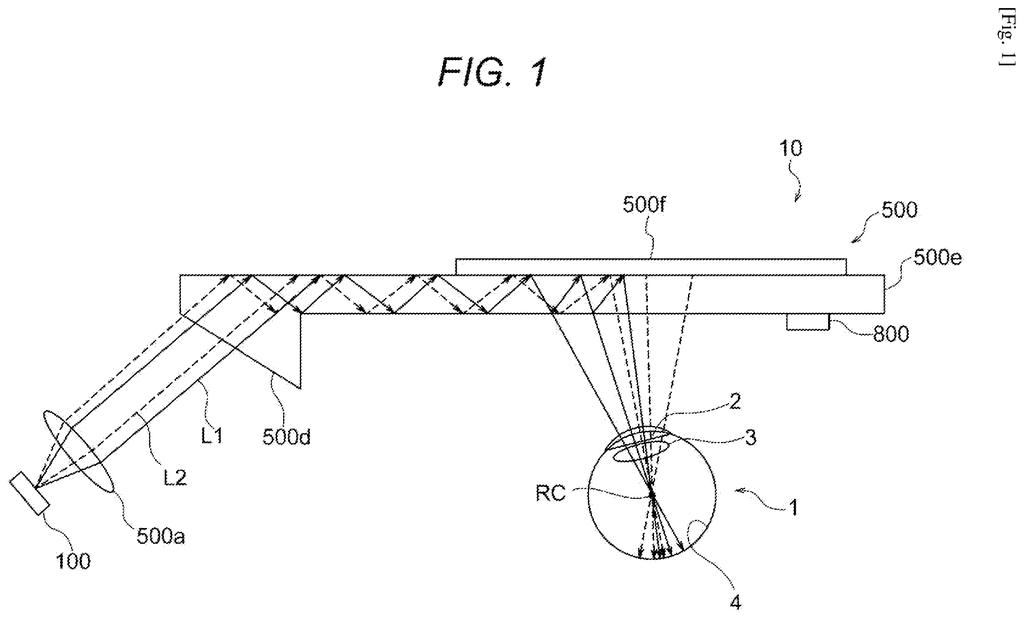
The system has three main parts: an eye tracker, an image generator, and an image output device. The eye tracker shines invisible infrared light at your eye and reads the reflection to work out your line of sight. It can also estimate your pupil size, using a brightness sensor and a stored table of average pupil sizes at different light levels.
The image generator uses a laser and a tiny movable mirror (a MEMS mirror, a microscopic mirror that tilts to paint a picture) to build the image. Based on the eye data, it switches which portion of the scene it sends. The light then travels inside a thin glass plate by bouncing off its inner surfaces, until a patterned layer (a diffraction grating, a fine pattern that bends light) redirects it toward your eye.
The key trick is that this layer focuses the light at or near the rotation center of the eyeball, within about 1.7 mm in the description. Because of that, the image keeps entering your pupil when your eye turns. The filing also describes:
- A controllable light shield (liquid crystal or a mask) that blocks parts of the light, with softened edges so the seams blur
- A motor that slides the plate toward or away from your eye
- A calibration step where you follow a marker on screen
- A sensor that measures the distance to your eye
The filing has three independent claims: one broad system, one built around the light source and a controller, and one method.
Why Sony wants thinner glass in display glasses
The practical payoff is comfort. Thick glass makes display glasses heavy at the front, which pulls them down your nose and can cause them to slip. It also pushes the lens close to your face, where your eyelashes brush it and your own glasses may not fit. In Sony's second example, the same 5.7 mm plate holds its image at a 53 mm eye distance instead of 14 mm, which would leave room for glasses.
The trade-off is that the glass shows a narrower slice of the picture (about ±7 degrees in the examples versus ±30 for the comparison design), so the design leans on the eye tracker working quickly. The filing says it is meant for augmented, virtual and mixed reality headsets, and it does not name a Sony product.
Sony's 41st filing we've tracked since July in the AR glasses race builds on hiding glitches behind blinks and training eye tracking on fake faces.
You would notice this one in the weight on your nose and in whether your own glasses fit under the headset. Those are the complaints that make people take a headset off after an hour, so a plate cut to under half its thickness goes after a real annoyance.
The catch is that you only get the benefit if the eye tracking keeps up. If the picture trails your gaze by even a moment, you would see the edges of the scene shift as you glance around, and that would be harder to forgive than a heavy frame.
Sony's own numbers come from a worked example, so treat them as a design target. As a pitch for lighter display glasses that fit over your own eyewear, though, it makes a clear and sensible case.
Get our take in your Top Stories
Liked this breakdown? Add Patentlyze as a preferred source on Google, and our plain-English take shows up more often in your Top Stories the next time Sony patent news breaks.
There are more where this came from
We read every patent application Big Tech publishes and send you the ones worth knowing. Plain English, free, every week.
The drawings
11 drawing sheets from US 2026/0329097 A1 · click any drawing to enlarge


Show the other 3 sheets


Want this weekly breakdown for a company we don't cover? Patentlyze Pro →
Be the first to weigh in