
Samsung Files Patent to Stitch a Wide Panorama From Phone Video of Moving Subjects
Zoom in on a runner and you lose the field around them; zoom out and the runner shrinks to a dot. Samsung's new patent describes a phone that records video as usual but also builds one wide picture showing everywhere the subject went.
What Samsung's moving-subject panorama video does
Every time you zoom in to film someone running across a park, the same trade-off shows up. You get a good look at the runner, but the surroundings fall out of the frame. Zoom back out and the runner turns into a blur.
Samsung's filing describes a phone that tracks where your subject moves while you record. Behind the scenes, it lines up the frames along that path and sews them into one big, wide picture of the whole scene. Any empty patches at the edges get filled in using nearby pixels from the real footage.
Both the wide picture and your original frames are saved together in a single video file. When you play it back, you see the broader scene, so you can follow the full path the subject took.
… estimate a movement trajectory of the object included in the plurality of frame images, stitch together frame images in which overlapping portions of the video signal are arranged to overlap according to the movement trajectory of the object to generate a stitched image having a second size larger than the first size; …
Translation: The software tracks the path of a moving subject across video frames to stitch them into a larger panoramic image.
How the phone tracks and sews together frames
While you record, the phone saves each frame (one of the still pictures that make up a video) and locks onto the moving subject. That can be something you tap on, or something the phone recognizes as a person, animal or object. It then measures how the subject shifts from frame to frame using motion vectors (a direction and a distance for each step). The filing says the phone also accounts for its own movement, using sensors like a gyroscope, so your hand wobble is not mistaken for the subject moving.
The path gets cleaned up in a few steps:
- Check: each motion reading is tested against a set threshold, and unreliable ones are dropped and replaced with estimates based on neighboring frames.
- Smooth: small shake is filtered out of the path.
- Size and scale: the phone predicts how big the final wide picture will be and resizes every frame to fit.
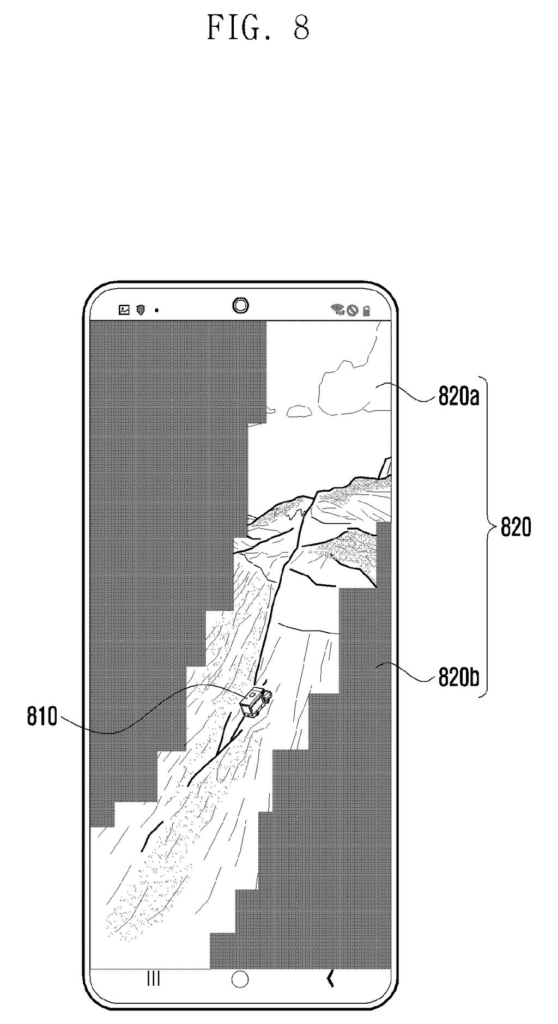
Next, the frames are laid on top of each other along the path and stitched together. The result has a frame area of real pixels and a blank area the camera never saw, which the claims say is filled in using the real pixels around it. The wide picture and the original frames are then stored as one video file, and the wide picture is what you see on playback.
Because the picture keeps growing as you film, the description says the phone can predict when the file will pass a size limit and show an on-screen message to wrap up.
Why wider phone video could change zoomed clips
If you film kids, pets or sports from a distance, you usually have to choose between a close view and the surroundings. This patent describes a way to keep both from a single recording, so you could see where a subject traveled without moving closer or switching to a wider lens.
It also looks designed for a phone that has limited power and storage. The filing says the processing happens frame by frame as you record, and it plans around file size from the start. The patent does not say whether it would ever appear as a feature in a camera app.
Samsung's 1523rd filing we've tracked since May adds to a run that includes fixing blinks in photos and hiding 3D data in video.
The clearest cost is size. Every second of footage adds to a growing wide picture, so the file can balloon fast, and Samsung's own filing answers that by capping how long you can record. That is a reasonable limit for a phone, but it means long clips simply will not get this treatment.
The subtler cost is accuracy. The wide picture fills its empty edges with pixels guessed from neighboring real ones, so part of what you see on playback is a reconstruction, not a direct record. Fine for a keepsake of a school race; less comfortable if anyone ever treats the image as proof of exactly what happened.
Both costs feel manageable for the job this feature is built for. You give up file space and a little literal precision; you get a single picture that shows where your subject went and what they were doing the whole time.
Get our take in your Top Stories
Liked this breakdown? Add Patentlyze as a preferred source on Google, and our plain-English take shows up more often in your Top Stories the next time Samsung patent news breaks.
There are more where this came from
We read every patent application Big Tech publishes and send you the ones worth knowing. Plain English, free, every week.
The drawings
10 drawing sheets from US 2026/0330650 A1 · click any drawing to enlarge


Show the other 2 sheets


Want this weekly breakdown for a company we don't cover? Patentlyze Pro →
Be the first to weigh in