
Google Files Patent for Reaction Videos Recorded Right on Your Phone
Making a reaction or commentary video usually means filming yourself, recording your screen, and gluing the two together afterward. A new Google patent application describes doing all of that in a single step, as it happens.
What Google's self-capture overlay actually does
Every time someone makes a reaction video, the same chore repeats: film your face, record your screen separately, then stitch the two together in an editing app. It's slow, and the timing is easy to get wrong.
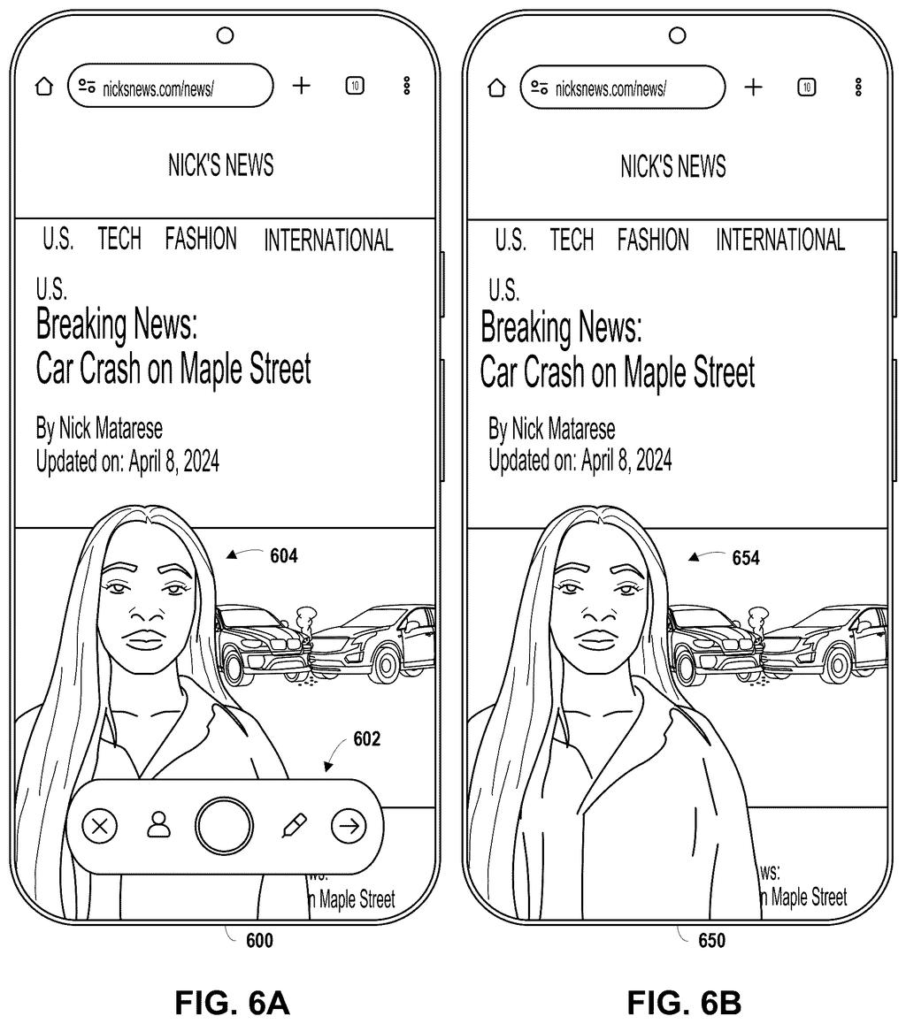
Google's patent application describes a way to do all of it at once. Your front camera records you, and the software erases the room behind you, leaving just you. At the same moment, it captures whatever is on your screen, like a game, a news article or a shopping page. It then lays you over that content and shows the finished video as you record.
You could also point at things on screen to trigger effects, or stream the result live to an audience. The filing presents this as a way to make commentary videos without juggling several different apps.
generating, by a computing device, a foreground data stream by at least removing a background region of video input, the video input received via a camera component of the computing device …
Translation: The phone uses its camera to film you and cuts out everything behind you.
How your face gets cut out and layered on screen
The core idea is a layered video recorder built into the device. It takes a feed from the camera and removes the background region of each frame, leaving only the person (the filing calls this the foreground stream). Separately, it takes a second feed from the graphics system, which is whatever an app is drawing on screen (the background stream). It then stacks the person over the screen content and shows the result in a viewing window.
To cut the person out, the filing describes two options. One is chroma keying (dropping every pixel in a chosen color range, the way a green screen works). The other is a machine learning model that learns to tell a person from a room. The software builds a mask (a map of which pixels are you), smooths the edges, and makes everything else transparent. The screen capture also leaves out the recorder's own buttons.
The claims add several optional features:
- Gestures: pointing or similar motions can trigger a markup effect or a zoom on part of the screen.
- Suggested actions: information about what's on screen, such as a game title or web address, can produce a tappable element that opens the app or page.
- Layer editing: a timeline-style panel gives each layer its own track.
- Effects from a machine learning model and uploading to a sharing platform, where viewers' text comments can appear as another layer.
The description also says the video can be uploaded in close to real time for live commentary, and mentions video calls where both people appear over an app.
… generating, by the computing device, video content by at least superimposing a first layer over a second layer, the first layer associated with the foreground data stream and the second layer associated with the background data stream …
Translation: The phone then places your cutout on top of whatever app content you are using.
Why reaction videos could get easier to make
If you make videos about games, articles, products or tutorials, the appeal is fewer steps. Today that job often means three separate apps and files that don't always agree on format. The filing argues that doing it in one pass also saves battery and processing work, though it offers no measurements to back that up.
The examiner's first review rejected the claims as filed, which is routine at this stage and usually leads to amendments. The patent application describes a feature, not a product, and says nothing about where or whether it would ship. It does list phones, tablets, laptops, TVs and VR headsets as possible devices. Live comments appearing on the creator's screen and the shared video are a notable touch for streamers.
Google's 68th filing we've tracked since May in the AI photo editing race builds on earlier applications like learning a style from few images and one sweep into panoramic video.
For anyone who has made a reaction video, the benefit here is easy to feel: you hit record, talk over what's on your screen, and the finished clip is already there. The steps that disappear are exactly the dull ones, like lining up two recordings and exporting in the right format.
If you never make videos, you would likely never notice this feature. The gesture effects and tappable suggestions are fun extras, and the claims treat them as add-ons to the main layering idea.
The broad core claim, a person cut out and placed over live screen content, will probably be argued over during review. Whatever survives, the everyday payoff stays modest and clear: less editing for people who already make this kind of video.
Get our take in your Top Stories
Liked this breakdown? Add Patentlyze as a preferred source on Google, and our plain-English take shows up more often in your Top Stories the next time Google patent news breaks.
There are more where this came from
We read every patent application Big Tech publishes and send you the ones worth knowing. Plain English, free, every week.
The drawings
9 drawing sheets from US 2026/0320851 A1 · click any drawing to enlarge


Show the other 1 sheets

Want this weekly breakdown for a company we don't cover? Patentlyze Pro →
Be the first to weigh in