
Apple · Filed May 22, 2026 · Published Oct 22, 2026

A New Apple Patent Gives a Headset Travel Case a Handle That Hides Itself

Apple's latest case filing is about a handle: a carry strap that tucks itself flat against the case when you let go, so it never snags on anything in your bag.
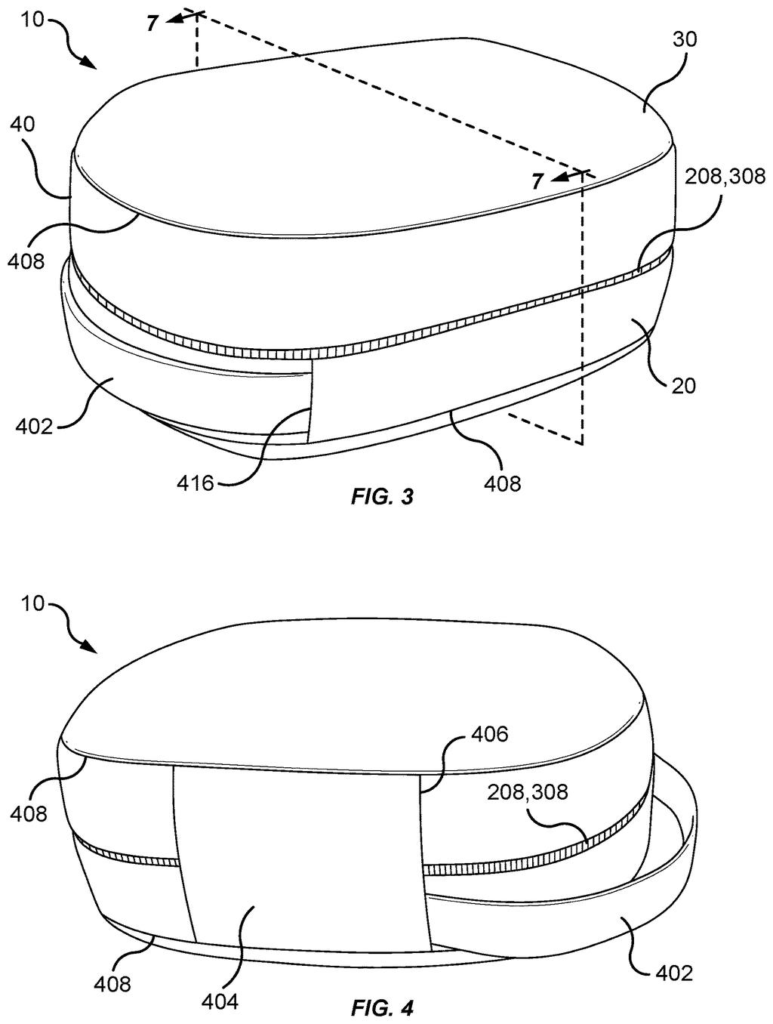
A headset travel case with a flexible carrying handle that pulls out when needed and tucks flat against the side when not in use. Drawing from patent filing US 2026/0324825 A1.
A headset travel case with a flexible carrying handle that pulls out when needed and tucks flat against the side when not in use.
See all 24 drawings from this filing ↓
Publication number US 2026/0324825 A1 US20260324825A1
Applicant Apple Inc.
Filing date May 22, 2026
Publication date Oct 22, 2026
Inventors Jae Hwang LEE, J. Gerson GOLDBERG, Mitchell SUCKLE, Roger FAN
US classification 206/521
Status when we published Waiting for an examiner (Jul 17, 2026)
Parent application is a Continuation of 18417829 (filed 2024-01-19)
Document 20 claims

What Apple's spring-loaded case handle does

Every time you grab a bag or case by its strap, the strap flops around afterward. It dangles, tangles with your charger cable, or catches on a zipper. Anyone who has packed a travel case knows the annoyance.

Apple's filing describes a hard-shelled, two-halves case (the examples are built around a headset like a VR or AR headset, plus accessories) with a handle that retracts on its own. You pull it out to carry the case. When you let go, a spring draws it back flush against the case.

The filing also describes a soft, puffy outer layer over the hard shell, so the case feels more like a padded jacket than a plastic box.

From the filing · CLAIM 1
… a handle movably connected to the sliding mechanism and configured to move between a nominal position and an extended position, wherein the sliding mechanism biases the handle into the nominal position.

Translation: A spring-loaded grip pulls itself flat when you let go.

How the handle slides out and snaps back

The claims cover a case with two shells joined by a hinge, like a clamshell. A handle is attached to one of the shells through a sliding mechanism, and that mechanism pushes the handle back into its resting ("nominal") position whenever nothing is pulling on it.

In the more detailed version, each end of the handle sits in a small pocket in the case's fabric, one under the hinge and one on the opposite side. Inside the pocket, a track (a short rail) is riveted to the hard shell, and a bar slides along it. The end of the handle hooks onto the bar, and a spring connects the bar back to the track. Pull the handle and the spring stretches. Let go and it pulls the handle back in.

A second independent claim focuses on the pockets themselves: the handle's ends live in pockets formed underneath the hinge, and they extend out or retract into them.

The description adds other details:

  • Each shell has a hard layer (thermoformed polycarbonate) under a flexible fabric jacket.
  • Layers of batting, like in a puffer jacket, cushion the outside.
  • A zipper closes the case.
  • A sliding shield inside adjusts to different headset sizes.

Why Apple is filing on a carrying case

For you, the benefit is small but real: a case that looks clean on a shelf and in a bag, and a handle that doesn't snag. The filing says the handle retracts "to provide a clean look and inhibit the handle catching or tangling inadvertently."

The larger picture is about accessories. The case is built around head-mounted displays, which are expensive, sized to the individual, and awkward to carry. A soft-feeling, adjustable case that holds a headset and its battery is a way to make that kind of device feel less like gear and more like something you'd carry every day. The filing notes the same ideas could apply to headphones, phones, cameras and smart watches.

Apple's 15th filing in our wearable tech coverage since May follows ideas like earbuds that detect sleep and a watch tracking fertility, showing how broadly Apple is exploring what a device on your body might sense.

Editorial take

This one is close to a shippable object. A spring, a rail and a few pockets in the fabric are ordinary parts, with no new chips, no software and nothing that has to be invented first. A factory that makes soft-sided luggage could build the handle tomorrow.

That also makes the filing modest. The headline feature is a handle that retracts, and the claims lean on common parts like a track, a bar and a spring. Whether Apple ever sells a case like this is a business decision, not an engineering one.

The more interesting idea is buried in the description: a single case with a sliding shield that fits headsets with different face cushions. If Apple wants to ship fewer case variants, that is the part to watch, though it is not what these claims cover.

Get our take in your Top Stories

Liked this breakdown? Add Patentlyze as a preferred source on Google, and our plain-English take shows up more often in your Top Stories the next time Apple patent news breaks.

There are more where this came from

We read every patent application Big Tech publishes and send you the ones worth knowing. Plain English, free, every week.

The drawings

24 drawing sheets from US 2026/0324825 A1 · click any drawing to enlarge

Open travel case holding a headset and battery, drawing sheet 1 from US 2026/0324825 A1
Sheet 1 Open travel case holding a headset and battery
Storage compartments tailored to fit gear securely, drawing sheet 2 from US 2026/0324825 A1
Sheet 2 Storage compartments tailored to fit gear securely
Retractable handle that pulls out and springs back, drawing sheet 3 from US 2026/0324825 A1
Sheet 3 Retractable handle that pulls out and springs back
Inside layers of the headset half of the shell, drawing sheet 4 from US 2026/0324825 A1
Sheet 4 Inside layers of the headset half of the shell
Outer padding layers with built-in handle slots, drawing sheet 5 from US 2026/0324825 A1
Sheet 5 Outer padding layers with built-in handle slots
Interior layers designed for holding the battery pack, drawing sheet 6 from US 2026/0324825 A1
Sheet 6 Interior layers designed for holding the battery pack
Exterior cushioning layers of the accessory shell, drawing sheet 7 from US 2026/0324825 A1
Sheet 7 Exterior cushioning layers of the accessory shell
Protective layers lining the closed clamshell body, drawing sheet 8 from US 2026/0324825 A1
Sheet 8 Protective layers lining the closed clamshell body
Show the other 16 sheets
Soft exterior padding flexing under pressure to absorb bumps, drawing sheet 9 from US 2026/0324825 A1
Sheet 9 Soft exterior padding flexing under pressure to absorb bumps
Outer foam layers cushioning a hard inner shell during impacts, drawing sheet 10 from US 2026/0324825 A1
Sheet 10 Outer foam layers cushioning a hard inner shell during impacts
A curved rim capping the edge of the molded foam, drawing sheet 11 from US 2026/0324825 A1
Sheet 11 A curved rim capping the edge of the molded foam
An adjustable divider placed near the case front, drawing sheet 12 from US 2026/0324825 A1
Sheet 12 An adjustable divider placed near the case front
Sliding the internal divider back to fit a larger headset, drawing sheet 13 from US 2026/0324825 A1
Sheet 13 Sliding the internal divider back to fit a larger headset
Parts of the sliding divider mechanism laid out in order, drawing sheet 14 from US 2026/0324825 A1
Sheet 14 Parts of the sliding divider mechanism laid out in order
Lifting the pull tab to release the fastener, drawing sheet 15 from US 2026/0324825 A1
Sheet 15 Lifting the pull tab to release the fastener
How the divider secures a headset inside the bottom shell, drawing sheet 16 from US 2026/0324825 A1
Sheet 16 How the divider secures a headset inside the bottom shell
Moving the divider back makes room for a bigger headset, drawing sheet 17 from US 2026/0324825 A1
Sheet 17 Moving the divider back makes room for a bigger headset
Pulling up the tab lets the partition slide and lock, drawing sheet 18 from US 2026/0324825 A1
Sheet 18 Pulling up the tab lets the partition slide and lock
A separate compartment in the lid holds the battery pack, drawing sheet 19 from US 2026/0324825 A1
Sheet 19 A separate compartment in the lid holds the battery pack
Parts of the battery holder taken apart before assembly, drawing sheet 20 from US 2026/0324825 A1
Sheet 20 Parts of the battery holder taken apart before assembly
An open strap ready to wrap around the battery, drawing sheet 21 from US 2026/0324825 A1
Sheet 21 An open strap ready to wrap around the battery
Fastening the strap locks the battery firmly in place, drawing sheet 22 from US 2026/0324825 A1
Sheet 22 Fastening the strap locks the battery firmly in place
Hidden springs inside the seam pull the handle flat, drawing sheet 23 from US 2026/0324825 A1
Sheet 23 Hidden springs inside the seam pull the handle flat
Springs mounted along the rim automatically retract the strap, drawing sheet 24 from US 2026/0324825 A1
Sheet 24 Springs mounted along the rim automatically retract the strap
Browse all the drawings 24 drawing sheets
Patent filing page

Source. Full patent text and figures from the official USPTO publication PDF.
Reader comments

Be the first to weigh in

Start the discussion

Real name or a handle, either is fine. Comments are read by a person before they appear, so allow a little time. Keep it about the filing.