
Apple Patents a Foam-Filled Eartip Designed to Fit More Ears
Getting earbuds to seal properly in every ear shape is one of the oldest headphone problems around, and Apple's latest patent filing suggests the company is rethinking the eartip itself, not just the audio inside it.
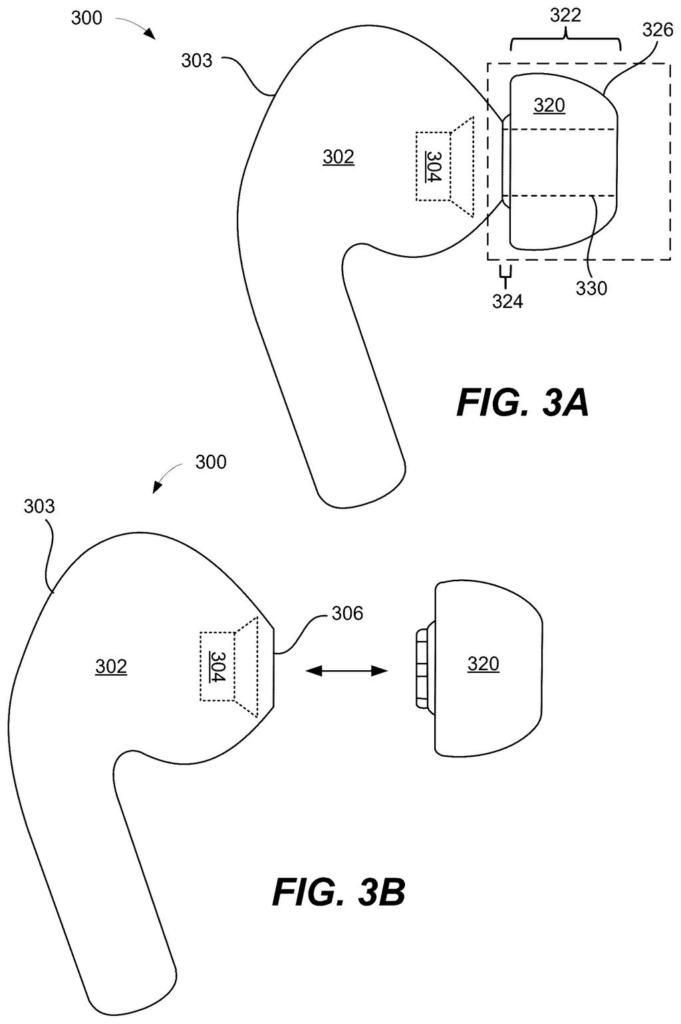
What Apple's foam-and-rubber eartip actually does
Imagine slipping on a pair of earbuds and, for once, they just stay put without you constantly readjusting them. That comfortable, locked-in feeling depends almost entirely on the small silicone tip that sits inside your ear canal, and most tips today either feel too rigid or too floppy.
Apple's new patent describes an eartip that layers two different materials into one piece: a firm silicone rubber structure that holds its shape and channels sound, plus a section of closed-cell silicone foam (think tiny sealed air bubbles, like the padding inside a bicycle helmet) packed around the inner tube. The foam fills the space between the inner sound channel and the outer rim, giving the tip a softer feel that can compress and conform to the shape of your ear.
The outer flange, that thin petal-like edge you see on an eartip, is kept separate from the foam section by a small gap Apple calls a deflection zone. That gap lets the rim flex independently so it can hug the contours of your ear canal without the whole tip going stiff.
… a closed-cell silicone foam section formed on and completely surrounding a portion of an outer surface of the annular inner body adjacent to the first end and extending to the outer flange thereby filling in space between the annular inner body and outer flange …
Translation: The eartip uses a layer of foam to fill the gap between the inner tube and the outer shell for a better fit.
How the foam layer and rubber flange work together
The patent describes a single, one-piece eartip body made of silicone rubber, with two main structural parts: an annular inner body (a hollow tube that carries sound from the earbud driver to your eardrum) and an annular outer flange (the soft, petal-shaped rim that presses against the walls of your ear canal to create a seal).
Between those two parts, Apple packs in a section of closed-cell silicone foam, a material where each tiny air bubble is completely sealed off from its neighbors. Unlike open-cell foam (which behaves more like a kitchen sponge), closed-cell foam springs back reliably and resists absorbing moisture. The foam completely surrounds part of the inner tube and extends outward to meet the outer flange, filling what would otherwise be empty space.
A small gap called the deflection zone sits between the outer flange and the foam-covered inner wall. This gap is the mechanical key to the design: it lets the outer rim flex and deflect inward when it meets resistance from your ear canal, without that force immediately stiffening the entire structure.
- Rigid inner frame: A firm ring couples to the base of the inner tube, aligning with the sound channel and giving the eartip a stable connection point to the earbud stem.
- Monolithic outer body: The rubber inner tube and outer flange are molded as one piece, so there are no seams to split or parts to misalign.
- Foam insert: The silicone foam is formed directly onto the rubber body rather than glued, so the two materials are structurally bonded.
… a deflection zone formed between the annular outer flange and the inner wall; and an annular rigid frame coupled to the annular inner body and defining a central frame opening formed through the frame that is aligned with the sound channel …
Translation: The design includes a flexible area that allows the tip to bend and a hard plastic ring to attach it to the earbud.
What this means for AirPods Pro comfort and fit
Poor eartip fit is not a niche complaint. Studies on hearing-aid and earphone use consistently find that fit is the top reason people stop wearing in-ear devices, and a bad acoustic seal can wipe out most of the benefit of active noise cancellation. For Apple, whose AirPods Pro rely heavily on that seal for both noise blocking and the Transparency mode that lets ambient sound back in, an eartip that fits a wider range of ear shapes has real commercial stakes.
Apple already ships four eartip sizes with AirPods Pro and includes an automatic ear-tip fit test in iOS, which tells you how well the seal is working. This patent suggests the company may be exploring materials that handle fit variation in the tip itself rather than asking users to swap sizes. That would reduce the friction of setup and potentially shrink the number of size options needed. Apple's move toward foam-composite eartips sits within a broader wave of new Big Tech patents targeting wearable comfort, where the materials question is becoming as competitive as the audio engineering.
Apple's 11th filing in our Wearable patents we cover since May follows work like a heart-risk warning patent and the Watch crown mechanics.
Earbuds that don't fit are earbuds that don't work. The seal between the tip and your ear canal is what makes noise cancellation function and bass sound full, so when that seal slips, a hundred-dollar audio experience collapses into something worse than cheap headphones.
Fusing a foam interior directly into the rubber tip during manufacturing means the foam can't migrate, compress unevenly, or degrade separately from the shell. That structural choice addresses why foam tips historically fail, not just how they feel on day one.
The remaining honesty is that human ears vary too much for any single shape to solve the fit problem completely. Multiple sizes would still matter. But for the specific failure this targets, the engineering is proportionate to the cost.
Get our take in your Top Stories
Liked this breakdown? Add Patentlyze as a preferred source on Google, and our plain-English take shows up more often in your Top Stories the next time Apple patent news breaks.
There are more where this came from
We read every patent application Big Tech publishes and send you the ones worth knowing. Plain English, free, every week.
The drawings
8 drawing sheets from US 2026/0255095 A1 · click any drawing to enlarge


Want this weekly breakdown for a company we don't cover? Patentlyze Pro →
Be the first to weigh in