
Samsung · Filed Feb 11, 2026 · Published Oct 22, 2026

A New Samsung Patent Teaches a Ring to Recalibrate When It Spins on Your Finger

A ring spins on your finger all day, and every spin changes what its sensor thinks your hand is doing. Samsung's filing describes a ring that works out how it's sitting and fixes its own readings.
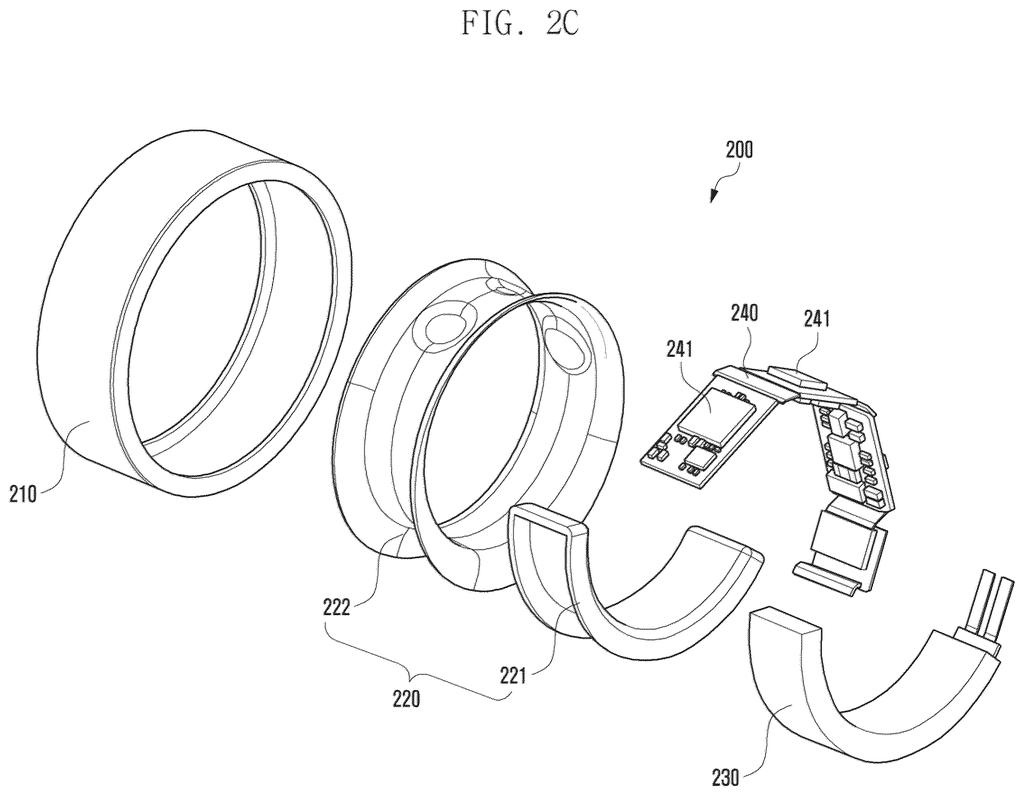
Inner components of a smart ring show how the battery, sensors, and computer chips fit together inside the wearable band. Drawing from patent filing US 2026/0325009 A1.
Inner components of a smart ring show how the battery, sensors, and computer chips fit together inside the wearable band.
See all 30 drawings from this filing ↓
Publication number US 2026/0325009 A1 US20260325009A1
Applicant Samsung Electronics Co., Ltd.
Filing date Feb 11, 2026
Publication date Oct 22, 2026
Inventors Yongsang CHO, Wonsuk Chung, Cheolo Kim, Jinyoup Ahn
US classification 600/595
Status when we published Waiting for an examiner (Aug 4, 2026)
Parent application is a Continuation of PCTKR2026000608 (filed 2026-01-12)
Document 20 claims

What Samsung's finger-ring recalibration does

A smartwatch stays put on your wrist, and a headset stays put on your head. A ring does not. It can go on a little differently each morning, and it can slowly rotate while you wear it. The same wave of your hand then looks different to the motion sensor inside, so gesture controls can misfire.

Samsung's filing describes a ring that figures out how it's currently sitting and adjusts for it. In one version, the ring asks you to do a simple move, like pressing your index finger against your thumb and then spreading them apart. From that, it works out which way its sensor is facing and corrects everything it measures afterward.

It can also do this without bothering you. While you walk or run, the swing of your arm gives the ring enough clues to recalibrate in the background.

From the filing · CLAIM 1
generate a first message requesting a user to perform a specified first gesture; obtain, at least based both on the generation of the first message and data generated by the motion sensor, a first vector and a second vector indicating acceleration in a direction of gravity using; …

Translation: The ring prompts you to make a specific hand movement so motion sensors can measure gravity.

How the ring figures out which way is up

The ring has a motion sensor (an accelerometer, which measures how fast the device speeds up or slows down along three directions, called x, y and z). Because the ring can rotate on the finger, those three directions point somewhere different each time you wear it. The patent's job is to find that rotation and cancel it out.

The main method works like this:

  • The ring sends a message, usually to your phone, asking you to do a specific gesture.
  • During the gesture, the ring records two readings of the direction gravity pulls, before and after the move.
  • From those two readings it builds its own three-direction map and calculates a correction (a rotation matrix, which is a recipe for turning the sensor's view back to a standard one).
  • It applies that correction to all later sensor data.

If the two gravity readings are too close together in angle, the correction would be unreliable, so the ring asks you to repeat the gesture.

There are backups. If you're lying down, or the sensor samples slowly to save battery, the ring asks for a bigger, slower gesture: pointing a finger forward and raising and lowering the arm. The third version needs no request at all. While you walk or run, the ring spots the forward direction, collects acceleration readings as your arm swings back and forth, and averages them over time.

From the filing · THE ABSTRACT
… calculate a correction value to convert the first x-axis acceleration value, the first y-axis acceleration value, and the first z-axis acceleration value into a second x-axis acceleration value, a second y-axis acceleration value, and a second z-axis acceleration value measured when the electronic device is in a specified wearing state.

Translation: It mathematically adjusts the sensor data to account for the ring spinning out of position on your finger.

Why a spinning ring matters for gesture control

If smart rings are going to control things like answering a call, taking a photo or pausing music with a flick of the hand, the gesture has to register the same way every time. A ring that works fine on Monday and misses your gestures after it twists around on Tuesday would frustrate people quickly. Self-calibration means you can put the ring on any way, and it simply works.

The filing also says the same idea could apply to smartwatches, earbuds and headsets, which sit slightly differently on every person. That would spare you from entering which hand you wear a watch on or retraining a device each time you adjust it. Like any patent application, this shows what Samsung is exploring, not a product that is coming.

Samsung's 29th filing we've tracked since June in our wearables that read your body watch list follows earlier applications like a heartbeat ID ring and a warm-wrist blood pressure watch.

Editorial take

For you, the benefit shows up as something that doesn't happen: a gesture that works every time, no matter how the ring has turned on your finger. If you wear a ring daily, that is the difference between a gadget you trust and one you stop using.

The quick calibration gesture asks for a few seconds of effort at most, and the walking-based option asks for nothing. That second route is the one most people would prefer, because nobody wants a setup chore each time they take a ring off to wash dishes.

The idea itself is fairly basic, since sensors need correcting whenever they can tilt. Still, it solves a real everyday annoyance for ring wearers, and the fact that it works in the background is what makes it worth building.

Get our take in your Top Stories

Liked this breakdown? Add Patentlyze as a preferred source on Google, and our plain-English take shows up more often in your Top Stories the next time Samsung patent news breaks.

There are more where this came from

We read every patent application Big Tech publishes and send you the ones worth knowing. Plain English, free, every week.

The drawings

30 drawing sheets from US 2026/0325009 A1 · click any drawing to enlarge

Internal parts and network links of a connected smart device, drawing sheet 1 from US 2026/0325009 A1
Sheet 1 Internal parts and network links of a connected smart device
Angled view of a smart ring with inner sensors, drawing sheet 2 from US 2026/0325009 A1
Sheet 2 Angled view of a smart ring with inner sensors
Looking through the smart ring showing contact bumps, drawing sheet 3 from US 2026/0325009 A1
Sheet 3 Looking through the smart ring showing contact bumps
Inside components of the smart ring laid out in order, drawing sheet 4 from US 2026/0325009 A1
Sheet 4 Inside components of the smart ring laid out in order
Wireless connection between a smart ring and a phone, drawing sheet 5 from US 2026/0325009 A1
Sheet 5 Wireless connection between a smart ring and a phone
Three axes measured by the ring motion sensor, drawing sheet 6 from US 2026/0325009 A1
Sheet 6 Three axes measured by the ring motion sensor
Direction readings when a hand moves with the ring aligned, drawing sheet 7 from US 2026/0325009 A1
Sheet 7 Direction readings when a hand moves with the ring aligned
Shifted motion readings after the ring rotates on your finger, drawing sheet 8 from US 2026/0325009 A1
Sheet 8 Shifted motion readings after the ring rotates on your finger
Show the other 22 sheets
Pointing down establishes a reference direction for the ring, drawing sheet 9 from US 2026/0325009 A1
Sheet 9 Pointing down establishes a reference direction for the ring
Angling the finger upward gives a second reference direction, drawing sheet 10 from US 2026/0325009 A1
Sheet 10 Angling the finger upward gives a second reference direction
Calculating a three-dimensional coordinate frame from hand motions, drawing sheet 11 from US 2026/0325009 A1
Sheet 11 Calculating a three-dimensional coordinate frame from hand motions
Math used to determine a rotation matrix for recalibration, drawing sheet 12 from US 2026/0325009 A1
Sheet 12 Math used to determine a rotation matrix for recalibration
Raw motion sensor signals before recalibration, drawing sheet 13 from US 2026/0325009 A1
Sheet 13 Raw motion sensor signals before recalibration
Adjusted motion signals after applying the rotation matrix, drawing sheet 14 from US 2026/0325009 A1
Sheet 14 Adjusted motion signals after applying the rotation matrix
Distorted motion signals recorded when the ring is twisted, drawing sheet 15 from US 2026/0325009 A1
Sheet 15 Distorted motion signals recorded when the ring is twisted
Recalibrated motion signals restoring accuracy after a twist, drawing sheet 16 from US 2026/0325009 A1
Sheet 16 Recalibrated motion signals restoring accuracy after a twist
How the ring tracks tilt using straight line hand movements, drawing sheet 17 from US 2026/0325009 A1
Sheet 17 How the ring tracks tilt using straight line hand movements
Distorted motion signals measured before correcting for ring tilt, drawing sheet 18 from US 2026/0325009 A1
Sheet 18 Distorted motion signals measured before correcting for ring tilt
Cleaned up motion readings after correcting for the tilted angle, drawing sheet 19 from US 2026/0325009 A1
Sheet 19 Cleaned up motion readings after correcting for the tilted angle
Motion data distorted by an opposite tilt before calibration, drawing sheet 20 from US 2026/0325009 A1
Sheet 20 Motion data distorted by an opposite tilt before calibration
Restored movement signals aligned with the user's actual gestures, drawing sheet 21 from US 2026/0325009 A1
Sheet 21 Restored movement signals aligned with the user's actual gestures
Detecting ring rotation automatically from normal arm swings while walking, drawing sheet 22 from US 2026/0325009 A1
Sheet 22 Detecting ring rotation automatically from normal arm swings while walking
Steps for turning corrected sensor readings into smart ring commands, drawing sheet 23 from US 2026/0325009 A1
Sheet 23 Steps for turning corrected sensor readings into smart ring commands
Prompting a guided hand movement to recalculate the ring's alignment, drawing sheet 24 from US 2026/0325009 A1
Sheet 24 Prompting a guided hand movement to recalculate the ring's alignment
Onscreen instructions guide a finger pinch to reset sensor alignment, drawing sheet 25 from US 2026/0325009 A1
Sheet 25 Onscreen instructions guide a finger pinch to reset sensor alignment
Prompts asking for a slower motion after failed resets, drawing sheet 26 from US 2026/0325009 A1
Sheet 26 Prompts asking for a slower motion after failed resets
Calculating a ring orientation fix from up and down movement, drawing sheet 27 from US 2026/0325009 A1
Sheet 27 Calculating a ring orientation fix from up and down movement
A phone app directs vertical hand shakes for recalibration, drawing sheet 28 from US 2026/0325009 A1
Sheet 28 A phone app directs vertical hand shakes for recalibration
Settings let users turn on automatic fixes during daily walks, drawing sheet 29 from US 2026/0325009 A1
Sheet 29 Settings let users turn on automatic fixes during daily walks
How the ring realigns sensors as your arms swing, drawing sheet 30 from US 2026/0325009 A1
Sheet 30 How the ring realigns sensors as your arms swing
Browse all the drawings 30 drawing sheets
Patent filing page

Source. Full patent text and figures from the official USPTO publication PDF.
Reader comments

Be the first to weigh in

Start the discussion

Real name or a handle, either is fine. Comments are read by a person before they appear, so allow a little time. Keep it about the filing.