
Apple Patents a Watch That Predicts Your Period and Fertile Days From Heart Rate
Your resting heart rate typically rises by about two beats per minute during your fertile window, and Apple's filing describes a watch that uses that tiny shift to predict your fertile days and your next period.
What Apple's heart-rate cycle tracker actually does
Most cycle trackers guess your next period from the dates you log and a running average. That works until your cycle turns irregular, and then planning a trip, a doctor visit or a pregnancy attempt becomes a coin flip. Apple's filing adds a new clue to the mix: your resting heart rate.
According to the filing, resting heart rate typically climbs by about two beats per minute around your fertile window, then drops again as your next period approaches. A watch worn day and night can notice that shift without you doing anything, and it uses the pattern to adjust its guesses.
You still log your period, and the system checks how well its earlier predictions held up. It only changes your calendar when it is confident, so your dates don't jump around from day to day.
… an ovulation estimator operative to: receive the processed data set from the preprocessing module; and use the processed data set to estimate a fertility window; and a period estimator operative to: receive the processed data set and an output from the ovulation estimator; and use the processed data set and the output from the ovulation estimator to estimate a period date.
Translation: Specialized software components calculate your fertile days and upcoming period using your heart rate data.
How the watch turns heart rate into fertile days
The claims describe a wearable with a heart rate sensor and three main pieces of software. A calendar module holds your logged periods and an initial guess. A preprocessing module blends that guess with heart rate data into one clean data set. An ovulation estimator then predicts your fertility window, and a period estimator uses that output to predict your next period date.
The preprocessor is picky. In one example, it needs heart rate data on at least 23 of the last 45 days (roughly half) before it passes anything along. It favors basal sedentary heart rate, meaning your lowest readings while at rest, such as the bottom 10% of a day's samples, both awake and asleep.
The ovulation estimator can combine an LSTM neural network (a type of AI that learns patterns across a sequence of days) with a deep neural network. It scores each of the next 30 or so days for how likely it is to fall in your fertile window. The filing describes making several of these predictions on consecutive days and comparing them: days where they agree count as more reliable.
Updates reach your calendar only under rules. A new fertile window must still be in the future, and a period estimate can update once per cycle. Dates can also be shaded by likelihood.
A mechanism for estimating windows for menstrual cycles and fertility. The mechanism tracks menstrual cycles based on accuracy of predictions as compared to user input logging the start and stop of a cycle; this user input and the accuracy of prior cycle predictions is used to improve and update future predictions.
Translation: The system gets smarter over time by comparing its guesses against the dates you actually log.
Why your calendar could correct itself mid-cycle
The practical payoff is for anyone who plans around their cycle: trying to conceive, avoiding pregnancy, or booking travel. Instead of leaning only on the dates you log, a watch you already wear to bed could feed its guesses with data it collects on its own. The filing even describes versions that skip manual logging entirely, and ones that add a temperature sensor or a sleep monitor under the mattress.
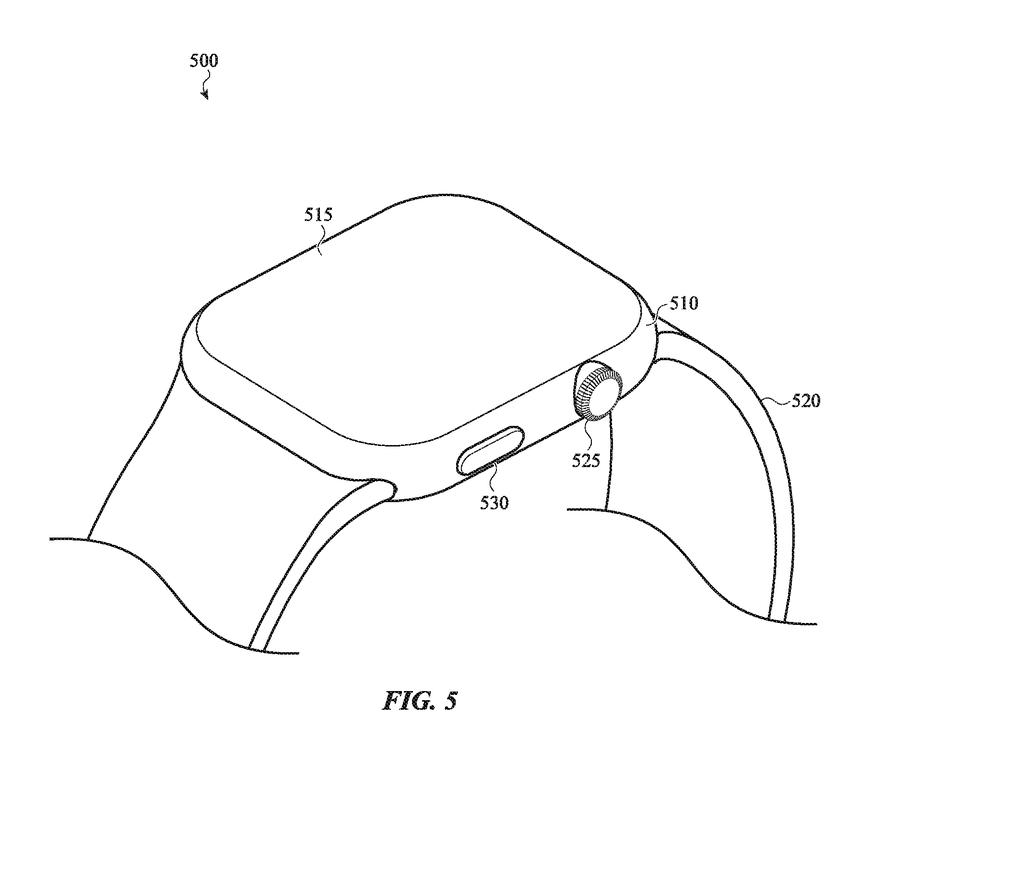
Apple's patent application describes a watch with a crown, a button and a heart rate sensor, so it maps onto the cycle tracking that Apple Watch owners can already use. Keep in mind this is a patent application, and it gives no accuracy figures, so how well the idea works in daily life is unknown.
Apple's 12th filing we've tracked since May in our Apple health sensor patents builds on earlier applications like the health chart patent and the heartbeat risk warning patent.
If you track your cycle today, the benefit you would notice is a calendar that corrects itself mid-cycle, instead of waiting for you to log the surprise. For people with irregular cycles, that is when a prediction matters most: before the trip, before the appointment, before the test.
The filing's restraint also helps you. Updates arrive only when the system is confident and the window is still ahead of you, and alerts are capped, so you should not get a nagging feed of shifting dates.
The open question is accuracy. A two-beat change in resting heart rate is small and varies from person to person, and the filing offers no numbers on how much better the guesses get. The real test is whether the predictions hold up for people whose cycles are least regular.
Get our take in your Top Stories
Liked this breakdown? Add Patentlyze as a preferred source on Google, and our plain-English take shows up more often in your Top Stories the next time Apple patent news breaks.
There are more where this came from
We read every patent application Big Tech publishes and send you the ones worth knowing. Plain English, free, every week.
The drawings
6 drawing sheets from US 2026/0306074 A1 · click any drawing to enlarge


Want this weekly breakdown for a company we don't cover? Patentlyze Pro →
Be the first to weigh in