
Tesla Files Patent for Underbody Fans That Vacuum a Car Onto the Road
Race cars use wings to press themselves onto the track, but wings only work once you are going fast. Tesla's patent application describes fans and drop-down skirts that vacuum the car onto the road, even from a standstill.
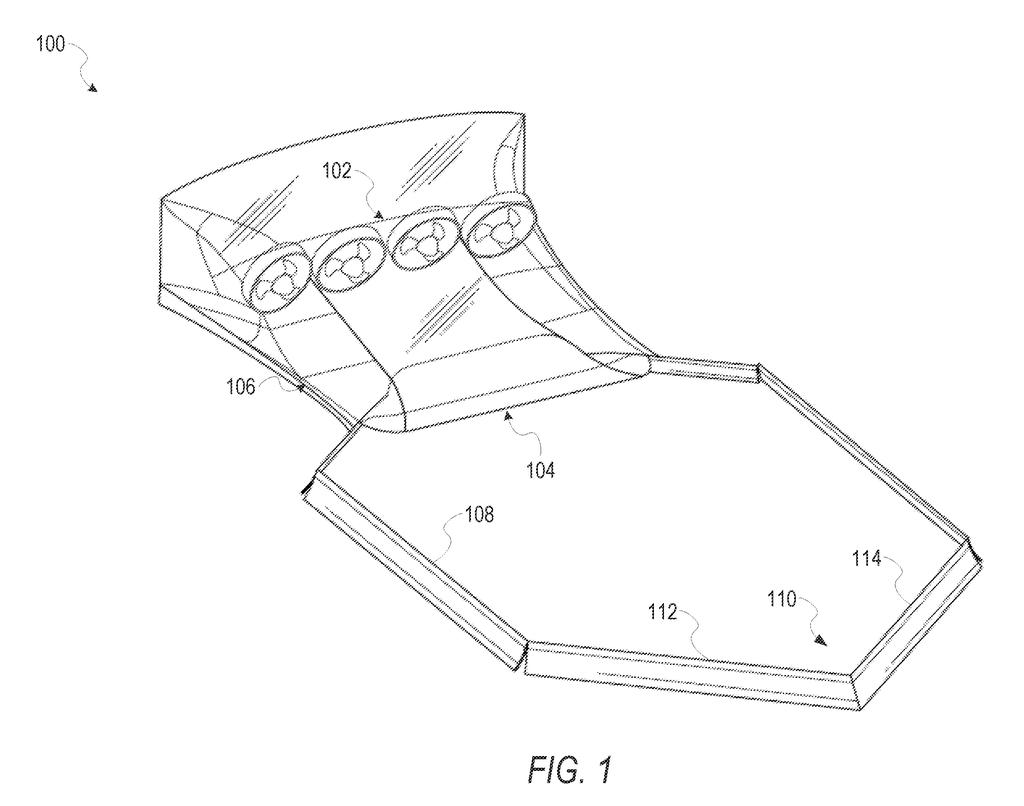
What Tesla's underbody suction system does
A sports car sits at a red light, then the driver floors it. At that speed, the air rushing over the body does almost nothing to push the tires into the pavement, so they can slip. Wings and spoilers only help once you are already moving fast.
Tesla's patent application describes a fix underneath the car. Fans pull air out from beneath the floor while movable skirts, a bit like curtains, drop down to seal the gap against the road. With the air thinned out, the car gets pressed down and the tires get more grip, even at a crawl.
When you speed up or hit a bumpy stretch, the system changes its setup. Some skirts lift away and every fan spins up, so the car keeps part of that pressing-down effect without scraping over every bump.
one or more fans positioned in an airflow pathway of a vehicle, the airflow pathway extending to a bounded region under the vehicle; a plurality of deployable elements configured to selectively interact with a ground surface to define the bounded region under the vehicle …
Translation: Fans and drop-down seals create a sealed chamber beneath the vehicle to manipulate airflow.
How the skirts and fans switch between modes
The claims cover a control system that reads sensor data, decides how far to lower each deployable element (the skirts), and runs the fans and skirts together to create downforce. Downforce is a downward push on the car that presses the tires harder into the road and adds grip.
The filing describes two main modes:
- First mode: every skirt is lowered, including front, rear and sides, to seal off the area under the car. The central fans pull air out of that sealed space. The filing points to low-speed, smooth-surface uses such as 0-60 sprints or autocross.
- Second mode: only the side skirts stay down while the front and rear skirts retract. All fans run, including the outer ones, to move more air under the floor. This suits higher speeds or uneven ground.
The system picks a mode from sensor inputs such as speed, GPS location, wheel position, and pitch and roll (how much the car tips nose to tail or side to side). Ground sensors, which could be lasers, cameras, radar or ultrasonic, can measure the gap to the road. Stored map data can warn it about an upcoming turn, hill or pothole. Skirts can also stop partway, for example to keep ground clearance on public roads.
The filing also describes mesh at the fan inlets to keep rocks out, different fan power levels per mode, and an option for the driver to choose a mode by hand.
… a complete set of skirts creates a fully sealed bounded region under the vehicle with central fans generating maximum downforce at low speeds on smooth surfaces.
Translation: Skirt panels seal off the bottom of the car so fans can suck the vehicle downward when driving slowly.
Why low-speed grip matters for Tesla's patent
If a system like this were ever built into a car, the practical payoff would be more grip when you launch or corner hard, without needing high speed first. The filing points to performance driving, such as sprints, autocross and track sessions, as the main use. It also describes a partial setting for public roads that keeps enough ground clearance.
The tradeoff is moving parts under the car that have to live with rocks, bumps and wear. The filing covers this with mesh filters, flexible skirt materials and sensors that watch the seal, but it gives no performance numbers. It is a patent application, so it shows an idea Tesla wants on record, not a feature you can buy.
That makes this Tesla's 52nd filing in our Tesla coverage since May, a run that includes the door-skin crash idea and the self-tilting truck.
The problem here is real but narrow. Cars gain very little pressing-down force at low speed, and that is exactly when a hard launch or a tight corner asks the most of the tires.
For track days and fast launches, that gap is worth fixing, and the approach is sized to match: suction that works at a standstill, plus a second setup for fast or bumpy driving. For daily commuting the problem barely exists, and the filing itself points to sprints and autocross as the target.
The harder problem is the one the document handles with a list of options: skirts that scrape the road, rocks near fan inlets, and rough surfaces that break the seal. The filing offers mesh filters and partial deployment, but it gives no performance numbers, so the size of the payoff stays unknown.
Get our take in your Top Stories
Liked this breakdown? Add Patentlyze as a preferred source on Google, and our plain-English take shows up more often in your Top Stories the next time Tesla patent news breaks.
There are more where this came from
We read every patent application Big Tech publishes and send you the ones worth knowing. Plain English, free, every week.
The drawings
5 drawing sheets from US 2026/0336727 A1 · click any drawing to enlarge


Want this weekly breakdown for a company we don't cover? Patentlyze Pro →
Be the first to weigh in