
Tesla Files Patent for Giving Repair Technicians Temporary, Owner-Approved Access to Your Car's Data
Today a mechanic often has to plug a special gadget into your car to read its data. Tesla's patent describes a sign-in and approval process that could cut the need for that gadget, with you in the loop.
What Tesla's owner-approved repair access does
A driver drops a car at a service center because of a strange noise. The technician walks over and plugs a special gadget into a port under the dashboard to read what the car has recorded. That is how it usually works today, and it means the technician needs the car in hand and the right hardware.
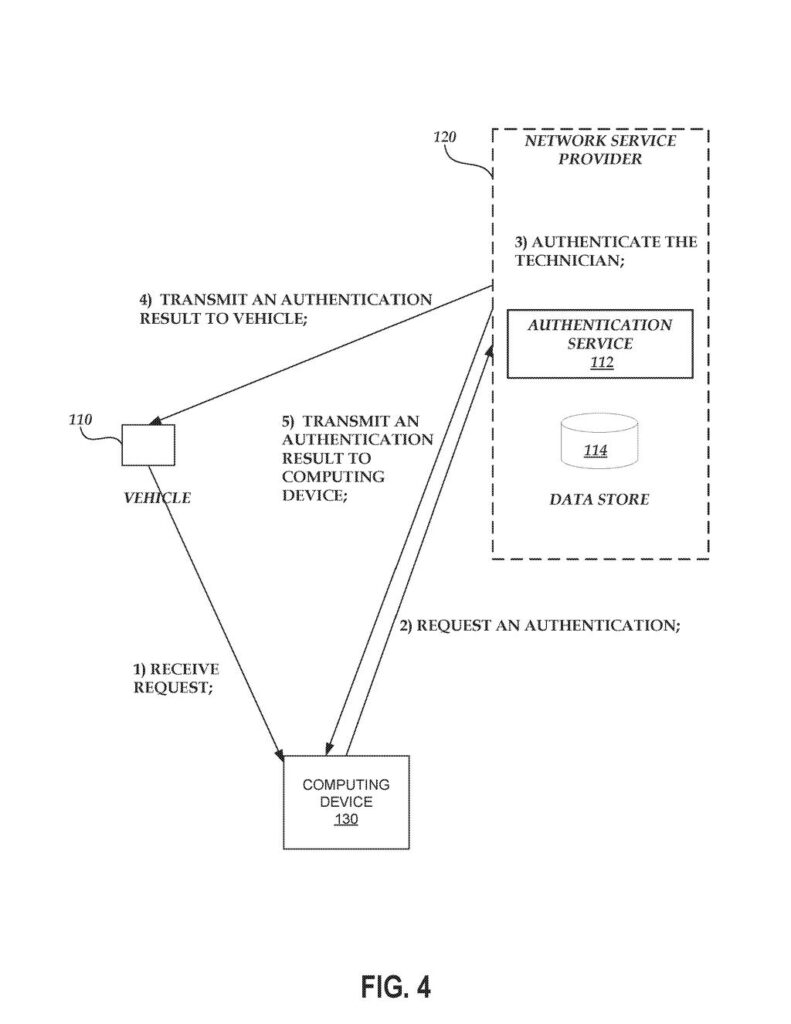
Tesla's patent describes a different route. The technician signs in with a credential, and an online service checks that they are qualified and that the requested job makes sense for that specific car. If everything checks out, the car and the technician both get a notice that access is approved, and the technician receives the digital pass for the data they need.
You stay in the loop. If a job needs more than your default settings allow, you get a prompt by email, text message, app notification, or on the car's screen, asking what to permit.
… transmitting a notification comprising an indication that access to at least one vehicle system has been approved and credentials that allow access to vehicle data; …
Translation: The car sends out a message confirming that the repair worker has been given permission to view its systems.
How the car checks a technician before opening up
The filing covers a permission system for repair visits. A technician sends a request for a specific car, along with proof of who they are. The system verifies that proof, then checks that the type of service being requested fits that particular vehicle.
If both checks pass, the system works out what access to grant. It then sends a notification saying access to at least one vehicle system is approved, plus credentials (a digital pass) that allow access to the vehicle's data. Until the sign-in is verified, the technician has no rights to the car's data.
The filing describes several details around that core:
- The technician's identity can be stored in a token (a digital proof of sign-in) that an online network service provider validates.
- A request can include the car's VIN (its serial number), the owner's email, a reason for the work, and how long access is needed.
- The checks can include a valid subscription, enough qualifications for the job, and whether the requested work is duplicative or redundant.
- Each approval can carry limits: how long it lasts, which data is visible, conditions that automatically revoke it, and when the owner is notified.
If a job needs more than the owner's default settings, the owner gets a prompt by email, text, app notification, or in-car message. Access runs through a common interface on the technician's own device, and results such as engine oil data, coolant temperature, mileage, oxygen sensor readings and knocking information can be stored.
A system for providing vehicle data access obtains technician authentication information associated with a technician and corresponding to a request to access an identified vehicle.
Translation: The system checks the identity of a mechanic who is asking to plug into a specific car.
Why shop visits could need less special gear
For you, the practical change would be control. Instead of handing over a car and hoping the shop reads only what it needs, you could be asked to approve a specific job, for a set time, with limits on which data is visible. The filing also lists conditions that end access automatically.
For shops, the filing describes access through a common interface, with no custom hardware or software required. That could mean fewer special tools plugged into a port under the dash and more work done from the technician's own laptop or tablet. The description also mentions sending diagnostic or repair software to the car, though the claims center on the sign-in and approval steps.
Tesla's 47th filing in our Tesla coverage since May follows patents like cars correcting each other's GPS and touch-sensitive robot hand skin.
Among car patents, this one sits close to a shippable feature. It needs no new hardware. The pieces are an online service that checks credentials, software in the car that accepts a digital pass, and a way to message the owner, which the filing lists as email, text, app or the in-car screen.
The shortest route to a product is a backend service plus a software update to the car. The harder work sits outside the patent: signing up technicians, deciding which jobs need your approval, and getting shops to trust the sign-in.
Nothing here is exotic. It is a sensible permissions flow, and if it ever shows up in a product you would most likely see it as an approval prompt on your phone.
Get our take in your Top Stories
Liked this breakdown? Add Patentlyze as a preferred source on Google, and our plain-English take shows up more often in your Top Stories the next time Tesla patent news breaks.
There are more where this came from
We read every patent application Big Tech publishes and send you the ones worth knowing. Plain English, free, every week.
The drawings
7 drawing sheets from US 2026/0321072 A1 · click any drawing to enlarge


Want this weekly breakdown for a company we don't cover? Patentlyze Pro →
Be the first to weigh in