
Sony Files Patent to Show Who Sent the Warning Projected on the Road
If cars start painting arrows and stop lines on the pavement, you will need to know which car painted them. Sony's filing answers with the car's own lights.
What Sony's blinking-car-lights idea actually does
Imagine you're driving in the center lane when a blinking arrow appears on the pavement ahead of you, warning of a lane change. Two cars are alongside, one on each side. Which one is about to cut in?
That confusion is what Sony's filing goes after. Cars may someday project lights, arrows and stop lines onto the road to talk to the people around them. When several cars do it at once, the messages blur together. Sony's fix is to have the car's own lights, such as LED strips on the bumper or sides, blink in time with the projection or glow the same color. The car can also play beeps in the same rhythm.
So the projection tells you what is about to happen, and the car's lights tell you who is saying it.
a projection control unit configured to control an output of projection information, which is projected from a mobile body onto a road surface on which the mobile body travels, for communication with another entity …
Translation: The system manages warnings and messages projected from a moving vehicle onto the pavement for others to see.
How the car's lights sync with road projections
The filing describes two main parts inside a vehicle (or a robot that moves through public spaces). A projection control unit decides what to paint on the road, based on the vehicle's travel plan and what its sensors see around it. An addition control unit then controls extra signals, mainly the car's own lights, that point back to the car as the source.
The filing gives several examples:
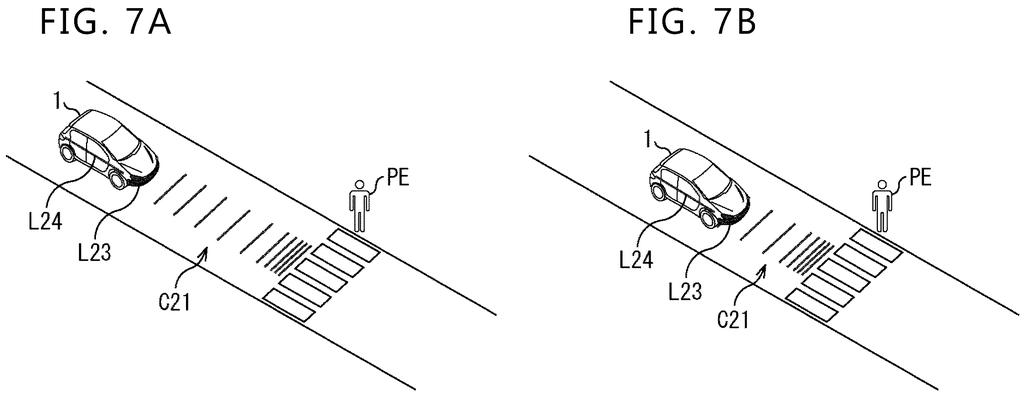
- Body lights (headlights, LED tape, bumper or wheel lights) glow where a projected light pattern seems to begin, so the pattern looks like it flows out of the car.
- Body lights blink at the same rate as a blinking projection, or match its color.
- Beeps play in rhythm with visual changes in the projection, such as blinking or a color shift.
- The projected path of where the car will go also shows where it has been and where it is now.
The car can detect other projections on the road using a distance sensor (such as LiDAR, which measures distance with laser light), and it can tell its own projections from everyone else's. It also picks the form of signal to fit the situation. If the car is moving fast, or the audience is another vehicle, it skips audio and uses light. In automatic mode it checks whether anyone nearby could see it, including people in blind spots.
Why this matters on crowded roads full of signals
The practical problem is crowding. The filing notes that the amount of information projected onto roads is expected to grow, with moving images overlapping and roadside equipment adding its own. A warning is only useful if you can tell who it comes from, whether you are a driver, a cyclist or someone at a crosswalk.
The idea is simple to add to a self-driving car, since it reuses lights a car already has. The examiner's first review rejected the claims as filed, which is routine at this stage and usually followed by amendments. Nothing here says a car with these features is coming, but it shows Sony thinking about how cars will talk to the people around them.
Sony's 33rd filing we've tracked since July in the self-driving sensing race adds to a run that includes one on camera timing failures and one on self-aligning sensors.
Here is the benefit you would notice: you glance at a blinking arrow on the road and know at once which car sent it. Without that link, a projected warning is one more bit of glare on a busy street, and you may pull back from the wrong car.
The approach is plain, and that is a plus. Matching colors and matching blinks are things anyone reads instantly, with no manual and no new symbols to memorize. The beeps are the weakest part, since the filing itself says audio makes little sense at speed or around other vehicles.
If cars ever do paint the road, a fix like this will matter at the busiest moments: lane changes, unmarked intersections and crosswalks. It is a modest idea, and the sort of detail that makes a new feature feel trustworthy.
Get our take in your Top Stories
Liked this breakdown? Add Patentlyze as a preferred source on Google, and our plain-English take shows up more often in your Top Stories the next time Sony patent news breaks.
There are more where this came from
We read every patent application Big Tech publishes and send you the ones worth knowing. Plain English, free, every week.
The drawings
14 drawing sheets from US 2026/0326664 A1 · click any drawing to enlarge


Show the other 6 sheets


Want this weekly breakdown for a company we don't cover? Patentlyze Pro →
Be the first to weigh in