
Intel Files Patent to Help AI Decide Whether Part of a Photo Holds an Object
Intel's patent application describes a way for image AI to judge each patch of a photo with three scores at once, then spend its training time on the cases it keeps getting wrong.
What Intel's three-score photo check does
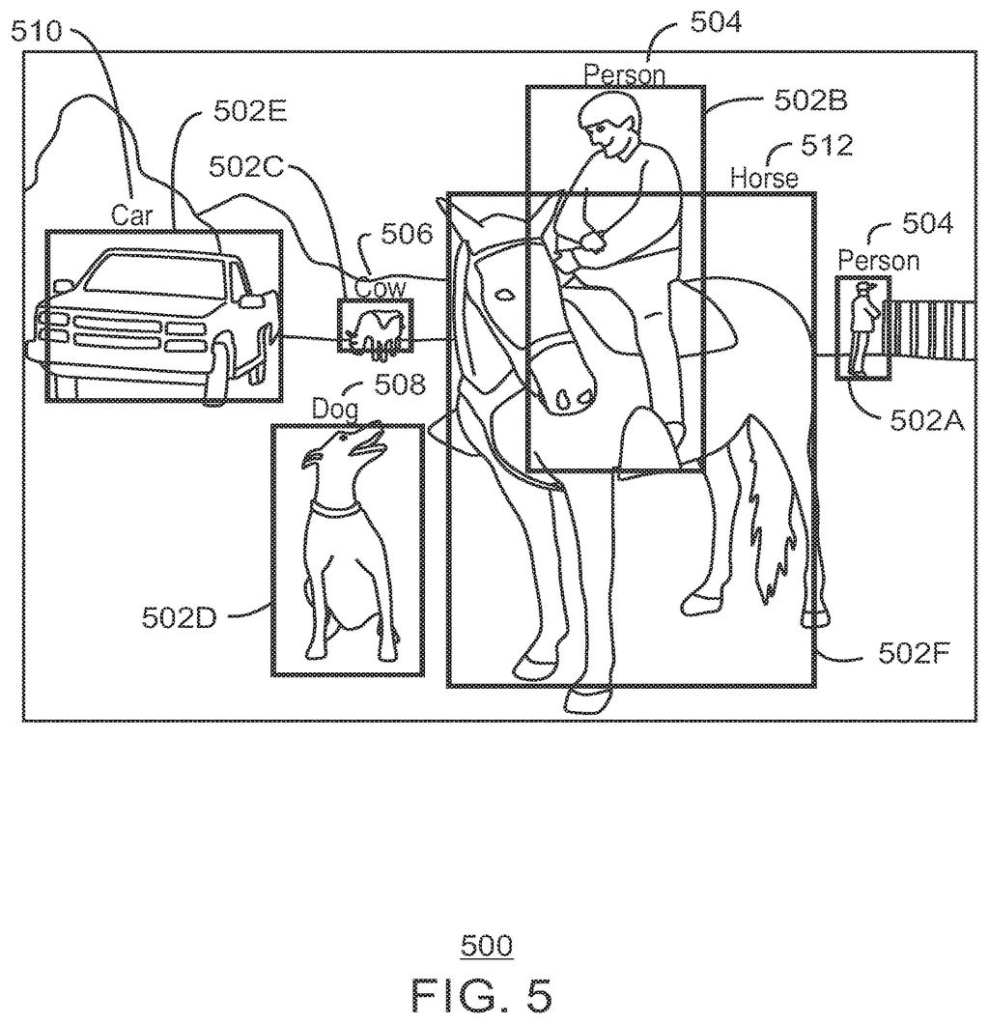
Every time software draws a box around a dog in a photo, or an AI flags a person in front of a camera, it has first looked at thousands of possible spots in the image and decided that almost all of them are empty. Teaching an AI to make that call is lopsided. Intel's filing says training data can contain as many as 100,000 pieces of background for every one real object.
Intel's patent application describes a scoring check for each candidate spot. The AI rates how likely the spot is to hold something, how well the drawn box fits it, and what kind of thing it is. Those three ratings fold into a single number that shows how wrong the AI currently is about that spot.
The spots with the worst numbers are the useful ones to study. In Intel's example, 60,000 candidate boxes from two images get trimmed to about 300 tough cases for the AI to learn from.
… determine a multi-task loss score based on (a) the objectness score, (b) the localization value, and (c) the classification score, the multi-task loss score used to determine whether an object is located within the first region of the image.
Translation: The system combines three different scores to decide if a part of the image actually contains an object.
How Intel picks the 300 toughest training cases
The first claim covers an object detection system. A machine learning model looks at an image and gives each region an objectness score, the probability that the region holds some object at all. Regions that clear a threshold move on. For each one, the system calculates a localization value (how accurately the drawn box fits the object) and a classification score (how likely the object is a particular type, such as a person or a dog).
Those three numbers combine into a multi-task loss score, which is a measure of how wrong the AI currently is. Dependent claims add a labeled bounding box, enlarging the image with bilinear interpolation (blending neighboring pixels to make a bigger picture), and the VGG-16 network, a well-known older image model.
The description covers the training side. The network reads the image at several zoom levels, resizes each level's feature maps (the patterns the AI has picked out) to a common size, and stacks them, so every candidate box carries both fine and coarse detail. Boxes with high loss are the 'hard examples,' and a fixed number, about 300 in the example, are used to update the network.
The filing also describes training the box-proposing network and the detection network together, sharing layers. Intel reports an accuracy gain of more than 4.6% in one experiment.
An example apparatus for mining multi-scale hard examples includes a convolutional neural network to receive a mini-batch of sample candidates and generate basic feature maps.
Translation: The AI reviews batches of image data to build initial visual maps for detecting difficult objects.
Why training on mistakes matters for image AI
Detection accuracy shows up in everyday tools: photo search, augmented reality, security cameras and driver assistance, all of which the filing lists. Its pitch is better accuracy while using fewer training images, since the AI studies its mistakes instead of re-reading easy cases.
The filing is a continuation in a family that traces back to a 2017 international application, and it leans on networks from 2014 and 2015, so it reflects an earlier stage of image AI. The examiner's first review rejected the claims as filed, a routine step that usually leads to amendments, so the final scope could change.
That makes this Intel's fourth filing in AI vision patents we've tracked since May, following one on isolating objects in photos and one on cameras reading a scene.
The problem here is real. When 100,000 background patches show up for every real object, an AI can look accurate by answering 'nothing here' over and over, and most of its training time goes to cases it already handles.
Intel's answer fits the size of that problem. Find the few hundred spots the AI keeps fumbling and put the training effort there. Cutting 60,000 candidate boxes down to 300 lessons shows how aggressively the filing narrows the work.
A gain of more than 4.6% in one experiment is a useful bump for a model judged on how often it is right. The networks named in the filing date to 2014 and 2015, so treat this as sturdy, routine engineering on a well-known problem. Its practical effect reaches you only through whatever detection tools end up trained this way.
Get our take in your Top Stories
Liked this breakdown? Add Patentlyze as a preferred source on Google, and our plain-English take shows up more often in your Top Stories the next time Intel patent news breaks.
There are more where this came from
We read every patent application Big Tech publishes and send you the ones worth knowing. Plain English, free, every week.
The drawings
7 drawing sheets from US 2026/0340979 A1 · click any drawing to enlarge


Want this weekly breakdown for a company we don't cover? Patentlyze Pro →
Be the first to weigh in