
Samsung Patents a Background-Stripping Method to Make Object Detection Faster
Before an AI model even tries to spot a person or car in a video, Samsung wants it to strip away everything that isn't the target — by comparing each frame against a library of known backgrounds.
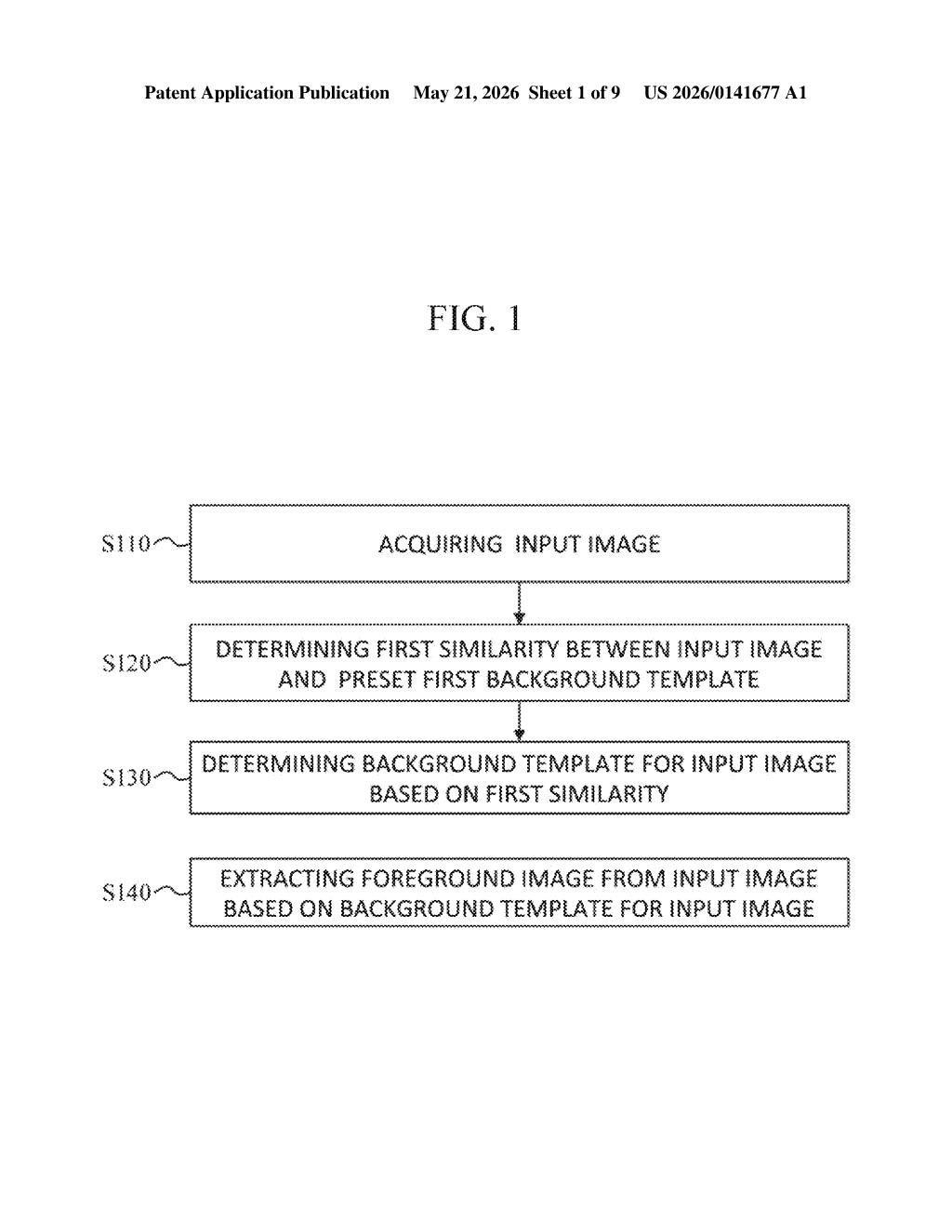
What Samsung's foreground-extraction patent actually does
Imagine you're trying to find a person walking through a busy parking lot on a security camera. Instead of asking an AI to scan the entire frame — cars, pavement, sky, buildings and all — what if it could first erase everything that's supposed to be there, and only look at what's new? That's the core idea here.
Samsung's patent describes a system that takes each incoming video frame and compares it against a pre-stored "background template" — essentially a reference picture of what the scene looks like when nothing interesting is happening. If the frame looks a lot like that template, the system uses it to subtract the background, leaving only the foreground: the stuff that moved, appeared, or changed.
The result is a cleaner image handed off to a target detection model, so the AI doesn't have to work as hard to find what matters. It's a preprocessing step designed to make object detection more accurate and efficient, especially in video feeds where the background is mostly static.
How Samsung matches frames to background templates
The method works in two phases: background template selection and foreground extraction.
First, the system takes an incoming frame and computes a similarity score against a "preset first background template" — think of this as a reference snapshot of the empty scene. That similarity score then determines which background template to actually use for subtraction. The patent implies there may be multiple candidate templates (e.g., for different lighting conditions or time-of-day variations), and the similarity check picks the best match.
Once the right template is chosen, the system performs foreground extraction — subtracting or masking out the background pixels to isolate objects that don't belong to the static scene. The cleaned-up foreground image is then passed to a target detection model (likely a neural network like YOLO or a similar architecture) that looks for specific objects.
For video, this happens sequentially across frames:
- Acquire a frame from the video stream
- Score it against the background template library
- Extract the foreground
- Run object detection on the foreground only
By reducing the visual noise the detector sees, the approach can lower false positives and potentially reduce the compute load on the detection model itself.
What this means for Samsung's camera and vision systems
Background subtraction is a decades-old computer vision technique, but the framing here — using a similarity-based template selection step rather than a fixed background — suggests Samsung is targeting real-world conditions where scenes shift (different times of day, weather, camera angle drift). This is relevant for security cameras, in-vehicle vision systems, and smartphone camera features like scene detection or augmented reality overlays.
For you as a user, this kind of preprocessing could mean faster, more accurate detection in Samsung's Galaxy cameras, SmartThings home sensors, or automotive vision chips — any scenario where a camera needs to reliably spot objects in a mostly-static scene without burning through compute resources on the background.
This is a solid but fairly incremental engineering patent — background subtraction as a preprocessing stage for neural object detectors is well-trodden ground in computer vision research. The differentiator Samsung is staking out is the similarity-based template selection, which is a practical improvement for real-world deployment. It's not a conceptual leap, but it's the kind of careful systems work that actually ships in products.
There are more where this came from
We read every patent application Big Tech publishes and send you the ones worth knowing. Plain English, free, every week.
Want this weekly breakdown for a company we don't cover? Patentlyze Pro →