
Microsoft Files Patent for an Always-On Recorder That Deletes Everyone's Voice but Yours
Microsoft has described a phone or wearable that can listen all day but is built to forget everyone except you. It sorts the voices, deletes the rest, and keeps a transcript of only your side of the conversation.
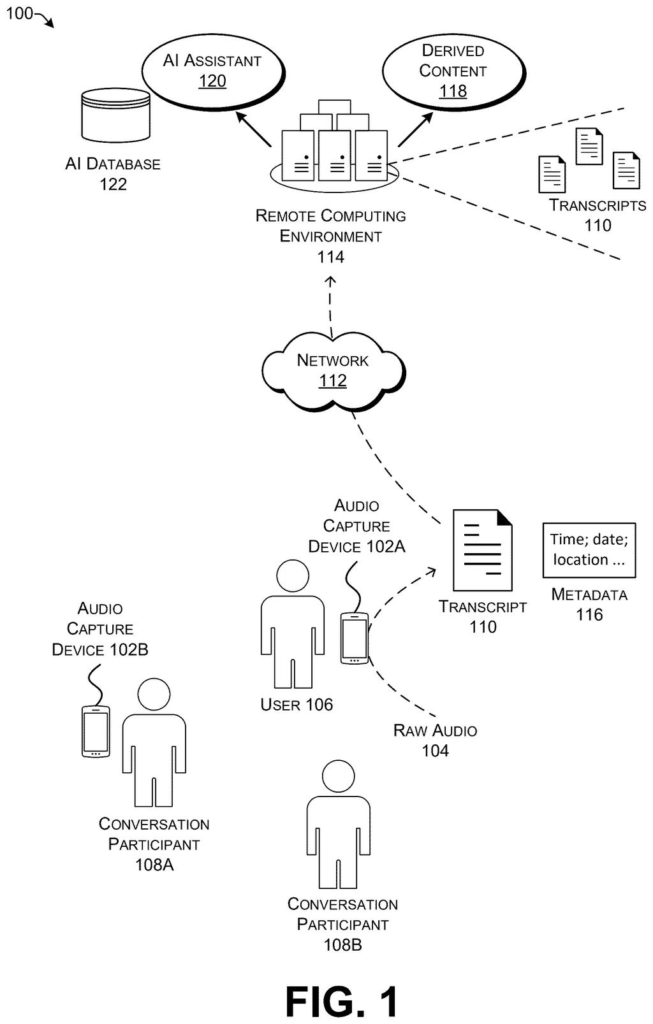
What Microsoft's you-only audio recorder does
Ever left a voice recorder running at a café and realized it caught the couple at the next table too? That is the problem Microsoft is trying to solve for devices that listen all day.
In this patent application, your phone or wearable keeps listening, but it sorts the audio by voice, works out which one is yours, and throws away the raw recording along with everyone else's speech. What you keep is a written transcript of only what you said.
Why keep your own words at all? Microsoft says they could train a personal AI assistant on how you talk, or produce summaries and to-do lists. If the people you talked with give permission, their parts can be added too, for a fuller record. Family and coworkers could say yes ahead of time, and others could approve a request on the spot.
… discarding the raw audio and voice streams of conversation participants other than the user; and generating a transcript of speech of the user from the voice stream of the user.
Translation: It throws away everyone else's words and only keeps a written record of what you said.
How the device sorts voices and drops the rest
The filing describes a device (a smartphone, earbuds, smart glasses, a watch, or even a smart speaker) that captures raw audio from its surroundings and holds it only briefly, for example in a rolling buffer where new recordings overwrite the oldest. Then it runs a short chain of steps:
- Voice activity recognition spots stretches that contain human speech and skips the rest, saving memory and battery.
- Diarization (sorting audio by "who spoke when") splits the recording into one stream per voice.
- Voice identification compares each stream to your voiceprint (a digital description of how you sound) to find yours.
- Discarding deletes or overwrites the raw audio and every other stream so it can't be recovered.
- Transcription turns your stream into text, with details like time, location and number of speakers attached.
Other people can opt in. A coworker might pre-approve only during work hours, or a family member only for one speaker in the living room. Someone could also approve live with a password, a biometric check, or a digital token sent from their own device. A cloud service can also match two people's separate transcripts from the same conversation, using proximity and timestamps, and merge them if the other person agreed.
The filing admits diarization can slip, letting a few of someone else's words into your transcript, especially when people talk over each other.
The transcript may be used for training a personalized artificial intelligence (AI) assistant or generating derived content.
Translation: Your private notes can then be used to train your own custom artificial intelligence helper.
Why bystanders matter to a personal AI assistant
If you want an AI assistant that knows how you talk and what is on your plate, the hard part is feeding it enough of your daily life. Recording everything is the easy answer, and also the one that makes friends, coworkers and strangers uneasy around you. This filing is Microsoft's attempt at a version those people could tolerate, since their voices are dropped by default.
The same idea is described for photos and video: recognize your face, delete everyone else's. The filing lists summaries, task lists and follow-up reminders as uses. A patent application is not a product, though, and nothing here says whether Microsoft will ever build one.
That makes this Microsoft's 17th filing we've tracked since August in our on-device AI privacy watchlist, adding to earlier applications on splitting AI work by device and shielding riskiest training data.
Most people would notice this in a single moment: a friend's phone sits on the table, and you wonder whether your words are heading into someone's archive. A device that deletes your voice by default answers that worry directly. That is the clearest benefit here, and it goes to the people around the user.
For the user, the result is half a conversation. A transcript of only your side makes for thin summaries and odd to-do lists, so the useful version needs your friends to say yes, and plenty will ignore a permission prompt. The filing treats no response as a no, which is the right default and also means many records will stay lopsided.
The filing also admits the sorting can slip, letting a few of someone else's words into your transcript when people talk over each other. You would only find that out by reading your own archive. The design instinct earns a clear thumbs up, and the proof will be how rarely that leak happens.
Get our take in your Top Stories
Liked this breakdown? Add Patentlyze as a preferred source on Google, and our plain-English take shows up more often in your Top Stories the next time Microsoft patent news breaks.
There are more where this came from
We read every patent application Big Tech publishes and send you the ones worth knowing. Plain English, free, every week.
The drawings
8 drawing sheets from US 2026/0341279 A1 · click any drawing to enlarge


Want this weekly breakdown for a company we don't cover? Patentlyze Pro →
Be the first to weigh in