
Adobe Files Patent for Changing a Person's Pose in a Photo by Describing It
Adobe describes an AI that writes a body pose as a list of joint coordinates (nose here, left elbow there) and uses that list to redraw a person in a photo. You would steer it with a plain sentence like 'arms raised in the air.'
What Adobe's pose-from-text photo editing does
A photographer finishes a portrait session, and the client's favorite shot has one problem: the subject has her arms folded, and the client wanted a wave. Fixing that today means careful manual retouching or a re-shoot.
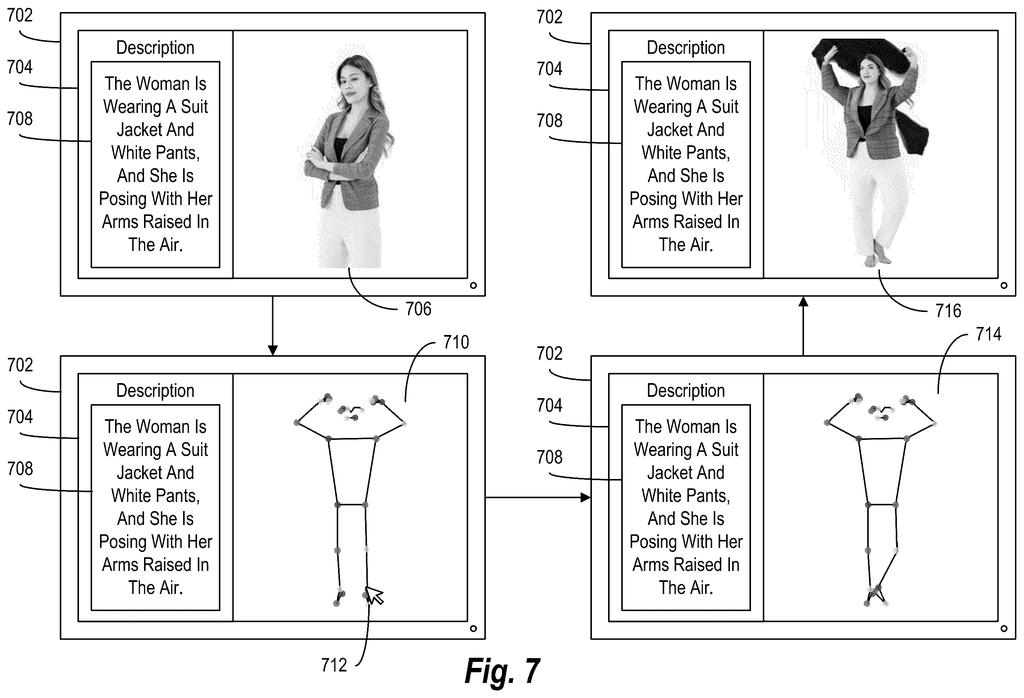
Adobe's patent application describes a way to fix it by typing. You give the software your photo and a sentence like 'she is posing with her arms raised in the air,' and it works out where the head, elbows, knees and other joints should go, then redraws the person in that pose.
It can also read the pose of someone already in a photo so a different person can take their place, or invent a believable pose for a person you want to add to a scene. You could even drag the joints of a stick-figure to fine-tune the result.
… generating, utilizing a multimodal large language model, a text description of predicted pose keypoints based on the digital image …
Translation: An AI translates the person's body positions into written descriptions.
How the AI turns body joints into text coordinates
The core idea is to have a multimodal large language model (an AI that reads both pictures and text) describe a pose in writing. Given your photo, it outputs a text list of body landmarks, such as nose, 0.86, 0.43, left elbow, 0.45, 0.64, where the numbers are positions as fractions of the image's width and height. The filing uses 33 landmarks per person.
That list becomes a stick-figure skeleton, and the skeleton guides the image. The system can look up the closest match in a database of dense pose images (detailed maps of a body's shape and position) by comparing joint distances, and by comparing text captions if you typed a description. A generative image model then draws the final picture. The claims cover three jobs:
- Estimate: read the pose of a person already in a photo, so someone else can replace them in the same pose.
- Hallucinate: invent a believable pose for a person added to a scene, based on the scene or your description.
- Repose: move a person in the photo from one pose to another you describe.
To train it, Adobe fine-tunes an existing model by comparing its guessed coordinates against known-correct ones and adjusting. For the invent-a-pose task, it erases the person from a training photo and asks the model to guess where they stood. Another claim covers letting you drag the skeleton's joints by hand before the final image is made.
… utilizing a multimodal large language model to estimate, hallucinate, and/or repose human poses in digital images …
Translation: The system uses AI to guess, invent, and alter how humans are positioned in photos.
Why typing a pose could change portrait editing
If this works the way the filing describes, fixing a pose in your photo could shrink to typing one sentence. The filing lists Photoshop, Firefly and Lightroom among the Adobe apps it could operate with, and the draggable skeleton would give you a way to nudge an elbow when the first try is off. The same approach could help you add a person to a scene in a pose that fits the setting.
The filing's own tests report that its trained model placed far more body points close to the right spot than two other language models it compared against. Keep in mind this is a patent application: the examiner's first review rejected the claims as filed, which is routine and usually followed by amendments, and a filing says nothing about when or whether any of this reaches a product.
That makes this Adobe's 38th filing we've tracked since May on controllable AI images, joining earlier work on fixing garbled text and pasting objects with matched lighting.
Getting a body to stand the way you want is one of the most annoying jobs in photo editing. A wrong pose means a re-shoot, an hour of manual retouching, or a stack of AI attempts that keep giving someone the wrong arms. That cost is real for anyone who edits portraits or product shots for a living.
Adobe's answer is modest in size, and that fits the problem. The model's only job is to write out where about 33 body landmarks should sit, and existing image tools do the drawing. A small, well-defined task is easier to get right than a vague 'fix the pose' request.
The numbers in the filing come from Adobe's own tests against two unnamed language models, so treat them as a promising sketch. Still, going from roughly 40 percent to roughly 75 percent of predictions counted as correct on the pose-reading task suggests the approach hits the weak point directly.
Get our take in your Top Stories
Liked this breakdown? Add Patentlyze as a preferred source on Google, and our plain-English take shows up more often in your Top Stories the next time Adobe patent news breaks.
There are more where this came from
We read every patent application Big Tech publishes and send you the ones worth knowing. Plain English, free, every week.
The drawings
16 drawing sheets from US 2026/0340895 A1 · click any drawing to enlarge


Show the other 8 sheets


Want this weekly breakdown for a company we don't cover? Patentlyze Pro →
Be the first to weigh in