
Microsoft Files Patent for a Content Filter That Re-Checks Its Own Answer Until It Settles
Microsoft's patent application describes a content filter that second-guesses itself, feeding its own verdict back in and re-checking until the answer stops changing.
What Microsoft's self-rechecking filter does
Ever had a spam filter flag a harmless email while a truly nasty one sailed through? Judging whether a message is offensive is hard, because offensive covers profanity, harassment, threats and hate speech all at once, and one program rarely handles all four well.
Microsoft's patent application describes a panel of small checkers instead of one big one. Some look for single words, others for phrases, others read whole passages. Each group of checkers is packed into a container, and containers can sit inside other containers, like Russian nesting dolls.
The part the claims focus on is the double-check. The container gives its verdict, then feeds that verdict back in and judges the message again. It repeats until the answer stops changing. Only then does the system act: warn you, delete part of the message, swap it out, or lock the message away.
… iteratively causing the first container to re-execute the classification task until a convergence condition is satisfied, the convergence condition determined based on the output state becoming stabilize …
Translation: The system runs the content check over and over until the AI finally stops changing its mind.
How the nested models vote and re-run
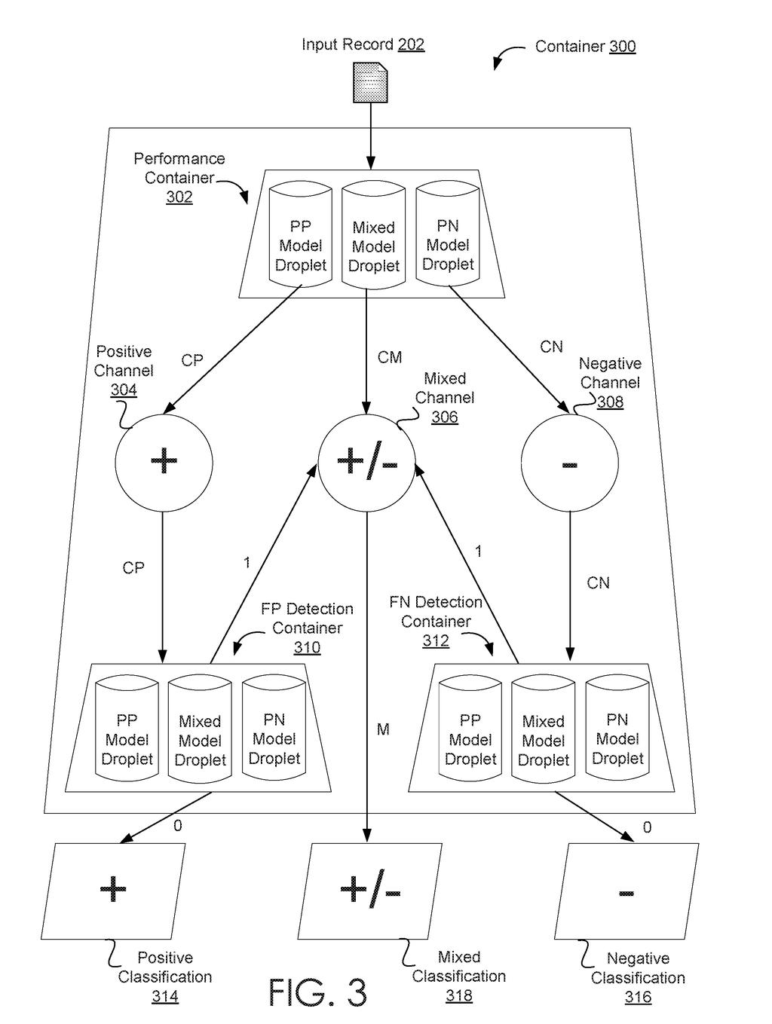
The claims cover a loop. A computer receives a digital record (an email, chat message, document or social post) that must be checked against a policy. A container, meaning a bundle of models, classifies it and produces an output state, which is the current verdict: positive, negative, or mixed (unsure).
That verdict goes back into the same container as a new input, and the container classifies again and updates the state. This repeats until a convergence condition is met, which the claims describe as the output state stabilizing (in one version, staying unchanged between runs). Then the system acts on the record.
The description lists what can go inside the containers:
- Word-list models (lexicon-based classifiers): one list drawn from examples labeled as violations, one from clean examples, and one from words found in both.
- Error-checking containers that look for false positives (innocent content flagged) and false negatives (bad content missed), sending doubtful cases to the mixed channel.
- Transformer models (a type of AI that reads whole sentences and paragraphs) for larger chunks of text.
Containers can nest, and one can even hold a copy of itself. The listed actions are a warning, deleting part of the content, replacing the deleted part, or quarantining the record.
In response to determining that the content violates the policy, at least one mitigation (or intervention) action are performed. The at least one mitigation action may alter subsequent transmissions of the record.
Translation: Once the system decides something breaks the rules, it steps in to block or change how the message gets sent.
What this means for message screening
If a company has to screen millions of emails, chats and posts for rule-breaking, the hard part is getting it right without burying people in wrongly flagged messages. This filing's answer is layers of specialized checkers with built-in error hunters, plus a repeat-until-stable loop on each message. The description says the nested arrangement also makes the reasoning easier to inspect than a single neural network, which is useful when someone asks why their message was pulled.
For you, the possible upside shows up as fewer false alarms on harmless messages and fewer nasty ones slipping by. The filing names no product, so treat it as a design sketch. The offensive-language example is one use, and the description says the same structure could aim at other policies and tasks.
This is the 24th Microsoft filing we've tracked since July in the AI guardrails race, following one tracing email inspiration and one on chatbot consistency.
Every extra pass costs time and computing power, and this design runs the check again on each message until the answer stops moving. For a busy system screening millions of messages, that bill adds up. The payoff the filing promises is fewer wrong calls, which looks like a fair swap anywhere a mistaken flag hurts someone.
The bigger risk is that an answer that stops changing is not always right. A checker can settle on a wrong verdict as firmly as a right one, and word-list models can be fooled by creative spelling. The error-checking containers help, yet they are models too, and they can be wrong.
The design also gives up the simplicity of one big model in exchange for a setup whose logic a person can read. That reads as a good trade. A filter you can inspect beats a black box when your job includes explaining why a message was pulled.
Get our take in your Top Stories
Liked this breakdown? Add Patentlyze as a preferred source on Google, and our plain-English take shows up more often in your Top Stories the next time Microsoft patent news breaks.
There are more where this came from
We read every patent application Big Tech publishes and send you the ones worth knowing. Plain English, free, every week.
The drawings
10 drawing sheets from US 2026/0340557 A1 · click any drawing to enlarge


Show the other 2 sheets


Want this weekly breakdown for a company we don't cover? Patentlyze Pro →
Be the first to weigh in